Meta Ads Attribution Windows in 2026: What Changed and What to Use
Meta removed the 7-day and 28-day view windows in January 2026. What attribution windows are, which one to use, and how to compare Meta with Shopify.
On this page
An attribution window is how long after someone clicks or views your ad Meta will still credit the ad with a purchase. The common setting is 7-day click and 1-day view: a purchase within seven days of a click, or one day of a view, counts. On 12 January 2026 Meta removed the 7-day and 28-day view windows from its ads reporting, so longer view-through credit is gone. Use 7-day click, 1-day view for reporting, and check it against Shopify.
Key takeaways
- A click window counts purchases after a click; a view window counts purchases after someone only saw the ad.
- Meta's standard setting is 7-day click and 1-day view.
- Since 12 January 2026, the 7-day and 28-day view windows are no longer available in Meta's ads reporting.
- Longer and view-based windows credit more purchases to ads, including some that would have happened anyway.
- Compare Meta's numbers with Shopify orders tagged with UTMs, and judge profit on kept orders.
How attribution windows work
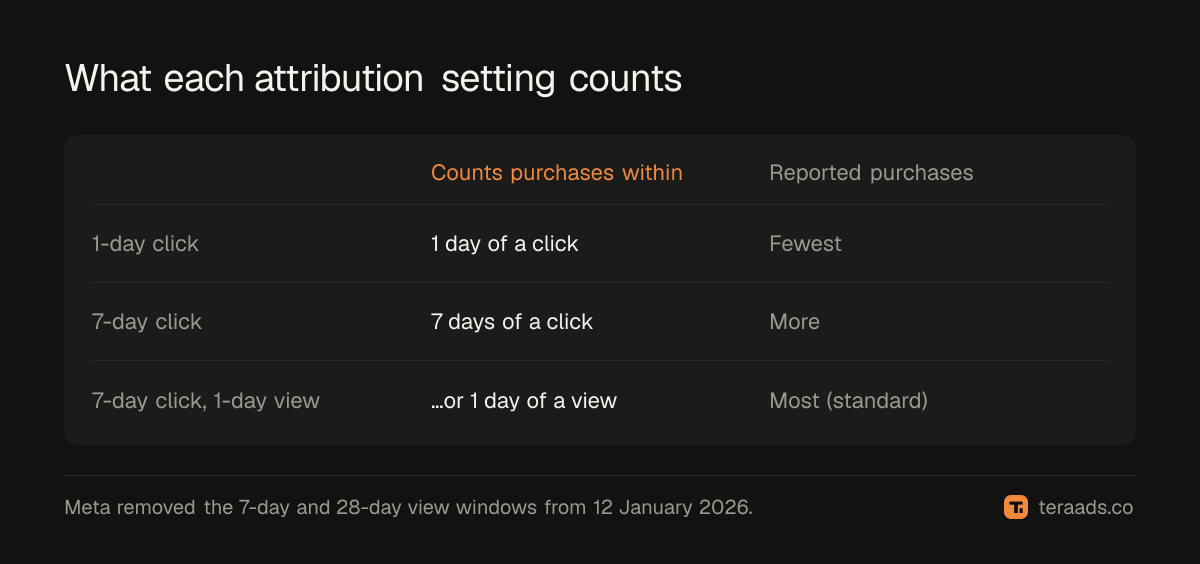
When someone buys, Meta looks back for an ad interaction by that person. If they clicked an ad within the click window, or saw one within the view window, Meta credits the ad with the purchase. Common settings:
| Setting | Counts a purchase if it happens within… | Effect on reported results |
|---|---|---|
| 1-day click | 1 day of a click | Fewest purchases; closest to direct response |
| 7-day click | 7 days of a click | More purchases, including slower deciders |
| 7-day click, 1-day view | 7 days of a click or 1 day of a view | Meta's standard setting; adds view-through |
| 1-day view only | 1 day of a view, no click | View-through only; easy to over-credit |
What changed in January 2026
Meta restricted the attribution windows available in its ads reporting, removing the 7-day view and 28-day view windows from 12 January 2026 (PPC Land on Meta's attribution changes). Advertisers who had reported on those longer view windows saw fewer purchases credited to their ads overnight, even though nothing about real sales changed.
The practical effect for most brands: the standard 7-day click, 1-day view setting is now the longest view-based option, and comparisons with numbers from before the change need care. If last year's reports used a 28-day view window, this year's ROAS will look lower for that reason alone.
Which window should you use?
For most Shopify brands:
- Report on 7-day click, 1-day view for day-to-day reading, because it's Meta's standard and what most benchmarks use.
- Check 1-day click and 7-day click separately when deciding whether to scale. If most of a campaign's purchases are view-through only, be sceptical.
- Keep one setting for comparisons over time. Changing windows changes the numbers without changing sales.
Why Meta and Shopify still disagree
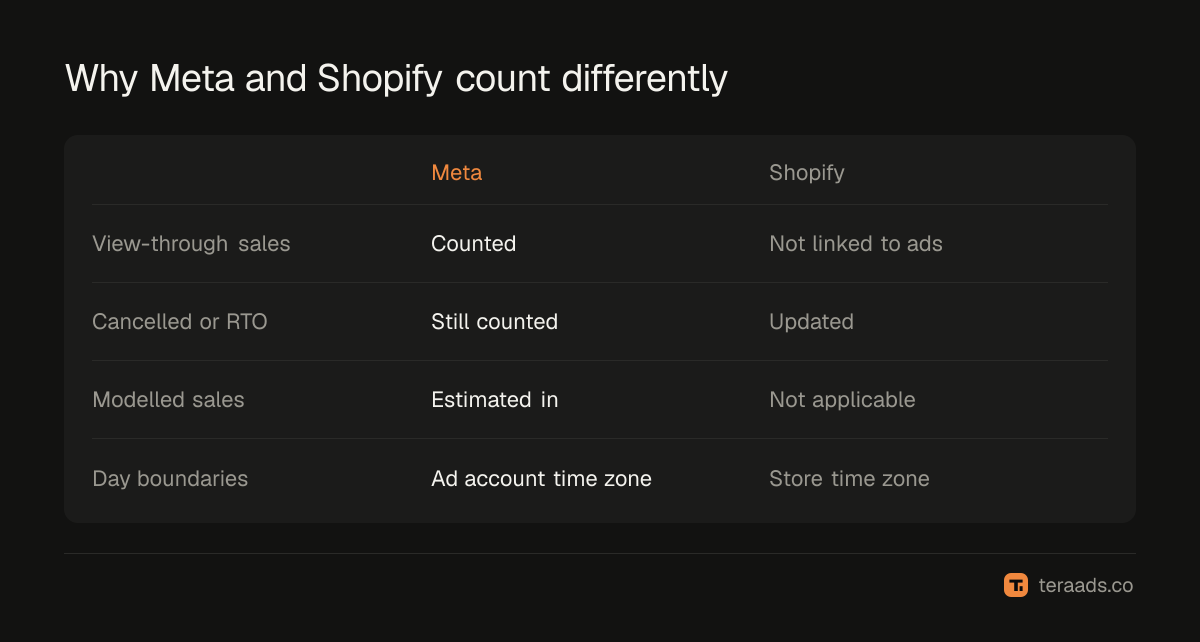
Even with the right window, Meta's purchase count won't match Shopify's orders:
- View-through credit: someone who saw an ad and bought later through Google is counted by Meta, and by Google if they clicked there.
- Cancellations and RTO: Meta counts the purchase when the order is placed; a returned COD order stays counted.
- Modelled conversions: Meta estimates some conversions it can't observe directly.
- Time zones and dates: a purchase can land on a different day in each tool.
The full list and a reconciliation method are in Meta Ads vs Shopify sales. The returns effect matters most for brands with cash-on-delivery orders; true ROAS after RTO and COD shows the size of it.
A setup that survives window changes
Platform attribution will keep changing. Two habits keep your decisions stable:
- UTM-tag every ad. Shopify then records which campaign brought each order, independent of Meta's windows. See UTM parameters for Shopify.
- Judge totals. Total Shopify revenue against total ad spend (MER) doesn't depend on any attribution window.
Use Meta's numbers to compare campaigns with each other, and Shopify's numbers to decide whether ads make money.
Reading reports after the change
If you compare this year with last year in Meta's reports, check which attribution setting each period used. A campaign reported on 7-day click and 28-day view last year will show fewer purchases on today's settings even if sales are identical. Re-run old reports on the current standard setting where Meta still allows it, or compare on Shopify orders instead.
When you look at a single campaign, split its purchases by window. In Ads Manager you can compare attribution settings side by side. A campaign whose purchases mostly appear only in view-through columns is worth questioning: those buyers saw an ad but didn't click, and many may have bought anyway.
For cash-on-delivery brands, add one more step: take the purchases Meta reports, remove the share that your store data says gets cancelled or returned, and compare with spend. That gives a figure close to what the campaign really earned. The Meta vs Shopify guide has a step-by-step reconciliation you can repeat weekly.
Attribution windows and creative testing
Window choice changes which ads look best. Ads that people watch but rarely click, such as long videos, tend to collect more view-through credit; ads with a strong call to action collect more click credit. When you compare creatives, use the same click-based view alongside the standard setting, so a video that only wins on views doesn't push out an ad that actually drives clicks and orders. Confirm winners on UTM-tagged Shopify orders before scaling them.
Tera Ads uses Shopify orders as the truth for sales and puts Meta Ads and Google Ads spend beside them, with every campaign from both platforms in one table and profit after returns. It is free for one business.
Frequently asked questions
What is the default attribution window on Meta?
The standard setting is 7-day click and 1-day view: purchases within seven days of a click or one day of a view are credited to the ad.
Did Meta remove the 28-day attribution window?
Meta removed the 7-day view and 28-day view windows from its ads reporting from 12 January 2026. Click-based windows such as 7-day click remain.
Why did my Meta ROAS drop in January 2026?
If you reported on a longer view window, the January change reduced the purchases credited to ads. Compare like with like, using the same window for both periods.
Is view-through attribution reliable?
It's the least reliable part, because people who only saw an ad may have bought anyway. Treat campaigns that rely mostly on view-through purchases with caution.
Which attribution window matches Shopify best?
None matches exactly. A click-based window is usually closer to UTM-tagged Shopify orders, but cancellations, RTO and cross-channel journeys still cause gaps.