Meta Ads Attribution Settings After March 2026: What Counts as a Click
Meta now counts click-through conversions only after link clicks, with likes and saves moved to engage-through. What each setting means and which one to use.
On this page
Meta's attribution setting decides which purchases Ads Manager credits to your ads: those after a link click within 1 or 7 days, those after an engagement such as a like or a 5-second video view, and those after someone only saw the ad within a day. Since Meta's March 2026 update, only link clicks count as clicks; likes, shares and saves moved into a new engage-through category. Use 7-day click for purchase campaigns, compare settings before judging results, and check everything against Shopify orders.
Key takeaways
- Click-through now means a link click; other interactions no longer earn click-through credit, per Meta's March 2026 announcement.
- Engage-through replaced engaged-view and covers non-link interactions and video views of at least 5 seconds.
- View-through is 1 day or off; the 7-day and 28-day view windows were removed in January 2026.
- Billing doesn't change with the attribution setting; only reporting and how results are credited.
- Use Compare Attribution Settings in Ads Manager, and judge profit on Shopify orders after RTO.
What changed in 2026
January. Meta removed the 7-day and 28-day view windows from ads reporting on 12 January 2026; attribution windows in 2026 covers that change.
March. In Simplifying Ad Measurement for a Social-First World, dated 3 March 2026, Meta announced that only link clicks would count toward click-through attribution for website and in-store conversions. Likes, shares, saves and other non-link interactions moved into engage-through attribution, which consolidates the old engaged-view category, and the video threshold for an engaged view fell from 10 seconds to 5. Meta said billing wouldn't change, reporting could shift, and the rollout would vary by account. Its stated aim was to reduce the gap between Meta's click numbers and tools like Google Analytics.
The settings today
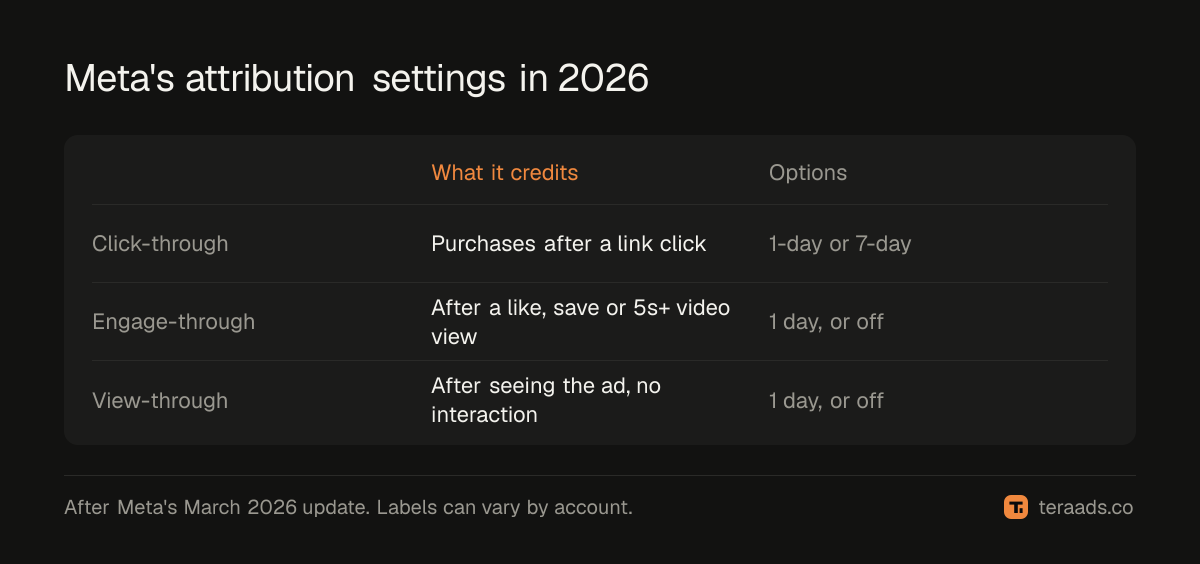
| Setting | What it credits | Options |
|---|---|---|
| Click-through | Purchases after a link click on the ad | 1-day or 7-day click |
| Engage-through | Purchases after a non-link interaction, or a video view of 5 seconds or more | 1 day, or off |
| View-through | Purchases after someone saw the ad without interacting | 1 day, or off |
Which setting to use
For purchase campaigns, keep 7-day click. Most D2C buyers don't buy within a day of clicking, especially for considered products, and a 1-day click window would hide real results from the delivery system.
Engage-through and view-through add purchases from people who didn't click a link. Some of those buyers were influenced by the ad; others would have bought anyway. They're useful as context, but they inflate apparent ROAS. View-through conversions explains how to read them.
Keep the setting stable. Changing it changes what the delivery system optimises for and makes before-and-after comparisons meaningless.
Compare settings before you judge
Ads Manager's Compare Attribution Settings shows the same campaign's results under different windows side by side. Use it to see how much of a campaign's reported performance depends on views and engagements:
- If most purchases come from 7-day click, the campaign drives visits that convert.
- If a large share comes from 1-day view or engage-through, the campaign may be reaching people who were going to buy anyway, often retargeting.
Why Meta still won't match Shopify
Even with link-click-only attribution, Meta and Shopify count differently. Meta credits purchases within its windows to its own ads, including some also credited to Google or email, and models some conversions it can't observe. Shopify credits each order once, using visits it recorded. Why Meta and Shopify disagree explains the gaps. For decisions, use Shopify orders with UTMs, after RTO.
What the March change means for your numbers
Accounts where many conversions followed likes, saves or shares may see lower click-through numbers and higher engage-through numbers after the change, even if nothing about real sales changed. If your Meta ROAS shifted in spring 2026, check whether the change explains it before changing budgets. Totals in Shopify are the reality check.
A weekly check against Shopify
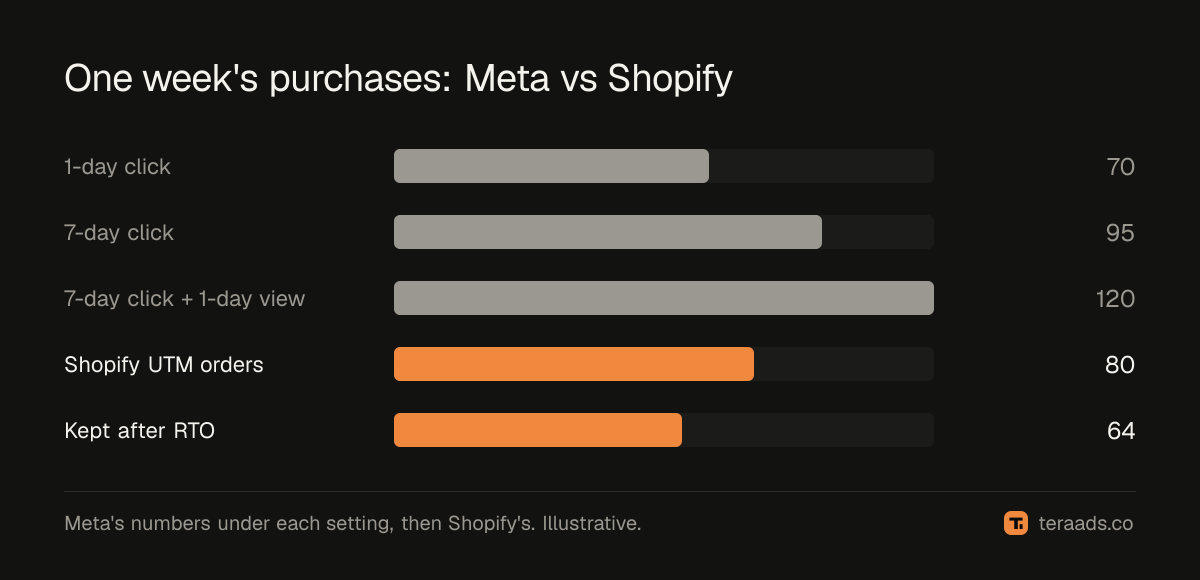
Here is a simple routine that keeps attribution honest. Suppose Ads Manager reports 120 purchases last week on 7-day click and 1-day view. Using Compare Attribution Settings, you see:
- 1-day click: 70 purchases.
- 7-day click: 95 purchases.
- Engage-through and 1-day view: the remaining 25.
Then check Shopify. Orders tagged with Meta UTMs come to 80, and after refusals settle, 64 were delivered and kept.
What this tells you:
- Click-based results (95) are closer to reality than the full 120, but still above Shopify's 80, because UTMs miss some buyers who return directly and Meta counts some buyers who'd have come anyway.
- The 25 non-click purchases are context, not proof. If a campaign's results lean heavily on them, it's probably reaching people who already knew you.
- Kept orders (64) are what pay the bills. Divide spend by kept orders to get the cost you can compare with your break-even.
Record the four numbers every week in the same sheet: Meta at your chosen setting, Meta at 7-day click, Shopify UTM orders and kept orders. After a month, the ratios between them become stable enough to translate Meta's live numbers into a realistic estimate between weekly checks.
Common mistakes
Comparing months across the change. Click numbers before and after March 2026 aren't defined the same way.
Adding engage-through and view-through purchases to click results and calling it ROAS. You're counting some sales that would have happened anyway.
Switching to 1-day click to "be conservative". It changes optimisation, not just reporting.
Trusting any setting over Shopify. Platform attribution is a guide; orders after RTO are the truth.
Ignoring retargeting. View-based credit flatters retargeting most.
Tera Ads shows Meta Ads and Google Ads spend beside your Shopify orders, with profit after RTO from Shiprocket for every campaign, so attribution changes don't change what you see in the bank. It is free for one business.
Frequently asked questions
What changed in Meta attribution in March 2026?
Click-through attribution now counts only link clicks. Non-link interactions moved to engage-through, and the engaged video view threshold fell from 10 to 5 seconds.
What is engage-through attribution?
Credit for purchases after someone interacted with an ad without clicking a link, such as a like, save or 5-second video view.
Which Meta attribution setting should I use?
For purchase campaigns, 7-day click. Treat engage-through and view-through results as context, not proof.
Does the attribution setting change what I pay?
No. Meta said billing doesn't change; the setting affects reporting and how results are credited.
Why do Meta and Shopify still disagree?
Meta credits its own ads within its windows and models some conversions. Shopify counts each order once from recorded visits.