View-Through Conversions: Should You Count Sales From Ads Nobody Clicked?
View-through conversions credit ads people saw but didn't click. How Meta and Google count them, why they inflate ROAS, and how to judge campaigns without them.
On this page
A view-through conversion is a purchase credited to an ad the buyer saw but didn't click, within a set window after the view. Meta's default setting counts purchases within one day of viewing an ad, alongside seven days after a click. View-throughs can reflect real influence, but they also credit ads for sales that would have happened anyway, so they inflate ROAS. Check results with click-only numbers and Shopify orders.
Key takeaways
- View-through conversions count purchases after an ad impression with no click.
- Meta's default attribution setting is 7-day click and 1-day view.
- Ads shown to people who were already going to buy, such as retargeting, collect many view-throughs.
- Compare click-only results with the default to see how much ROAS depends on views.
- Judge real impact with Shopify orders, blended MER and incrementality tests.
How view-through attribution works
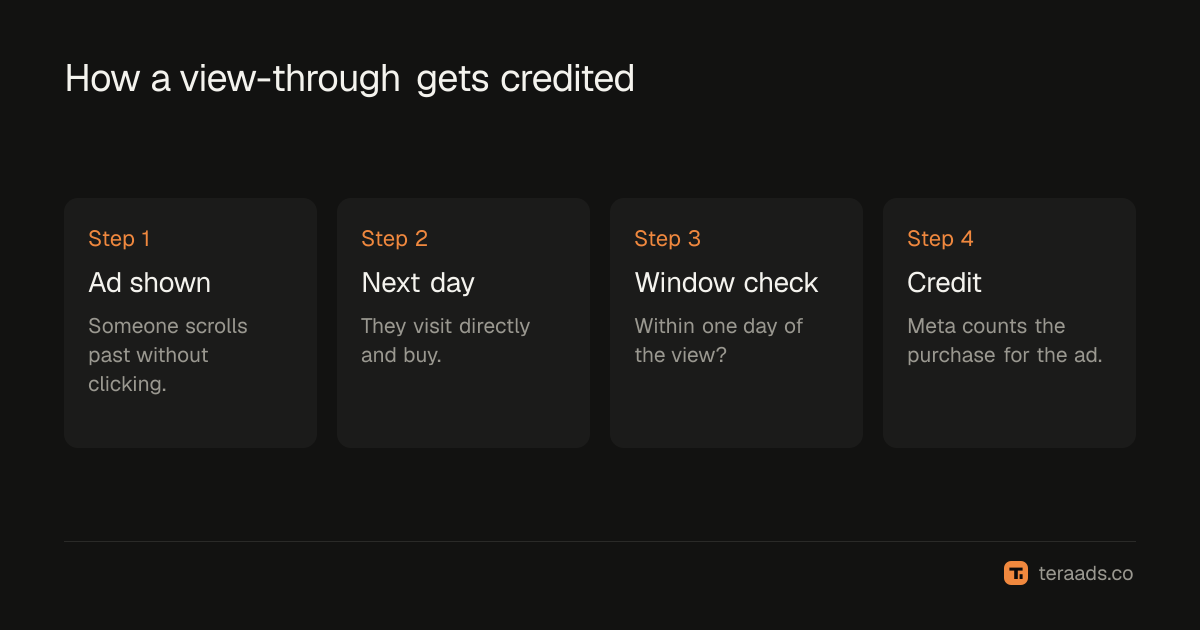
Someone scrolls past your Reels ad without tapping it. The next morning they open your site directly and buy. Under Meta's default 7-day click, 1-day view setting, that purchase counts as a conversion for the ad, because the purchase came within a day of the view.
The window matters. A one-day view window catches people who saw the ad and bought soon after. It also catches people who were going to buy anyway and happened to scroll past your ad that day, which is very likely if you show ads to your own visitors and customers.
How the platforms count them
| Platform | How view-through works | Where to see it |
|---|---|---|
| Meta Ads | Default setting is 7-day click, 1-day view; purchases within a day of a view count | Compare attribution settings in Ads Manager columns |
| Google Ads (Display, Demand Gen, YouTube) | View-through conversions are reported separately for impressions without interaction | The view-through conversions column |
| Google Ads (YouTube) | Engaged-view conversions count purchases after someone watches a set length of a video ad without clicking | Engaged-view conversion columns |
| Google Search and Shopping | Click-based; no view-through | Not applicable |
Attribution windows after January 2026 covers Meta's current settings in detail.
Why view-throughs inflate results
Three groups make up most view-through conversions:
- People influenced by the ad. They saw it, remembered the brand and bought. This is real value.
- People already on their way. Returning visitors, cart abandoners and past customers who were going to buy, and saw your ad because you targeted them.
- Coincidences. People who bought for other reasons, such as a friend's recommendation or a Google search, and happened to see an ad that day.
Only the first group is value the ad created. Retargeting and campaigns aimed at existing customers have a high share of the other two, so their view-through numbers flatter them most.
Seeing how much ROAS depends on views
In Ads Manager you can compare results under different attribution settings in the columns. Compare your default results with click-only results for the same period:
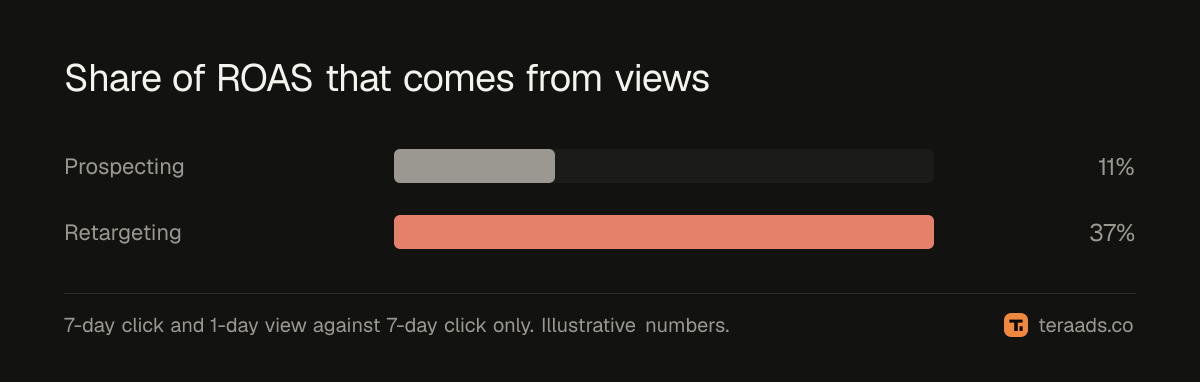
| Campaign | ROAS, 7-day click and 1-day view | ROAS, 7-day click only | Share from views |
|---|---|---|---|
| Prospecting | 2.8x | 2.5x | 11% |
| Retargeting | 6.2x | 3.9x | 37% |
A campaign whose results depend heavily on views needs a closer look. It isn't necessarily useless, but the default number overstates it.
Do views matter at all?
Yes, especially for video and for prospecting. Many people don't click ads but are influenced by them, and some buy days later by searching your name. Ignoring views entirely undervalues awareness campaigns. The goal isn't to discard view-throughs but to stop treating them as proof.
How to judge campaigns honestly
- Compare click-only and default results for each campaign, as above.
- Check Shopify. Total orders and UTM-tagged orders are independent of view-through rules. Meta Ads vs Shopify sales explains the gaps.
- Watch blended numbers. If a campaign's view-through conversions rise but total Shopify revenue doesn't, the views aren't adding sales.
- Test. Holdouts and budget tests show what a campaign actually adds; see incrementality testing.
View-throughs for cash-on-delivery stores
For COD-heavy stores, view-through conversions add another layer of overstatement. Meta counts the purchase when the order is placed, so a view-through credit for an order that is later refused is a sale that never happened, credited to an ad that may not have influenced it. Retargeting campaigns aimed at recent visitors can collect many of these, because people who browse and abandon are often the ones who place impulse COD orders.
When you compare campaigns, use click-only results and kept Shopify orders together. A campaign that still looks profitable on 7-day click results and kept orders is a safe one to scale. A campaign that's only profitable with view-through credit and before returns needs a test before it gets more budget.
If you share results with a founder, client or investor, say which attribution setting the numbers use. "ROAS 6.2x" means little without "7-day click, 1-day view, before returns". A simple habit is to report two numbers for every campaign: platform ROAS on the default setting and real ROAS on kept orders; true ROAS after RTO and COD shows the calculation. Watch the gap over time: if it widens, more of your reported results are coming from attribution rules rather than from sales.
Common mistakes
Treating default ROAS as fact. It includes views that may not have mattered.
Cutting all view-heavy campaigns. Video and prospecting influence people who never click.
Comparing campaigns with different settings. Use the same attribution setting across comparisons.
Retargeting on view-based results. Retargeting collects the most coincidental views.
Ignoring Shopify totals. The store doesn't care which ad was viewed.
Tera Ads shows Meta Ads and Google Ads spend beside your Shopify orders and profit after returns, so you can judge campaigns against sales that happened rather than sales a platform credited. It is free for one business.
Frequently asked questions
What is a view-through conversion?
A purchase credited to an ad that the buyer saw but didn't click, within a set window after the view, such as one day.
Does Meta count view-through conversions by default?
Yes. Meta's default attribution setting is 7-day click and 1-day view, so purchases within a day of viewing an ad count.
Are view-through conversions real?
Some are: people influenced by an ad they didn't click. Others would have happened anyway. Tests and Shopify totals show the difference.
Should I turn off view-through attribution?
You don't need to change the setting. Compare click-only results with the default to see how much each campaign relies on views.
Which campaigns have the most view-through conversions?
Usually retargeting and campaigns aimed at existing customers, because they reach people who were already likely to buy.