AI Creative Briefs: Turn Ad Results Into Better Images and Videos
Use Claude or ChatGPT to turn ad performance and customer reviews into clear creative briefs for designers, editors and UGC creators, then test what comes back.
On this page
An AI creative brief starts from evidence: which ads worked, why customers buy, and what they worry about. Give Claude or ChatGPT your ad results and customer reviews, ask it to find the patterns, then have it write a one-page brief per concept with the hook, angle, proof, format and success measure. A person still decides which concepts to make, and every brief ends in a test judged on purchases and kept orders.
Key takeaways
- A brief is a hypothesis: one audience, one angle, one hook, one way to measure it.
- AI is fastest at the analysis step: grouping ads by hook and finding what winners share.
- Customer reviews and objections give briefs the specific detail designers and creators need.
- Keep briefs to one page so creators actually follow them.
- Measure each concept on cost per purchase and kept orders, then feed results into the next round.
Why briefs matter more than tools
Most ad accounts don't fail for lack of ideas; they fail because new creatives repeat old ones with different colours. A good brief forces a choice: who this is for, what single idea it tests and how you'll know if it worked. AI is useful because it can read a month of ad results and two hundred reviews faster than any person, and turn the patterns into concrete instructions.
What a good brief contains
| Section | What goes in it | Example |
|---|---|---|
| Audience | Who this ad is for | First-time buyers, women 25–40, gifting |
| Angle | The single reason to buy it tests | "Looks expensive, priced for gifting" |
| Hook | The first two seconds or first line | Close-up of the clasp, "Nobody guesses the price" |
| Proof | What makes the claim believable | Hallmark, review quotes, 7-day returns |
| Format | Placement, length and ratio | 9:16 Reels, 15–20 seconds, captions on |
| Offer and CTA | What the viewer should do | Prepaid discount, "Shop the gift edit" |
| Success measure | How the concept will be judged | Cost per purchase below ₹600 after ₹15,000 spend |
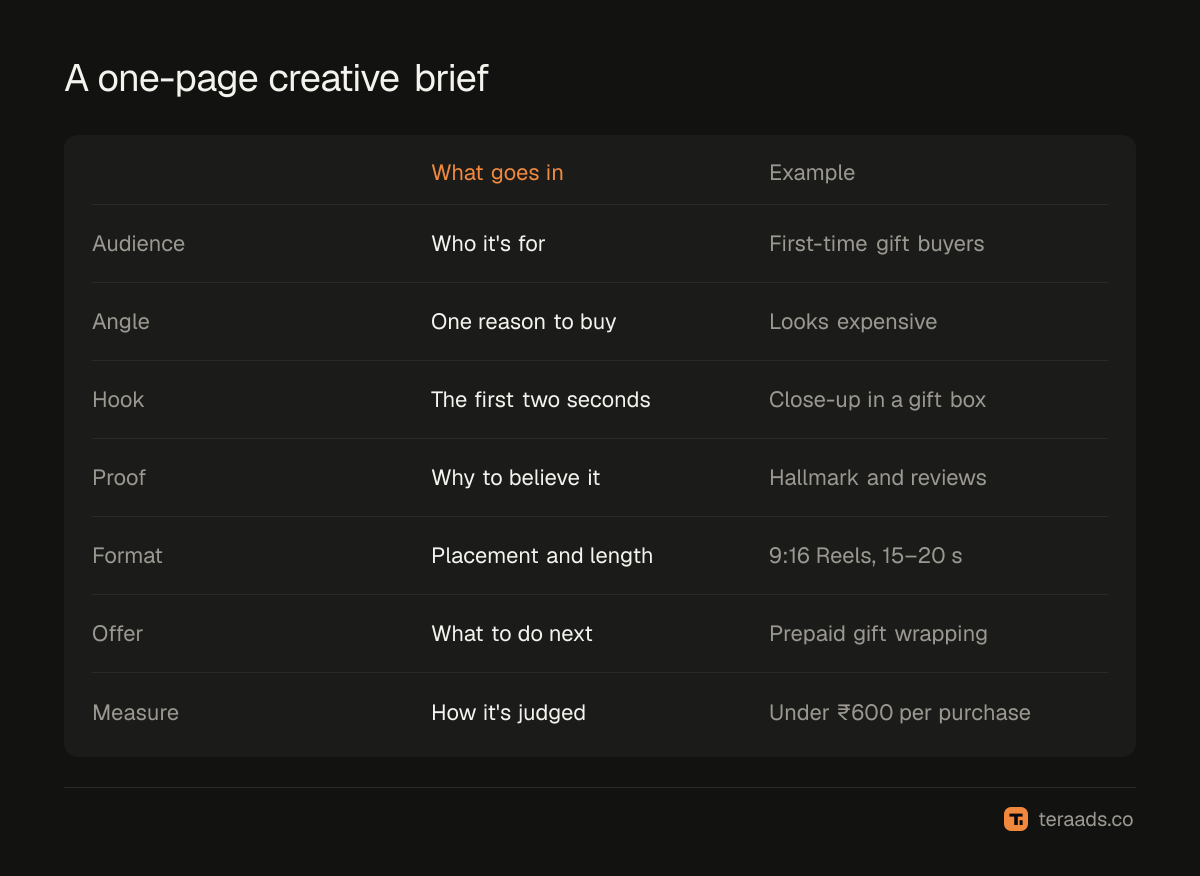
Writing briefs with AI, step by step
- Export ad results. From Ads Manager, export ad-level results for the last 60–90 days with spend, CTR, hook rate if you track it, purchases and cost per purchase. Add a column describing each ad's opening, format and offer.
- Paste customer material. Reviews, common questions and objections, with names and contact details removed.
- Ask for patterns. "Group these ads by hook type and format. Which groups have the best cost per purchase with at least ₹10,000 spend? What do the top five ads share?"
- Ask for concepts. "Propose five new concepts that build on the winning patterns or answer the most common objection. One line each."
- Choose two or three. You know the brand, stock and season; pick the concepts worth making.
- Ask for the briefs. "Write a one-page brief for each chosen concept using these sections: audience, angle, hook, proof, format, offer, success measure."
Briefing UGC creators
User-generated content works when it feels real, so briefs for creators should guide without scripting every word. Ask the AI to turn each brief into a creator version: the angle in plain language, three hook options, the points to mention, things not to say (such as unproven claims) and the deliverables: length, ratio, raw files. Ask creators to speak naturally, in the language their audience uses.
Using the results
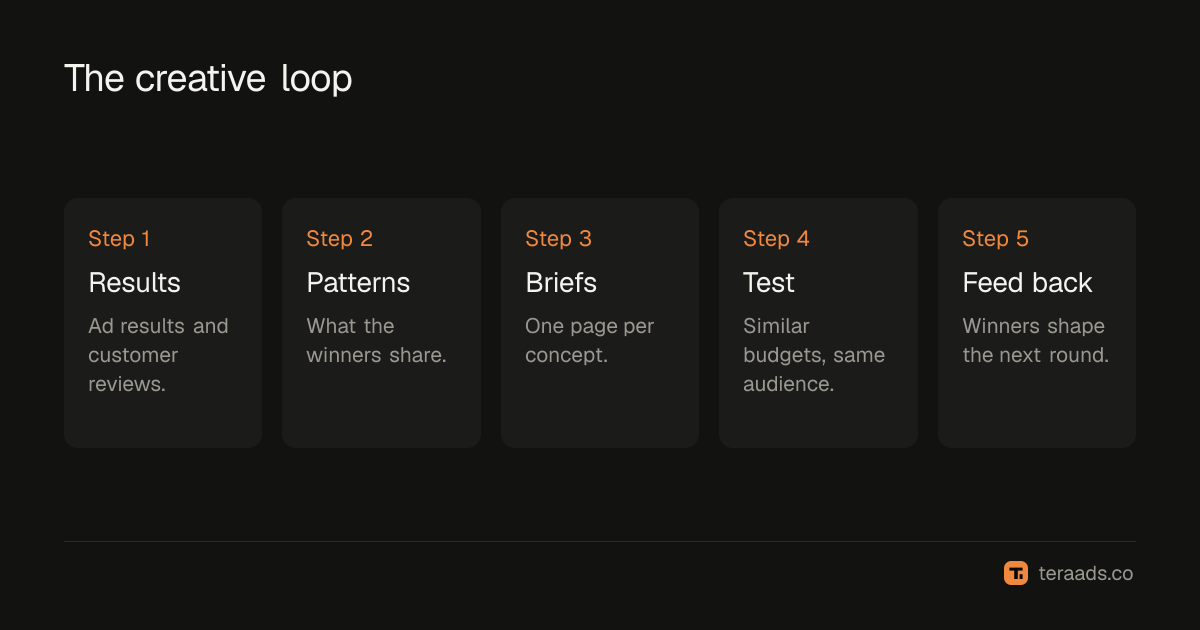
Launch each concept as a test with similar budgets and the same audience, and compare cost per purchase once each has spent enough to collect purchases. For cash-on-delivery brands, check kept orders as well, because some hooks attract impulse buyers who refuse delivery.
Then close the loop. Paste the results back into the conversation: "Concept B won with a 35% lower cost per purchase. Concepts A and C lost. Update the patterns and propose the next three concepts." Each round sharpens the brief, and over a few months you build a record of what your customers respond to.
Fresh concepts from proven angles keep frequency from wearing out an audience, and replace ads before creative fatigue sets in. The same material also powers AI ad copy for the primary text and headlines.
Where AI helps less
- Visual taste. AI can describe a shot; it can't judge whether your product looks beautiful in it. Review concepts and drafts yourself.
- Brand truth. It doesn't know your stock, margins or upcoming launches unless you tell it.
- Small samples. With a handful of ads, patterns are mostly noise. Ask it to say when the data is too thin.
A sample brief
Here's what a finished brief might look like for an illustrative jewellery brand, drafted by an assistant from the brand's results and reviews, then edited by the founder:
- Audience: women aged 25–40 buying a gift, mostly first-time buyers.
- Angle: the earrings look far more expensive than they are.
- Hook: a close-up of the earrings in a gift box, with the on-screen line "She'll never guess the price."
- Proof: three short review quotes about compliments, the hallmark, and the 7-day return policy.
- Format: 9:16 Reels video, 15–20 seconds, captions on, product visible in the first second.
- Offer and CTA: free gift wrapping on prepaid orders; "Shop the gift edit."
- Success measure: cost per purchase below ₹600 after ₹15,000 spend, with RTO no higher than the account average.
Notice what's missing: no list of five benefits, no brand history. One idea, shown clearly, is easier to film and easier to judge.
Common mistakes
Briefs without a success measure. If you don't decide how to judge a concept, you'll judge it by opinion.
Too many ideas per brief. One angle per concept, or you can't tell what worked.
Ignoring objections. The most common worry in support chats is often the best hook.
Writing briefs nobody reads. Keep them to one page.
Not feeding results back. The loop is where the value builds.
Tera Ads shows every Meta Ads campaign beside your Shopify orders, with profit after returns, so creative tests can be judged on orders that were kept. It is free for one business.
Frequently asked questions
What is an AI creative brief?
A one-page plan for a new ad, written with an AI assistant from your ad results and customer feedback: audience, angle, hook, proof, format, offer and how it will be judged.
Can ChatGPT analyse which ad creatives work?
Yes, if you export ad results and describe each ad's hook, format and offer. It can group ads and find what winners share.
How do I brief UGC creators with AI?
Turn each brief into a creator version: the angle in plain words, hook options, points to mention, things not to say and the deliverables.
How many creative concepts should I test at once?
Usually two or three per round, with similar budgets, so each collects enough purchases to compare.
How do I measure a creative brief's success?
Set the measure in the brief, usually cost per purchase after a fixed spend, and check kept orders for cash-on-delivery stores.