AI Ad Copy for D2C Brands: Prompts, Variations and Testing
AI can write dozens of ad variations in minutes, most of them forgettable. How to brief it with real customer language, keep claims honest, and test what it writes.
On this page
AI writes useful ad copy when you give it what generic copy lacks: your customers' own words, your real proof points and a clear angle for each variation. Feed Claude or ChatGPT reviews, support questions and your best-performing ads, ask for variations that each test one idea, check every claim, and launch a small set as a proper test. Judge winners on purchases and kept orders, not on how clever the line sounds.
Key takeaways
- The input decides the output: reviews and customer questions beat product descriptions.
- Ask for variations that differ by one idea, such as the angle or the opening hook.
- Check every claim against what you can prove; ad platforms and Indian advertising rules both apply.
- Launch a few strong variations, not fifty weak ones.
- Judge copy on cost per purchase and kept orders, then feed the results back into the next brief.
Why most AI ad copy is forgettable
Ask an assistant to "write a Facebook ad for silver earrings" and you get the average of every jewellery ad it has seen: "elevate your style", "timeless elegance", a row of emojis. It's grammatical and invisible. The fix isn't a better adjective; it's better material. Copy works when it sounds like the customer and says something specific that only you can say.
The material to gather first
| Material | Where to find it | What it gives the AI |
|---|---|---|
| Customer reviews | Your store, marketplaces, Google reviews | Real words, real reasons to buy |
| Support questions | WhatsApp, email, Instagram DMs | Objections to answer |
| Best ads | Ads Manager, sorted by cost per purchase | Angles already proven |
| Proof points | Certifications, delivery times, return policy, numbers sold | Specific, checkable claims |
| Offer details | Current price, discount, COD or prepaid terms | Accurate calls to action |
Remove customer names and contact details from anything you paste.
Writing copy, step by step
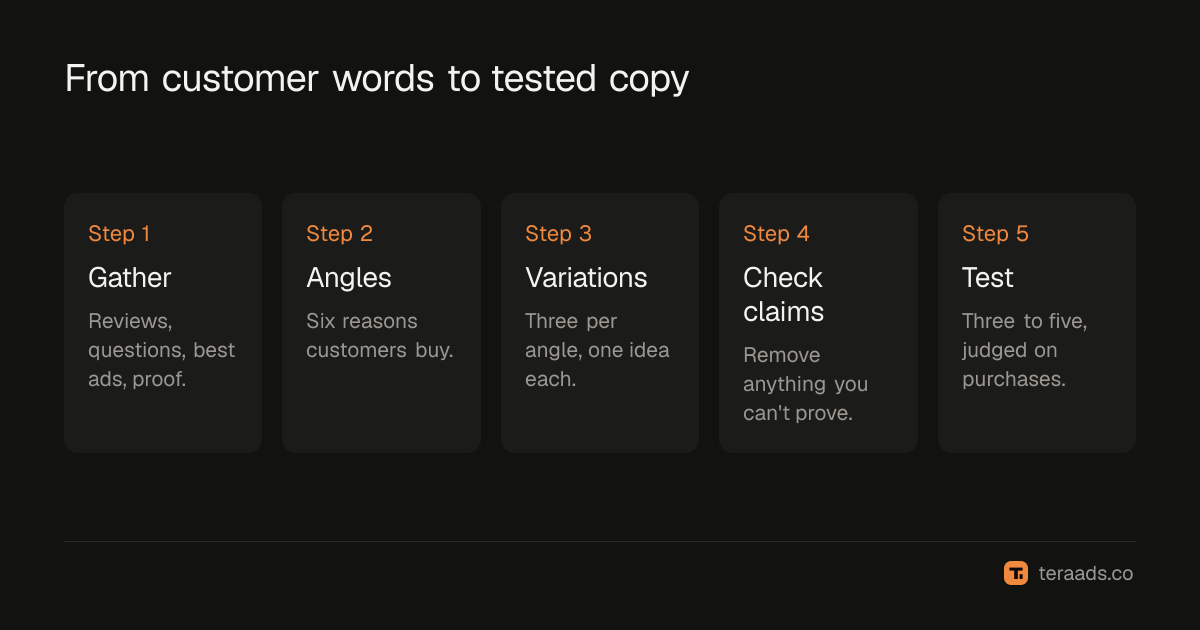
- Paste the material. Ten to thirty reviews, the five most common support questions, your three best ads and your proof points.
- Ask for angles before copy. "From this material, list six distinct reasons customers buy, with a quote that supports each." Pick the three strongest.
- Ask for variations by angle. "For each angle, write three primary texts under 125 characters and three headlines under 40 characters. Use customers' own phrases where possible."
- Ask for hooks separately. The first line decides whether anyone reads on; ask for ten opening lines for your strongest angle.
- Check every claim. Remove anything you can't prove, such as "best in India" or unverified health benefits.
- Shortlist for testing. Pick three to five variations that differ clearly by angle, and launch them as a test.
Prompts that produce better copy
- "Rewrite this ad in the tone of our customer reviews. Keep it under 100 words. No words like 'elevate' or 'timeless'."
- "Write five versions of this headline, each answering a different objection from the support questions."
- "Write this ad for a first-time buyer worried about cash on delivery and returns."
- "Translate this ad into natural Hinglish as an Instagram caption, not word-for-word."
- "Which of these ten headlines is most specific? Rank them and explain."
For Google responsive search ads, ask for headlines of up to 30 characters and descriptions of up to 90, which are Google's limits, and check the counts yourself.
Keeping claims honest
AI happily invents numbers, awards and guarantees. Every claim in an ad must be one you can support. Meta and Google review ads against their own policies, and in India the Advertising Standards Council of India's code applies to advertising claims, including comparisons with competitors. In practice:
- Use only numbers you can show, such as delivery times, return periods or customer counts.
- Avoid health, safety and before-and-after claims unless you have evidence and the category allows them.
- Keep discounts and prices current; a wrong price in an ad creates angry COD refusals.
- Don't name competitors unless you're sure the comparison is fair and verifiable.
Testing what the AI writes
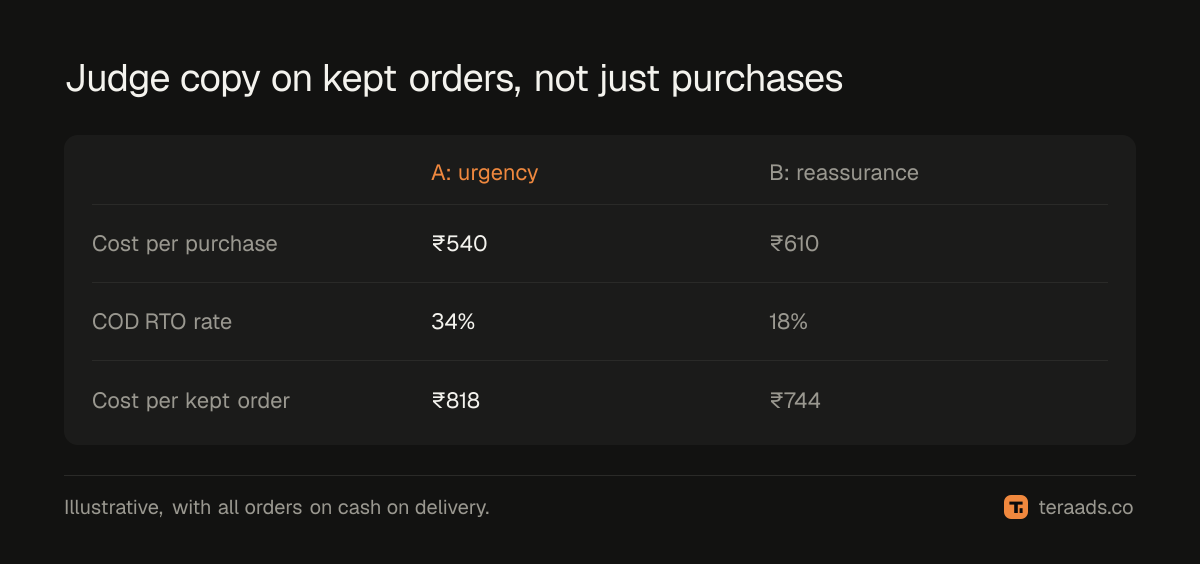
Copy is a hypothesis until it has spent money. Run a few variations against each other with the same audience and creative, give each enough budget to collect purchases, and compare cost per purchase. For cash-on-delivery brands, check kept orders too: copy that pushes urgency can bring impulse orders that get refused, which is why true ROAS after RTO and COD matters more than platform ROAS when picking a winner. Keep each ad set out of constant edits while it learns; the learning phase guide explains why.
When a variation wins, feed it back: "This angle won with a 30% lower cost per purchase. Write five new variations of it." Over time your brief becomes a record of what your customers respond to, which is more valuable than any single ad. Fresh variations of proven angles are also the best defence against creative fatigue. The AI creative briefs guide applies the same approach to images and video.
Copy for each stage of the buyer
The same product needs different copy for people at different stages. Cold audiences who have never heard of you need a reason to stop scrolling and a clear idea of what you sell, so lead with the problem or the most striking benefit. People who visited but didn't buy need reassurance: delivery time, returns, cash on delivery or a prepaid discount, and reviews from buyers like them. Past customers need something new, such as a new range or a product that goes with what they bought.
Ask the AI to write for one stage at a time and name the stage in the prompt: "Write for people who added to cart but didn't buy, whose most common worry is whether the size will fit." Copy written for everyone tends to persuade no one.
Common mistakes
Prompting with product descriptions only. You get catalogue copy, not ads.
Launching everything the AI writes. Too many variations split budget so none gets a fair test.
Publishing unchecked claims. Invented numbers and guarantees risk rejection, complaints and refusals.
Judging copy by taste. The market decides; measure purchases.
Not feeding results back. The next brief should start from what won.
Tera Ads shows every Meta Ads and Google Ads campaign in one table with profit worked out from your Shopify orders after returns, so you can see which ads bring orders that are kept. It is free for one business.
Frequently asked questions
Can ChatGPT or Claude write good Facebook ad copy?
Yes, when you give them customer reviews, objections, proof points and your best ads. Without that material the copy tends to be generic.
How many ad copy variations should I test?
Usually three to five per test, each differing by one clear idea, with enough budget for each to collect purchases.
Is AI-written ad copy allowed on Meta and Google?
Yes. Platforms judge the ad, not how it was written. The same policies apply, so check every claim.
How do I make AI copy sound less generic?
Paste real customer phrases, ban overused words in the prompt, and ask for specific claims you can prove.
Should I write ads in Hindi or Hinglish with AI?
If your customers talk that way, test it. Ask for natural phrasing rather than literal translation, and have a fluent speaker check it.