Meta Ads Frequency: What Number Is Too High, and What to Do About It
Frequency is how often the same person sees your Meta ads. Why there's no single magic number, how to read it with CTR and cost, and when to rotate or widen.
On this page
Frequency in Meta Ads is the average number of times each person in your reach saw your ad over a period: impressions divided by reach. There is no universal "too high" number. Prospecting campaigns usually start to tire somewhere around three to four over a week, retargeting can run higher, and the real signal is frequency rising while click-through falls and cost per purchase climbs.
Key takeaways
- Frequency = impressions ÷ reach, for the date range you pick. A 7-day view is the most useful.
- Watch frequency together with CTR and cost per purchase; frequency alone is not a verdict.
- Prospecting tires faster than retargeting, because cold audiences have less reason to keep looking.
- Fix high frequency with fresh creative, a wider audience, or fewer overlapping ad sets.
- Don't judge frequency on lifetime numbers; they always look high on old campaigns.
What frequency measures
Meta reports two numbers side by side: reach, the number of distinct people who saw your ad at least once, and impressions, the total number of times it was shown. Frequency is simply impressions divided by reach. If 10,000 people saw your ad 32,000 times this week, frequency is 3.2.
It's an average, so it hides spread: some people saw the ad once, a few saw it ten times. And it depends on the date range: lifetime frequency on a three-month-old campaign will look alarming even if this week's is fine. Use a rolling 7-day view to make decisions.
Why there's no magic number
You will read "keep frequency under 2" and "frequency of 7 is fine" in different places. Both can be true, because the right level depends on:
| Factor | Frequency can run higher when… | Frequency should stay lower when… |
|---|---|---|
| Audience temperature | Retargeting warm visitors and cart abandoners | Prospecting cold audiences |
| Creative variety | Several distinct ads rotate | One ad carries the whole ad set |
| Purchase cycle | Considered purchases need reminders | Impulse products are bought or ignored fast |
| Audience size | Large audiences with room to grow | Small, saturated audiences |
| Season | Sale periods with urgency | Ordinary weeks |
A useful working range many advertisers use: prospecting ad sets often begin to tire around three to four over seven days; retargeting can run higher. Treat these as starting points, then let your own CTR and cost data set the limit.
The signal that matters: frequency plus trend
Look at four numbers by week for each ad set:
- Frequency (7 days)
- CTR (link click-through rate)
- CPM (cost per thousand impressions)
- Cost per purchase, ideally on kept orders
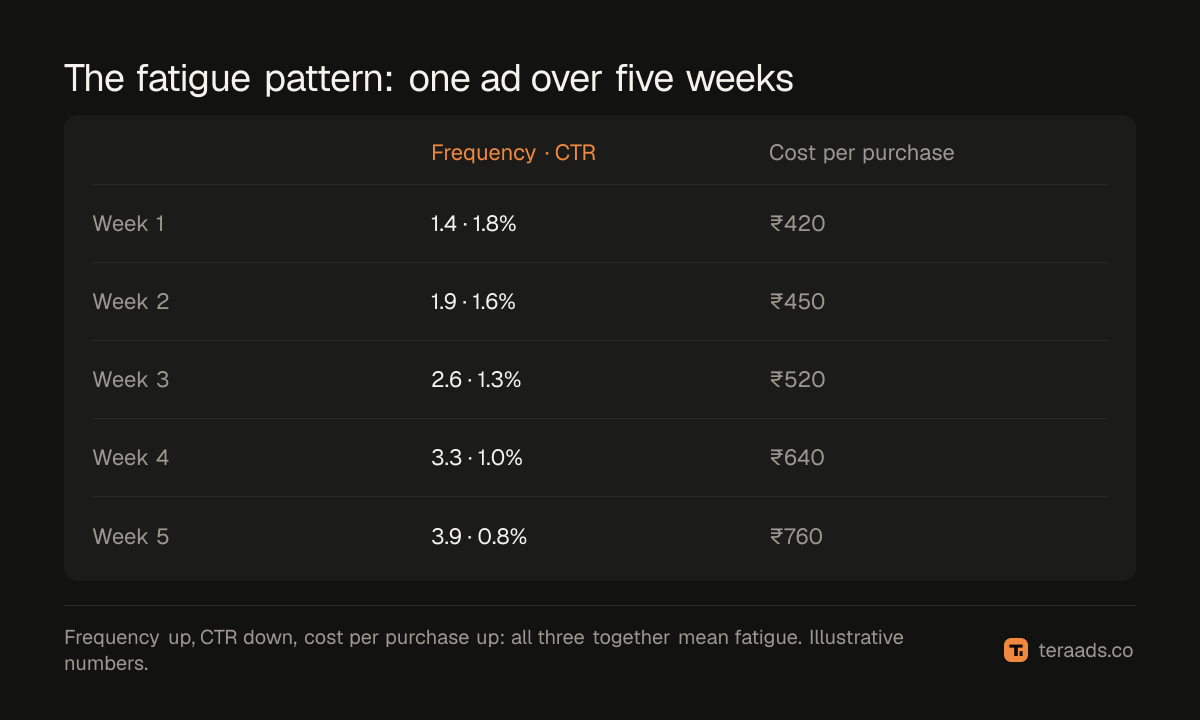
The fatigue pattern is clear when you see it: frequency rising, CTR falling, CPM flat or rising, cost per purchase climbing. When frequency rises but CTR and cost hold steady, the audience simply hasn't tired yet.
What to do when frequency is too high
Refresh the creative
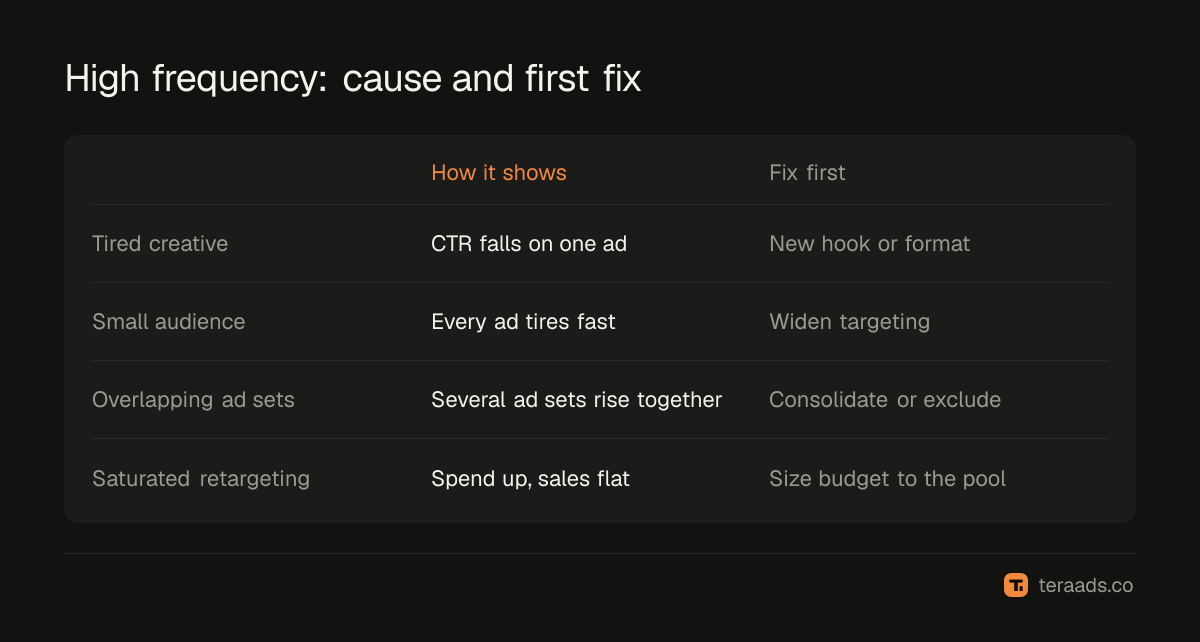
The most common fix. New hooks, formats and angles give the same people a reason to look again. The detail is in spotting creative fatigue.
Widen the audience
If the audience is small, frequency climbs fast no matter how good the creative is. Broaden targeting, use broader lookalikes, or move to broad targeting and let Meta find buyers.
Remove overlap
Several ad sets aimed at the same people push frequency up across all of them. Consolidate or exclude, as described in the audience overlap guide.
Lower the budget for saturated audiences
Retargeting pools are finite. If you spend more than the pool can absorb, frequency rises without more sales. Size retargeting budgets to the audience, not to a round number.
Use frequency caps where they exist
Reach and frequency buying and some objectives let you set frequency caps. For most conversion campaigns you control frequency indirectly, through audience size, budget and creative rotation.
Frequency in prospecting vs retargeting
Prospecting reaches people who don't know you. A cold viewer who ignored your ad three times is unlikely to click on the fifth view. Keep prospecting frequency modest, and rely on creative variety.
Retargeting reaches people who visited, viewed products or added to cart. They have a reason to come back, so higher frequency can still convert, especially in the first days after a visit. But exclude recent purchasers, and watch for cash-on-delivery orders that come back as RTO from aggressive retargeting; true ROAS after RTO and COD explains the effect.
A weekly frequency check
- Sort ad sets by spend; look at the top ten.
- Note 7-day frequency, CTR and cost per purchase, and compare with the previous week.
- Flag any ad set where frequency rose and CTR fell by a fifth or more.
- For flagged prospecting ad sets: rotate creative first; widen the audience second.
- For flagged retargeting ad sets: check audience size and budget, and exclusions.
Frequency with broad and Advantage+ audiences
Broad targeting and Advantage+ audiences give Meta a much bigger pool, so frequency usually stays lower for the same budget. When frequency still climbs on a broad ad set, the cause is rarely the audience; it's usually that one or two ads are taking almost all the spend. Check the ad-level breakdown: if one creative carries most of the impressions, it is tiring for everyone, and fresh ads matter more than any targeting change.
Tera Ads shows every Meta Ads and Google Ads campaign in one table with profit worked out from your Shopify orders, and its Meta deep dive covers funnel, audience overlap and creatives that still work. It is free for one business.
Frequently asked questions
What is a good frequency for Meta ads?
For prospecting, many advertisers see fatigue begin around three to four over seven days; retargeting can run higher. The right number for you is where CTR starts falling and cost per purchase starts rising.
Is a high frequency always bad?
No. High frequency with steady CTR and cost per purchase means the audience is still responding. It becomes a problem when performance declines as frequency climbs.
Why is my frequency high on a small budget?
Usually because the audience is small. A small audience reaches saturation quickly even on a low budget. Widen the audience or reduce overlap.
Should I look at lifetime or weekly frequency?
Weekly, or another rolling window. Lifetime frequency grows with a campaign's age and doesn't tell you what's happening now.
Does high frequency increase CPM?
It often goes together with rising CPMs, because Meta's system has fewer fresh, responsive people to show the ad to and engagement falls. Fresh creative and wider audiences usually help both.