Blended CAC: How to Calculate Customer Acquisition Cost for D2C
Blended CAC is all marketing spend divided by all new customers. How to calculate it, how it differs from paid CAC, and how to judge it against margin and payback.
On this page
Blended CAC is your total marketing spend divided by the number of new customers you gained in the same period. It ignores which channel gets credit, so it can't be inflated by attribution. Paid CAC divides ad spend by the new customers ads are credited with. Judge CAC against what a new customer is worth: the contribution margin from their first order and from the orders they place afterwards.
Key takeaways
- Blended CAC = total marketing spend ÷ new customers. Paid CAC = paid media spend ÷ new customers credited to ads.
- Count new customers from Shopify, after removing cancelled and RTO first orders.
- Blended CAC is harder to fool than platform CAC, because it doesn't depend on attribution.
- A CAC is only "good" next to contribution margin per customer and how fast it pays back.
- Track CAC and repeat purchase together; rising CAC is fine if customers are worth more.
The formula
Blended CAC = (ad spend + influencer and agency fees + other marketing costs) ÷ new customers in the period.
New customers means first-time buyers, counted from Shopify by customer, not by order. Remove first orders that were cancelled or returned to origin, because a customer whose only order never arrived wasn't really acquired.
| Metric | Formula | Strength | Weakness |
|---|---|---|---|
| Blended CAC | All marketing spend ÷ all new customers | Can't be inflated by attribution | Doesn't say which channel works |
| Paid CAC | Paid media spend ÷ new customers credited to ads | Shows the cost of paid acquisition | Depends on attribution, which overstates |
| Channel CAC | Channel spend ÷ new customers from that channel | Compares channels | Most dependent on attribution |
A worked example
An illustrative brand in one month:
- Meta Ads spend: ₹3,20,000
- Google Ads spend: ₹1,10,000
- Influencers and content: ₹70,000
- Total marketing: ₹5,00,000
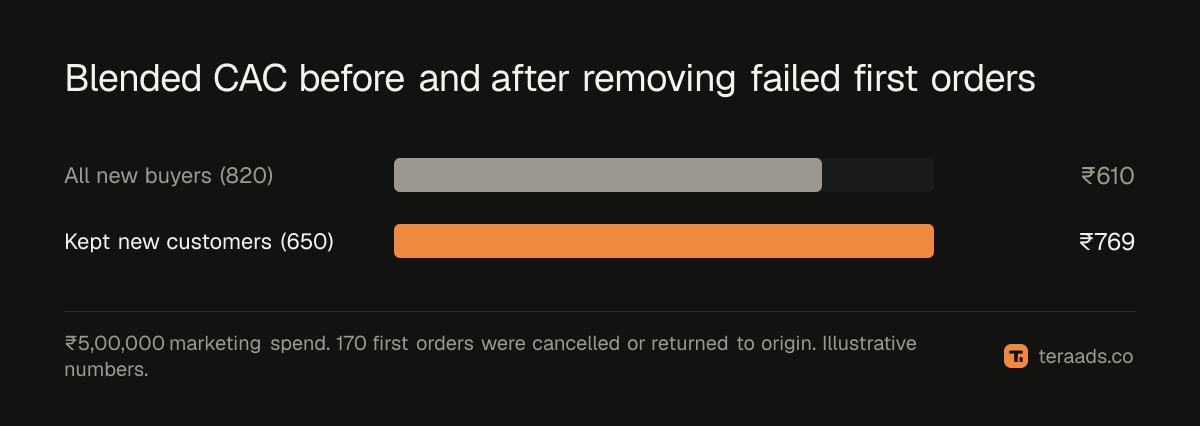
- First-time customers in Shopify: 820
- Of which first order cancelled or RTO: 170
- New customers kept: 650
Blended CAC = ₹5,00,000 ÷ 650 ≈ ₹769.
If you hadn't removed the cancelled and RTO first orders, CAC would look like ₹610 (₹5,00,000 ÷ 820), about a fifth better than reality. For brands with lots of cash-on-delivery orders, that correction matters.
Is your CAC good?
A CAC number means nothing alone. Compare it with what a new customer is worth.
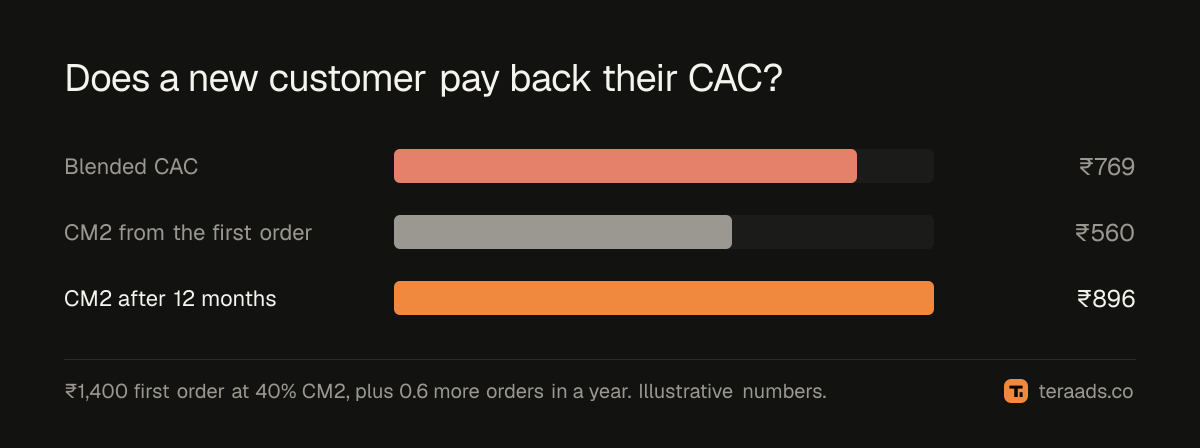
First-order payback. Contribution margin (CM2) from the first order. If the average first order is ₹1,400 at 40% CM2, it brings ₹560. Against a ₹769 CAC, the first order doesn't pay back; the customer needs to order again.
Repeat value. Contribution margin from the customer's later orders over, say, 6 or 12 months. If an average customer places 0.6 more orders in a year at ₹560 each, that's ₹336 more, bringing the total to ₹896, above the ₹769 CAC.
Payback period. How many months until the contribution margin from a customer covers their CAC. Shorter is safer, especially when cash is tight.
| CAC against first-order CM2 | What it means |
|---|---|
| CAC below first-order CM2 | Profitable on the first order; scale with confidence |
| CAC up to about 1.5 × first-order CM2 | Depends on repeat purchase; check that it really happens |
| CAC well above 1.5 × first-order CM2 | Risky unless repeat purchase is strong and proven |
The contribution margin guide explains how to work out CM2 per order.
Blended CAC and MER
Blended CAC and MER are two views of the same idea: judging marketing on totals rather than platform credit. MER divides total revenue by total marketing spend; blended CAC divides spend by new customers. Watch both. MER can look healthy while CAC rises if returning customers are carrying revenue, and that's a warning that acquisition is getting harder. MER vs ROAS covers MER in detail, and POAS covers profit at campaign level.
Ways to bring CAC down
- Cut campaigns that lose money after returns, rather than across-the-board budget cuts.
- Refresh tired creatives before raising budgets.
- Raise first-order value with bundles and thresholds for free shipping.
- Reduce RTO on first orders with prepaid nudges and order confirmation, so more acquired customers actually stay acquired.
- Separate brand searches from prospecting, so you don't pay to acquire people who already know you.
Counting new customers in Shopify
The denominator is where most CAC numbers go wrong. Shopify identifies customers by email or phone, so a buyer who checks out with a new email looks new. A few rules keep the count honest:
- Use first orders, not customers created. A customer record can exist before any purchase, for example from a newsletter sign-up. Count customers whose first paid order falls in the period.
- Remove failed first orders. Cancelled, unpaid and RTO first orders are not acquisitions.
- Merge obvious duplicates. The same phone number with two emails is one customer.
- Use the same window as spend. Spend in October against customers acquired in October; don't mix a 7-day spend window with a 30-day customer count.
For brands with a long delivery time, recalculate last month's CAC once its RTO outcomes have settled, usually two to three weeks after month end. The first number you see will look better than the final one.
Tera Ads shows Shopify sales, Meta Ads and Google Ads spend, and profit after returns on one screen, with every campaign from both platforms in one table. It is free for one business.
Frequently asked questions
What is the difference between CAC and blended CAC?
CAC can be calculated for one channel or for paid ads only. Blended CAC uses all marketing spend and all new customers, so it doesn't depend on which channel gets credit.
Should CAC include salaries?
Many brands calculate CAC on media and direct marketing costs only, and a fully loaded CAC that includes the marketing team separately. Be clear which one you're using.
What is a good CAC for a D2C brand in India?
There's no universal number; it depends on order value, margin and repeat purchase. CAC is good when contribution margin from the customer covers it within a payback period you can afford.
Why remove RTO orders from new customers?
Because a buyer whose only order was returned to origin never received the product and paid nothing. Counting them makes CAC look better than it is.
How often should I track blended CAC?
Monthly at least, and weekly if you spend heavily. Look at the trend alongside MER and repeat purchase rate.