Brand vs Non-Brand Search: Stop Brand Traffic Flattering Your ROAS
Searches for your own brand convert brilliantly and flatter Google Ads results. Why to separate brand from non-brand, how to do it, and how to judge each.
On this page
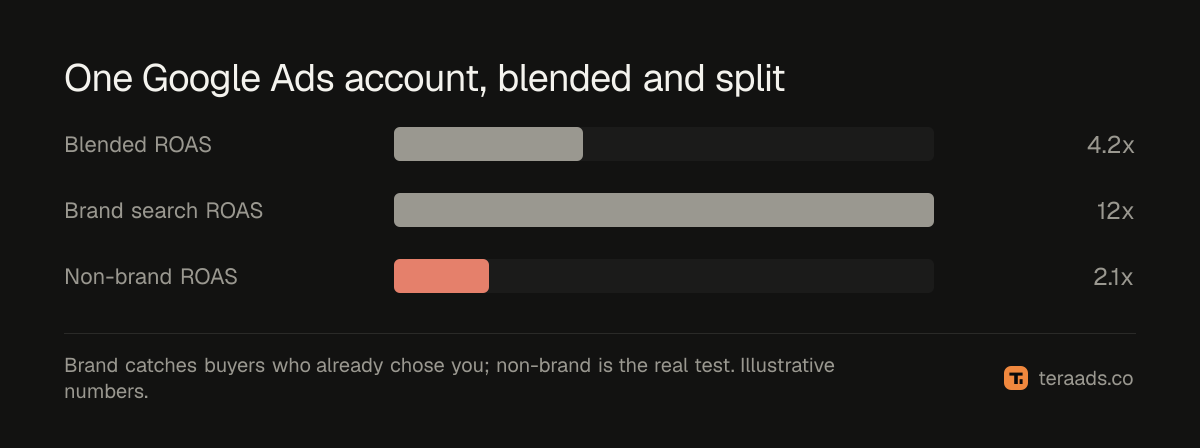
Brand search is people searching for your store's name; non-brand search is people searching for what you sell. Brand searches convert at very high rates because those buyers already chose you, often after seeing a Meta ad or a friend's recommendation. Mixed into one campaign, they make Google Ads look far more profitable than it is. Separate them, judge non-brand on new customers and profit, and keep brand spend small.
Key takeaways
- Brand searchers mostly already intend to buy; Google gets credit for demand it didn't create.
- Mixing brand and non-brand hides how well your Google Ads finds new customers.
- Run brand in its own small Search campaign, and exclude it from Performance Max and non-brand campaigns.
- Judge non-brand on profit after returns and new customers; judge brand on cost and protection.
- Test whether brand ads are needed at all by watching total brand orders when you pause them briefly.
Why brand traffic flatters results
A buyer sees your Instagram ad, remembers the name, and later searches for it on Google. They click your Google ad and buy. Google Ads records a sale; so may Meta. But the Google ad didn't create that sale; it caught a buyer who was already coming.
That's why brand campaigns often show ROAS several times higher than non-brand. Averaged together, a strong brand campaign can hide a non-brand campaign that loses money. Google's Performance Max will also show on brand searches unless you stop it, as covered in the Performance Max guide.
| Brand search | Non-brand search | |
|---|---|---|
| Example query | "aurora jewels earrings" | "silver hoop earrings for women" |
| Buyer intent | Already chose you | Shopping around |
| Typical ROAS | Very high | Lower, closer to the truth |
| New customers | Few | Many |
| What it tells you | How strong your brand demand is | Whether Google finds new buyers profitably |
How to separate them
- Create a brand Search campaign. Exact and phrase match on your brand name and its common misspellings.
- Exclude your brand from everything else. Add your brand as a negative keyword in non-brand Search campaigns, and add brand exclusions to Performance Max (Google's Performance Max controls).
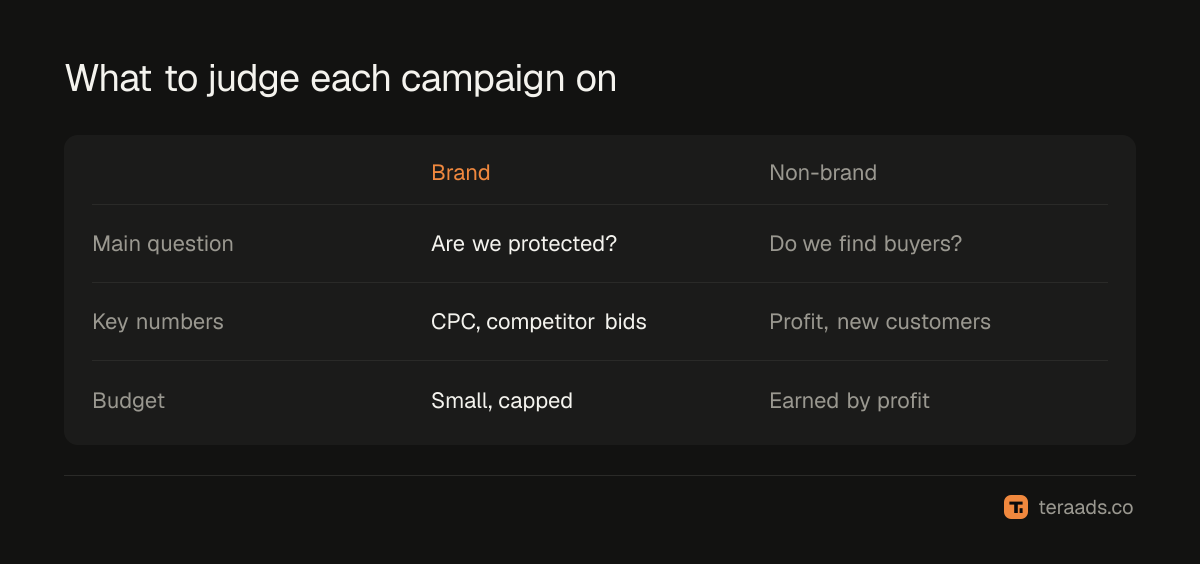
- Give brand a small, capped budget. It doesn't need much; brand searches are limited by how many people search for you.
- Check search terms weekly. Make sure brand terms land in the brand campaign and non-brand terms don't leak in; see the wasted search terms guide.
What to judge each on
Non-brand is your real test of Google Ads. Judge it on profit after returns from Shopify orders and on new customers. If non-brand doesn't pay, Google Ads isn't finding buyers profitably, whatever the blended ROAS says.
Brand is defence. Judge it on cost per click and whether competitors bid on your name. If nobody else bids on your brand, your organic listing may capture most of those buyers anyway.
Should you bid on your brand at all?
It depends on who else is in the auction:
- Competitors bid on your name: brand ads usually protect sales worth more than they cost, because otherwise a competitor's ad sits above your organic link.
- Nobody else bids: your organic result may catch most buyers. Test by pausing brand ads for a week or two and watching total orders from brand searches, paid and organic together.
- Marketplaces or resellers bid: brand ads keep buyers on your own store, where your margin is higher.
Any test should look at total orders and revenue, not Google Ads conversions, because the point is whether sales actually fall. MER vs ROAS explains why totals are the honest measure.
Brand search as a health signal
Brand search volume is a useful signal of whether your other marketing builds demand. When Meta campaigns, influencers or PR work, more people search for your name. Watch brand impressions over time in Google Ads and branded queries in Google Search Console. A rising trend means demand is growing; a falling one, while spend holds steady, is an early warning.
Common mistakes
- Reporting blended Google ROAS to justify more non-brand spend.
- Letting Performance Max serve on brand without exclusions.
- Big brand budgets that buy clicks you'd have got for free.
- Forgetting misspellings, which then leak into non-brand campaigns.
Measuring the real value of non-brand
Once brand and non-brand are separate, look at non-brand three ways:
- Profit after returns. Non-brand orders from Shopify, after cancellations and RTO, against non-brand spend. This is the number that decides budget.
- New customers. The share of non-brand orders from first-time buyers. Non-brand should bring mostly new customers; if it doesn't, it may be catching people who already know you through generic searches.
- Search terms. Which generic searches actually sell. Add negatives for the ones that don't, and move budget toward product groups that convert.
A non-brand campaign that makes a small profit while bringing mostly new customers is valuable even at a modest ROAS, because those customers can buy again. A non-brand campaign that loses money after returns needs fixing before it gets more budget. The wasted search terms guide is the place to start.
Brand campaigns and Meta's influence
Brand search volume often rises when Meta campaigns are running well, because people see an Instagram ad and search for the name later. That means some of the sales your brand campaign records were created by Meta. It's one more reason not to judge Google on blended numbers, and to look at total Shopify revenue against total spend across both platforms when deciding budgets. MER vs ROAS shows how to read the totals.
Tera Ads includes a Google Ads deep dive that lists wasted search terms, disapproved Shopping products and a scaling plan, and shows every Meta Ads and Google Ads campaign in one table with profit worked out from your Shopify orders. It is free for one business.
Frequently asked questions
What is a branded search campaign?
A Google Ads Search campaign that only targets searches containing your brand name, kept separate so you can see brand and non-brand results apart.
Why is my brand campaign ROAS so high?
Because most brand searchers already intend to buy from you. The campaign catches demand created elsewhere, so its ROAS overstates what the ads add.
How do I stop Performance Max showing on brand searches?
Add brand exclusions to the Performance Max campaign, and run a separate brand Search campaign to cover those searches.
Should small brands bid on their own name?
Check the auction first. If competitors or resellers bid on your name, a small brand campaign usually pays. If nobody does, test pausing it and watch total brand orders.
What should non-brand ROAS be?
It should be above your break-even ROAS on profit after returns. Non-brand is usually lower than brand; what matters is whether it makes money on its own.