CBO vs ABO on Meta: Campaign Budget or Ad Set Budget?
Campaign budget (CBO, now Advantage+ budget) lets Meta split money between ad sets; ABO fixes it yourself. When each works best, and how to use both.
On this page
CBO (campaign budget optimisation) sets one budget for the whole campaign and lets Meta move it between ad sets; ABO (ad set budget optimisation) gives each ad set its own fixed budget. Meta now calls campaign budgets Advantage+ campaign budget, and it's required for a campaign to keep Advantage+ status. Use ABO to test audiences or creatives fairly, and CBO to scale what's proven, letting Meta push money toward what converts.
Key takeaways
- CBO: one budget, Meta decides the split. ABO: you decide each ad set's budget.
- CBO usually finds efficient results faster but can starve ad sets that never get a fair chance.
- ABO gives each test a guaranteed budget, which makes comparisons fair.
- A common pattern: test in ABO, move winners into a CBO campaign to scale.
- Either way, each ad set still needs enough purchases to exit learning.
How each one works
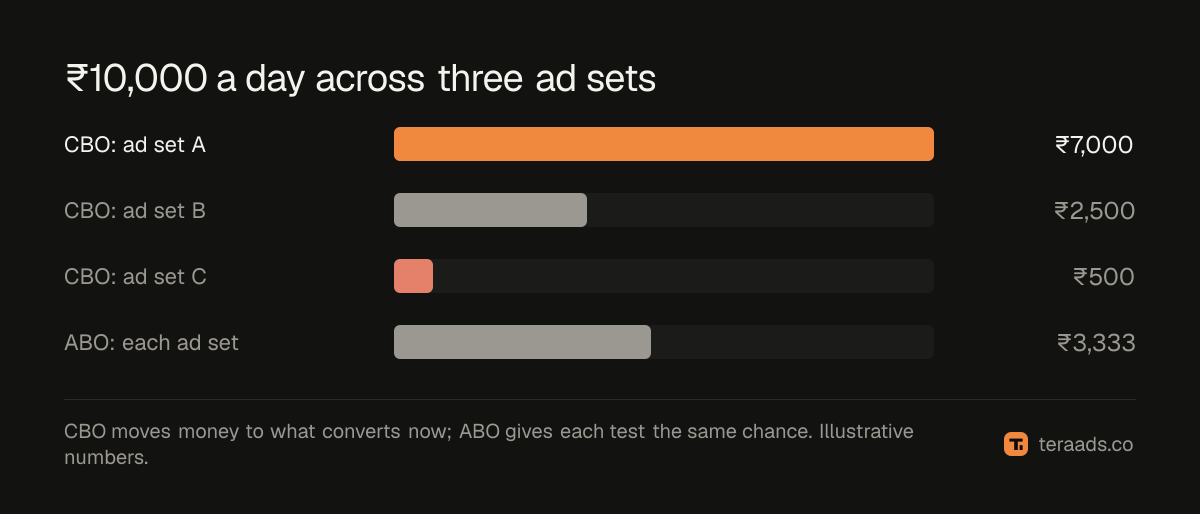
With CBO, you set a daily or lifetime budget on the campaign. Meta's system shifts spend between ad sets in real time toward those it predicts will get the most results for the money. One ad set may get most of the budget while another gets almost none.
With ABO, each ad set has its own budget. Meta optimises delivery inside each ad set, but money doesn't move between them. If ad set A has ₹2,000 a day, it spends ₹2,000 whether or not ad set B performs better.
| CBO (Advantage+ campaign budget) | ABO (ad set budget) | |
|---|---|---|
| Who splits the budget | Meta | You |
| Best for | Scaling proven audiences and creatives | Testing new audiences, offers or creatives |
| Fairness of tests | Low: weaker-looking ad sets may get little spend | High: every ad set gets its budget |
| Management effort | Lower | Higher |
| Advantage+ status | Required | Not compatible |
| Risk | Spend piles into one ad set, sometimes on early noise | Money keeps flowing to weak ad sets until you act |
When CBO is the better choice
- You're scaling. You have proven ad sets and want Meta to put more money behind whatever is converting today.
- Ad sets are similar in size and intent. CBO works best when ad sets compete on equal terms, such as broad audiences with different creative themes.
- You want Advantage+. Advantage+ Sales campaigns need a campaign budget; see the Advantage+ Sales guide.
- You have limited time. One budget to manage instead of many.
When ABO is the better choice
- You're testing. New creatives, audiences or offers each need a fair budget to prove themselves. Under CBO, Meta may decide in a day that a new ad set isn't worth spending on.
- Ad sets have very different sizes. A small retargeting ad set and a large broad one shouldn't compete for the same pool; the large one usually wins.
- You need predictable spend per segment. For example, a fixed budget for a new region or product line.
A simple structure that uses both
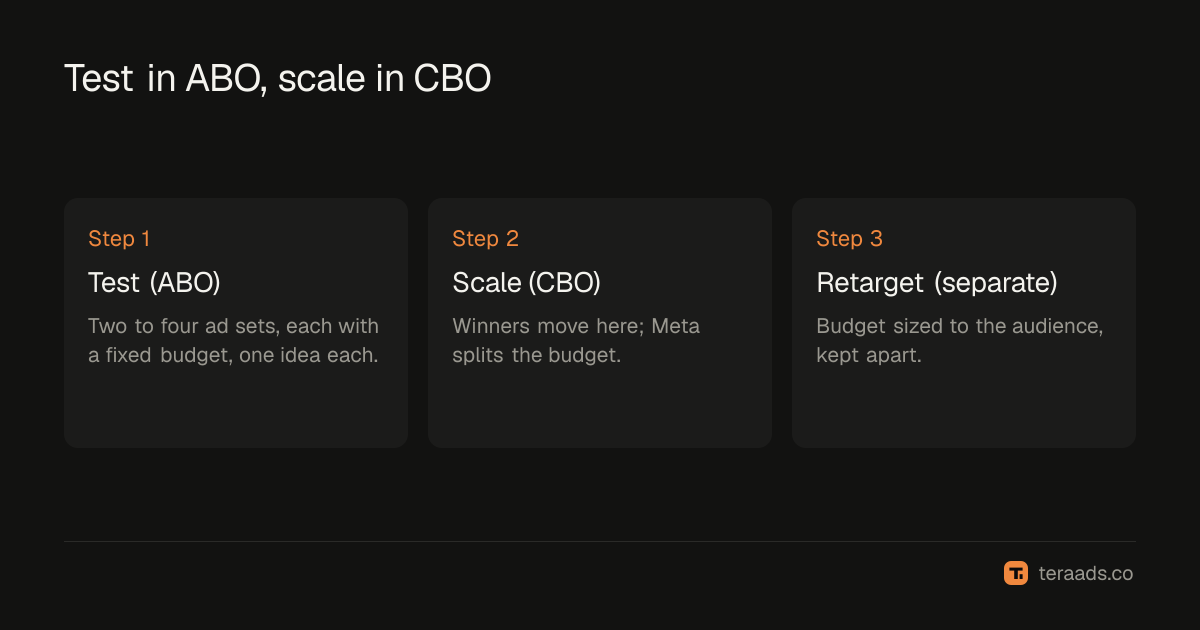
- Testing campaign (ABO). Two to four ad sets, each with a budget large enough to get meaningful results within a week. Each tests one thing: an audience, an angle, an offer.
- Scaling campaign (CBO). Winners from testing move here, as new ads or ad sets. Meta allocates the budget.
- Retargeting (separate). Keep retargeting apart so it doesn't absorb the scaling budget. Size its budget to the audience.
This keeps tests fair and scaling efficient, and keeps each part easy to read.
Budget size still matters
Neither option fixes a budget that's too small. Each ad set needs roughly 50 optimisation events in seven days to exit learning, as covered in the learning phase guide. Under CBO, too many ad sets for the budget means most never learn; under ABO, too little per ad set means none do. Fewer, better-funded ad sets beat many thin ones in both.
When you raise budgets, do it in steps; the budget scaling guide covers how fast to go.
How to judge the results
Whatever the structure, Ads Manager credits purchases that may later be cancelled or returned as RTO. Compare campaigns on kept Shopify orders and profit, especially if you take cash on delivery. A CBO campaign that piles budget into the ad set with the most purchases may be piling it into the one with the most impulse COD orders.
Common mistakes with each
CBO mistakes. Mixing very different ad sets in one campaign, such as cold prospecting and warm retargeting, so the easy one takes all the budget. Adding a new ad set to a mature CBO campaign and expecting it to get spend. Judging a CBO campaign by its best ad set rather than the whole.
ABO mistakes. Leaving losing ad sets running because each has its own budget. Spreading the budget across too many ad sets, so none exits learning. Moving budgets manually every day, which restarts learning and adds noise.
Both. Judging on Ads Manager purchases alone. For brands with cash-on-delivery orders, an ad set can lead on purchases and trail on kept orders. Compare ad sets on UTM-tagged Shopify orders after returns before moving money between them.
A good habit is a weekly review: move winners from testing to scaling, pause clear losers, and keep the number of ad sets small enough that each gets enough budget to learn.
Tera Ads shows every Meta Ads and Google Ads campaign in one table with profit worked out from your Shopify orders after returns. It is free for one business.
Frequently asked questions
What is the difference between CBO and ABO?
CBO sets the budget at campaign level and lets Meta divide it between ad sets. ABO sets a budget on each ad set, so you control the split.
Is CBO the same as Advantage campaign budget?
Yes. Meta renamed campaign budget optimisation to Advantage campaign budget, now Advantage+ campaign budget. It's the same idea: one budget, divided by Meta.
Which is better for testing creatives?
ABO, because each ad set gets its budget and every test has a fair chance. CBO may stop spending on new ads before they've had enough impressions to judge.
Can I set minimum spend per ad set in CBO?
Meta has offered ad set spend limits within campaign budgets. They help protect important ad sets, but heavy use undoes the point of CBO.
How many ad sets should a CBO campaign have?
As few as the budget can properly fund, often two to five. Each needs enough budget to get about 50 purchases a week to exit learning.