Meta Ads Learning Phase: What It Is and How to Get Out of It
Meta's learning phase needs about 50 optimisation events in seven days per ad set. What resets it, why ad sets get stuck in Learning Limited, and how to fix it.
On this page
The learning phase is the period after you launch or significantly edit a Meta ad set, while the delivery system explores who to show it to. Meta's guidance is that an ad set generally needs about 50 optimisation events (for example purchases) within seven days of its last significant edit to exit learning. Until then, results are less stable and usually more expensive. Ad sets that can't reach that volume show "Learning Limited".
Key takeaways
- Exiting learning needs roughly 50 of the event you optimise for, per ad set, in a rolling seven days.
- Significant edits (targeting, creative, bid strategy, big budget changes, long pauses) restart learning.
- "Learning Limited" means the ad set is unlikely to get enough events; fix the structure, not the creative.
- Fewer, larger ad sets learn faster than many small ones.
- Judge results after learning, on kept orders, not on the first few days.
What the learning phase actually is
Every time you launch an ad set, Meta's delivery system has to discover which people, placements and times produce the result you asked for. Early on it explores widely, which costs more per result. As it gathers conversions, it narrows in. Meta labels this period "Learning" in the Delivery column.
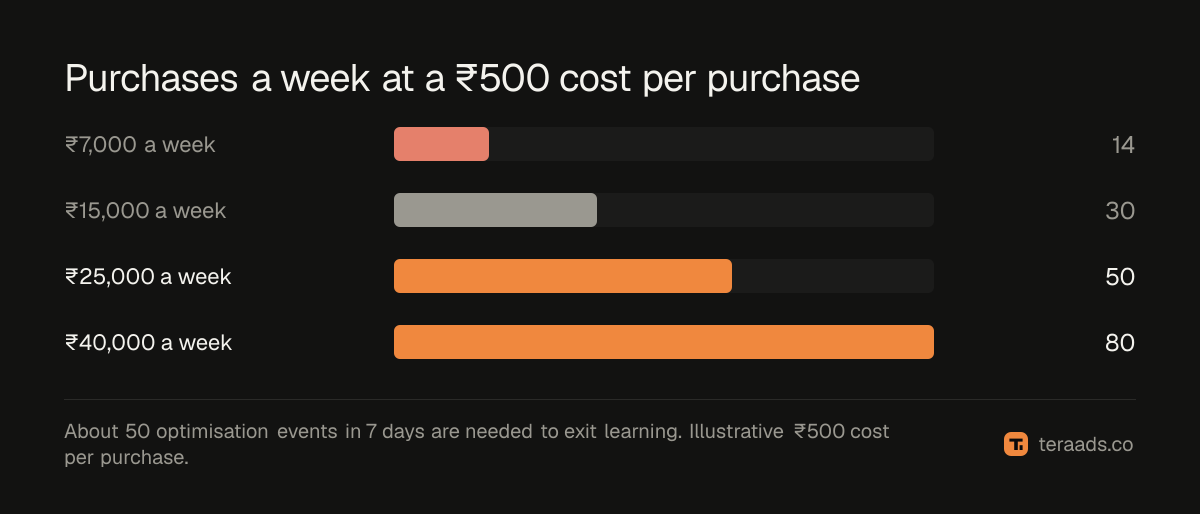
Meta's guidance, as widely reported from its Business Help Center, is that an ad set generally needs about 50 optimisation events within the seven days after its last significant edit to leave learning (PPC Land's learning phase explainer). Some advertisers have reported smaller thresholds in tests, so check what your own Ads Manager shows.
Two details matter:
- The events are the ones you optimise for. If the ad set optimises for purchases, 50 add-to-carts don't count.
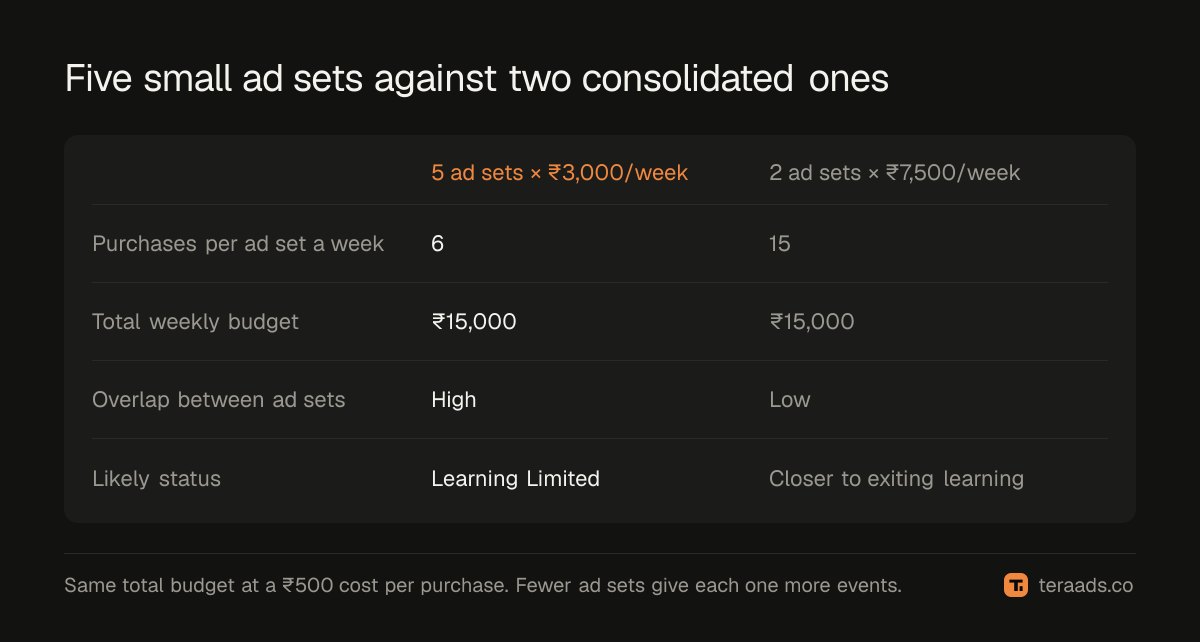
- It's per ad set. Five ad sets with 15 purchases each are five ad sets in learning, not one campaign out of it.
What resets learning
| Change | Usually restarts learning? |
|---|---|
| Changing targeting or audience | Yes |
| Changing or adding creative | Often (Meta lists adding a new ad as a significant edit) |
| Changing the optimisation event or bid strategy | Yes |
| Large budget change | Often, especially big jumps |
| Pausing for more than about seven days | Yes |
| Small budget tweaks | Usually not |
| Renaming the ad set | No |
The practical rule: batch your changes. Five small edits on five days can keep an ad set in learning all week; one planned edit on Monday lets it settle.
Why ad sets get stuck in Learning Limited
"Learning Limited" appears when Meta predicts the ad set won't get enough optimisation events. Common causes:
- Budget too small for your cost per purchase. If a purchase costs ₹500, you need about ₹25,000 a week (50 × ₹500) for one ad set to have a chance. A ₹500-a-day ad set won't get there.
- Too many ad sets splitting the budget. Ten ad sets at ₹1,000 a day learn worse than two at ₹5,000. Overlap makes it worse, as covered in the audience overlap guide.
- Audience too narrow. Small interest stacks or tight lookalikes run out of people to explore.
- Optimising for a rare event. If purchases are rare, consider a higher-volume event temporarily, accepting that it is a weaker signal.
- Constant edits. Every reset starts the count again.
How to exit learning faster
- Consolidate. Merge ad sets with the same goal into fewer, larger ones. This is the single biggest lever.
- Give each ad set enough budget. Weekly budget ≈ 50 × your expected cost per result, at minimum.
- Broaden targeting. Let Meta explore; broad or Advantage+ audiences usually learn faster than stacked interests.
- Make edits in batches. Plan changes weekly, not daily.
- Scale budgets in steps. Raising budget gradually is less disruptive than doubling it overnight.
- Keep creatives fresh in a planned way. Add new ads on a schedule, not in reaction to one bad day. See spotting creative fatigue.
Should you judge ads during learning?
Carefully. Costs during learning are typically higher and more volatile, so killing an ad set on day two often throws away the money spent teaching it. But "wait for learning" is not a reason to ignore an ad set that is clearly failing after a week of reasonable spend.
A balanced rule: give a new ad set at least a week, or about two to three times your target cost per purchase in spend, before deciding, and judge it on kept orders from Shopify rather than Ads Manager purchases alone. Meta counts purchases that are later cancelled or returned as RTO; true ROAS after RTO and COD shows how much that can matter.
Learning, frequency and fatigue
Learning is about the start of an ad set's life; fatigue is about the end of a creative's life. Both show up as rising costs, and they're easy to confuse. An ad set out of learning whose costs rise week after week, with frequency climbing, is usually fatigued, not "re-learning". The signs are in the frequency guide.
Tera Ads shows every Meta Ads and Google Ads campaign in one table with profit worked out from your Shopify orders after returns, and includes a Meta deep dive on funnel, audience overlap and creatives that still work. It is free for one business.
Frequently asked questions
How long does the Meta learning phase last?
Until the ad set gets about 50 optimisation events in the seven days after its last significant edit. For a well-funded ad set that can be two or three days; for a small one it may never end.
Does increasing budget reset the learning phase?
Large budget changes often do. Small, gradual increases usually don't. Scale in steps and avoid repeated big jumps.
Is Learning Limited bad?
It means the ad set is unlikely to get enough events to optimise well. It can still deliver results, but usually at a higher and less stable cost. Fix it by consolidating, adding budget or broadening targeting.
Does adding a new ad reset learning?
Meta lists adding a new ad to an ad set as a significant edit, although some advertisers report no reset in practice. Treat it as a possible reset and add new ads in planned batches.
Should I optimise for add-to-cart to exit learning faster?
Only as a temporary measure for very low-volume accounts. Add-to-cart is easier to get but a weaker signal for buyers; switch back to purchases once volume allows.