How to Scale Meta Ads Budgets Without Breaking Performance
Scaling Meta ads means spending more while keeping profit. Vertical vs horizontal scaling, how fast to raise budgets, what to watch, and when to stop.
On this page
Scaling Meta ads means raising spend on what works while keeping profit, and the main risk is that each extra rupee buys less than the last. Raise budgets on proven campaigns in steps, commonly around 20% every few days, rather than doubling overnight, and add new audiences and creatives alongside. Judge each step on kept orders and profit from Shopify, and stop when the extra spend no longer pays for itself.
Key takeaways
- Scale only campaigns that are profitable on kept orders, not just in Ads Manager.
- Vertical scaling raises budgets; horizontal scaling adds new audiences, creatives or campaigns.
- Raise budgets in steps; big jumps can restart learning and make costs swing.
- Watch marginal returns: what the last ₹10,000 bought, not the campaign average.
- Creative supply is usually the real limit on scale; plan for it before raising budgets.
Before you scale: is it really working?
Scaling a campaign that only looks profitable makes losses bigger. Check three things first:
- Profit on kept orders. Compare the campaign's UTM-tagged Shopify orders after cancellations and RTO with its spend. Its real ROAS should beat your break-even ROAS with room to spare.
- Stable results. At least a week or two of steady performance, out of the learning phase.
- New customers. A campaign that mostly reaches existing customers won't keep its results as it grows.
Vertical and horizontal scaling
| Vertical scaling | Horizontal scaling | |
|---|---|---|
| What you do | Raise budget on existing campaigns or ad sets | Add new audiences, creatives, campaigns or placements |
| Speed | Fast to do | Slower; needs new assets and testing |
| Main risk | Rising costs as the audience saturates; learning resets on big jumps | New tests may fail; more to manage |
| Best when | A campaign has headroom: broad audience, fresh creative | A campaign shows rising frequency or costs |
Most brands need both: vertical steps on campaigns with headroom, horizontal expansion to create new headroom.
How fast to raise budgets
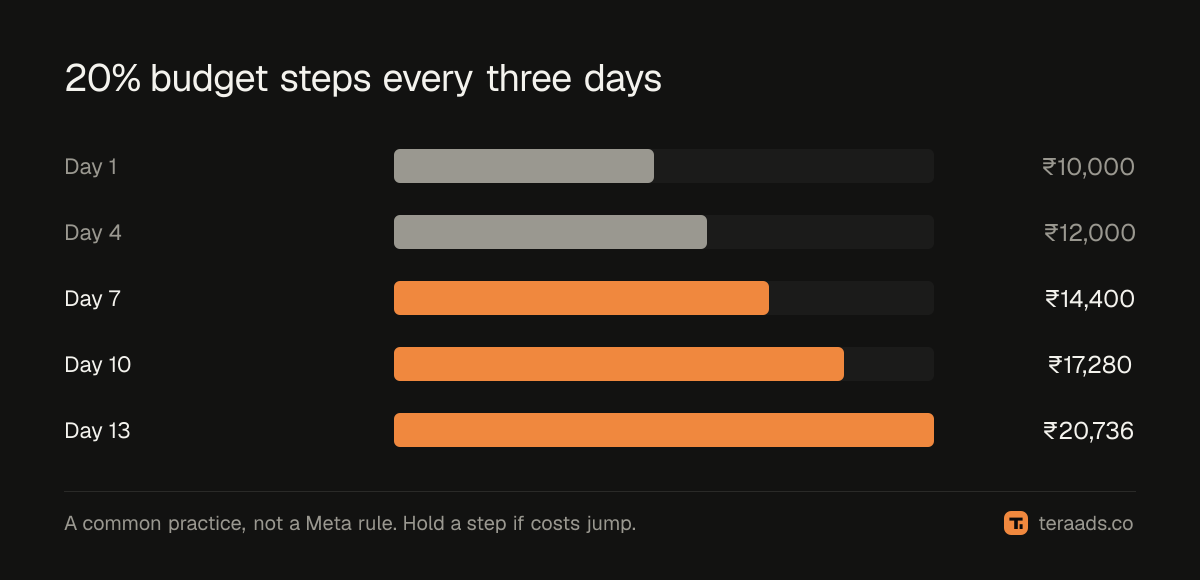
There's no official rule. A common practice is to raise budgets by about 20% at a time, every two to three days, and hold if costs jump. Large changes can count as significant edits and send an ad set back into learning, which raises costs for a while; see the learning phase guide.
Campaign budgets (CBO, now Advantage+ campaign budget) often absorb increases more smoothly than many small ad set budgets, because Meta can spread the extra money; CBO vs ABO covers the trade-offs.
Watch marginal returns, not averages
The campaign average hides what the extra spend is doing. If a campaign spent ₹10,000 a day at a 3.0x real ROAS, and now spends ₹15,000 at 2.6x, the average still looks fine. But the extra ₹5,000 brought in only about ₹9,000 (₹39,000 − ₹30,000), a 1.8x return on the increase. If your break-even ROAS is 2.5x, that last ₹5,000 is losing money.
| Daily spend | Real ROAS (kept orders) | Revenue | Extra revenue from the increase | Return on the increase |
|---|---|---|---|---|
| ₹10,000 | 3.0x | ₹30,000 | — | — |
| ₹12,000 | 2.9x | ₹34,800 | ₹4,800 | 2.4x |
| ₹15,000 | 2.6x | ₹39,000 | ₹4,200 | 1.4x |
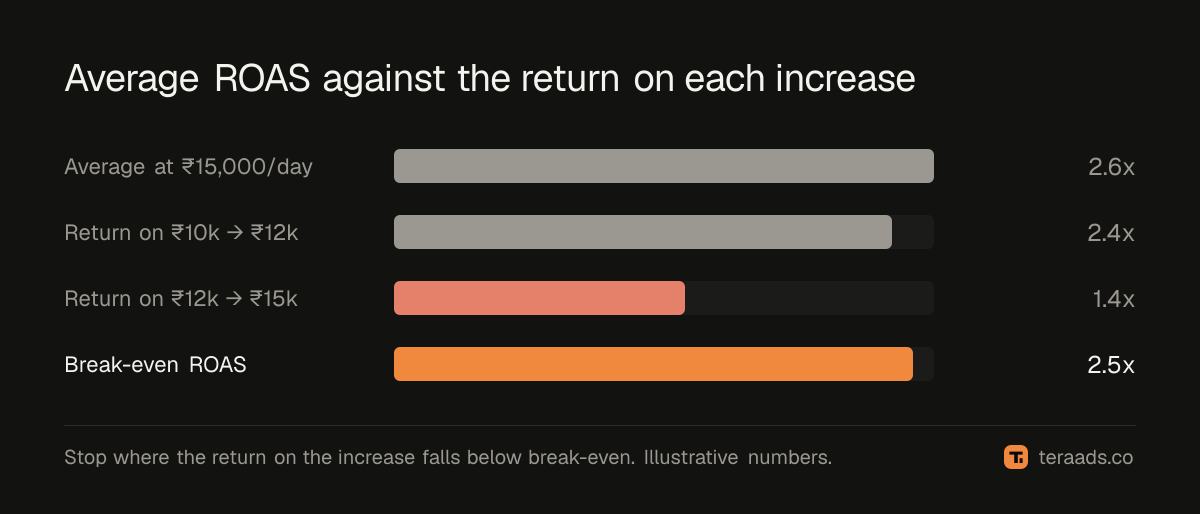
The point to stop scaling is where the return on the increase falls to your break-even, not where the average does.
Signs to pause scaling
- Cost per purchase rising for several days after an increase.
- Frequency climbing on prospecting ad sets.
- CTR falling across the campaign's ads.
- Real ROAS on kept orders falling faster than Ads Manager ROAS, often a sign of more impulse COD orders.
- Total Shopify revenue not rising in line with spend.
When you see these, hold the budget, add creative, or widen the audience before going further.
Creative is the real scaling limit
More budget means more impressions, which means more people seeing the same ads more often. Without new creative, results decay as you scale. Plan a creative pipeline before you plan the budget: new hooks, formats and angles every week or two. Horizontal scaling with new creative concepts is often more profitable than pushing more money through the same ads.
Scaling and total business results
Finally, check that scaling grows the business, not just Meta's reported numbers. When Meta spend rises 50%, does total Shopify revenue rise meaningfully? If not, the extra spend may be taking credit for sales other channels would have brought anyway. MER, total revenue divided by total ad spend, catches this; it falls when spend grows faster than sales.
A weekly scaling routine
Scaling works best as a habit rather than a one-off push:
- Monday: review last week on kept orders. For each campaign, real ROAS on UTM-tagged Shopify orders after cancellations and RTO, against break-even.
- Pick candidates. Campaigns comfortably above break-even, out of learning, with stable costs and healthy frequency.
- Raise in steps. One step on each candidate, then leave it alone for a few days.
- Add creative. New concepts into the campaigns you're scaling, before fatigue shows.
- Check totals. At the end of the week, did total Shopify revenue grow with total spend?
Write down each change and its date. When results move, you'll know what caused it, and you'll avoid stacking several edits that restart learning. Campaigns that keep earning more than break-even on each increase keep getting more; campaigns whose return on the increase falls below break-even go back to the previous budget.
Tera Ads shows every Meta Ads and Google Ads campaign in one table with profit worked out from your Shopify orders after returns, with Shopify sales and total ad spend on the same screen. It is free for one business.
Frequently asked questions
How much should I increase my Facebook ad budget at a time?
A common practice is about 20% every two to three days, holding if costs jump. There's no official rule; what matters is avoiding large swings that restart learning.
Does increasing budget reset the learning phase?
Large increases often do; small, gradual increases usually don't. Campaign-level budgets tend to absorb changes more smoothly.
What is horizontal scaling on Meta?
Growing spend by adding new audiences, creatives, campaigns or placements rather than raising budgets on existing ones.
When should I stop scaling a campaign?
When the return on each budget increase, measured on kept orders, falls to your break-even ROAS, even if the campaign average still looks profitable.
Why did my ROAS drop when I increased budget?
Extra spend reaches less responsive people and shows ads more often to the same people. Some decline is normal; a sharp drop means the audience or creative has run out of headroom.