Fake COD Orders: How to Spot Them and Stop Paying to Ship Them
Fake and prank cash-on-delivery orders cost two shipping legs each. The warning signs, simple checks before dispatch, and the rules that stop repeat offenders.
On this page
A fake COD order is a cash-on-delivery order placed with no intention of accepting it: pranks, competitors, made-up names, wrong numbers or duplicate test orders. Each one costs you shipping both ways, packaging and handling, and blocks stock for days. Most share warning signs you can check in seconds. Flag them automatically, confirm before dispatch, and block repeat offenders by phone number and address.
Key takeaways
- Fake orders are a slice of COD returns that confirmation catches cheaply, because nobody confirms them.
- Warning signs: odd names, incomplete addresses, unreachable numbers, repeat orders, mismatched details.
- Score orders on these signs and hold the risky ones until they're confirmed.
- Block repeat refusers by phone number and address, not just by email.
- Track how many orders you cancel as fake; it tells you whether your filters work.
Why fake orders happen
Cash on delivery costs the buyer nothing until delivery, so placing an order is free. That invites pranks, people testing whether a store is real, competitors wasting your shipping budget, and buyers entering someone else's address. Some orders are not malicious at all, just careless: duplicate orders placed twice by mistake, or wrong numbers.
Across Indian e-commerce, COD orders return to origin at about 26%, against under 2% for prepaid, according to Shipway's FY25 data (Shipway's FY25 RTO findings). Fake and careless orders are part of that gap, and the cheapest part to remove.
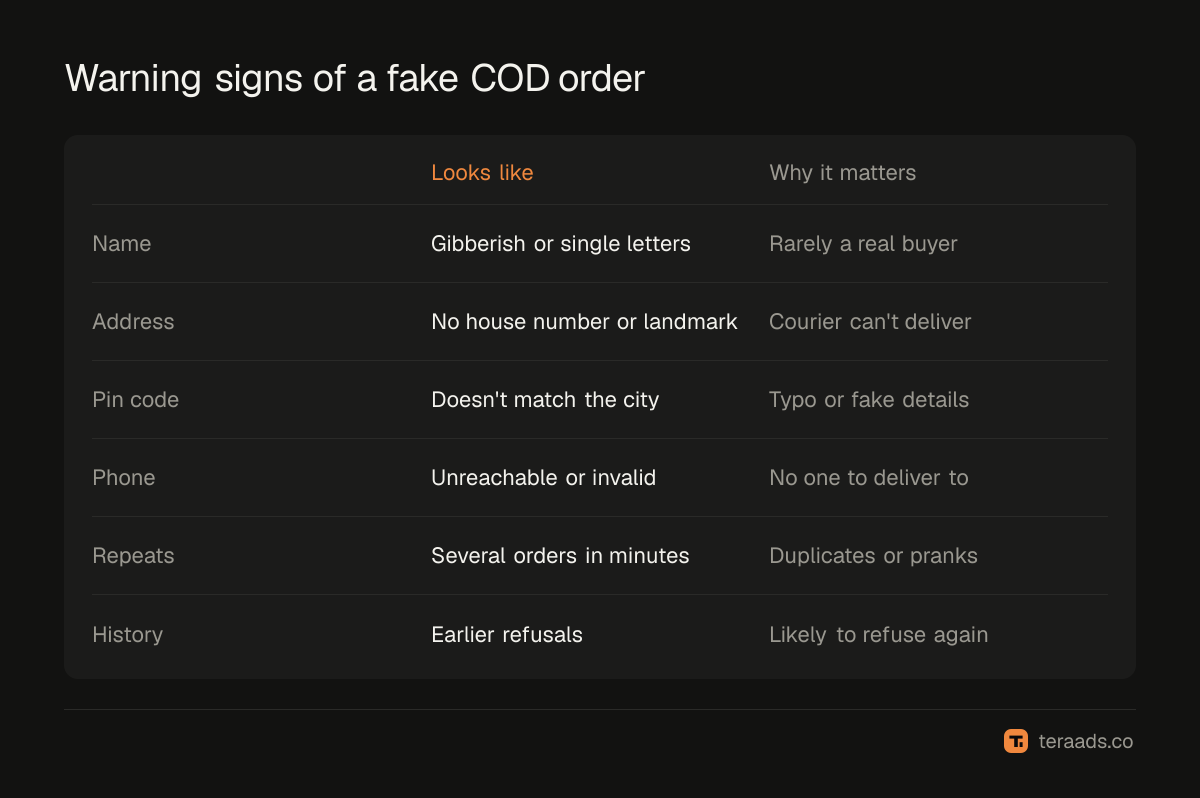
Warning signs
| Sign | Example | Why it matters |
|---|---|---|
| Unusual name | Single letters, celebrity names, gibberish | Pranks and tests rarely use real names |
| Incomplete address | No house number, no landmark, only a city | Couriers can't deliver; likely RTO |
| Pin code and city mismatch | Pin code belongs to another state | Typo or fake details |
| Unreachable number | Switched off, invalid or wrong digits | Courier can't contact the buyer |
| Repeat orders | Same number or address, several orders in minutes | Duplicates or pranks |
| Past refusals | Number or address with earlier RTOs | Repeat refusers |
| Unusual quantity | Ten units of one item, COD, first order | Rarely a genuine first purchase |
How to stop them, step by step
- Score every COD order. Give one point for each warning sign. Many COD and order-management apps for Shopify can flag risky orders automatically; a simple spreadsheet works at low volume.
- Hold risky orders. Orders above your score threshold stay unshipped until confirmed.
- Confirm by message, then call. Genuine buyers confirm; fake orders go silent. COD order confirmation covers the process.
- Ask for an advance on the riskiest. A small online payment through partial COD stops almost every prank, because pranksters won't pay.
- Block repeat offenders. Keep a list of phone numbers and addresses with repeated refusals or confirmed fake orders, and switch off COD for them.
- Review weekly. Check how many orders you cancelled as fake and whether any genuine buyers were caught; adjust the threshold.
Blocking without hurting genuine buyers
Be careful with blocks. A shared address such as a hostel or office may have one bad buyer and many good ones. Prefer blocking COD rather than blocking orders, so a genuine buyer can still pay online. Base blocks on evidence, such as repeated refusals or confirmed fake details, not on a single sign. And give staff a way to unblock a buyer who calls to complain.
Location-based patterns are a different problem; some areas return more for reasons that have nothing to do with fraud. Pin code RTO analysis explains how to handle those fairly.
What it saves
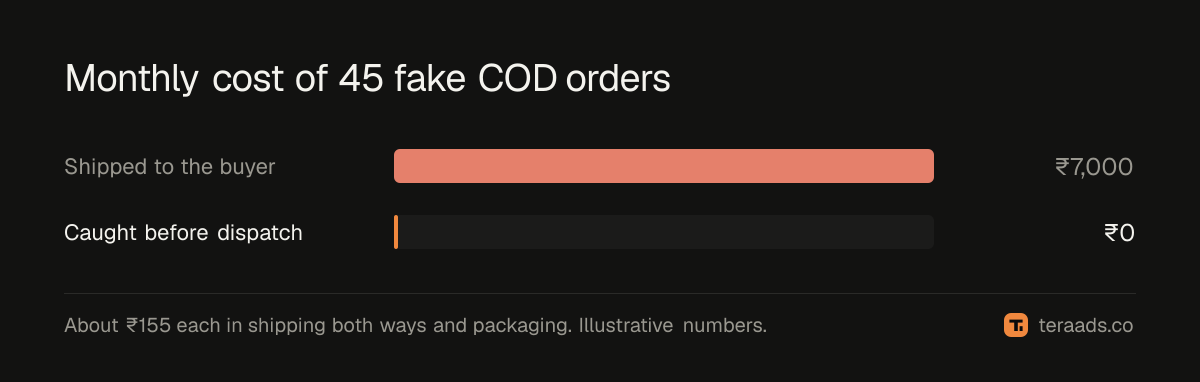
Take an illustrative brand shipping 1,500 COD orders a month, with ₹70 shipping each way and ₹15 packaging. If 3% of orders are fake or careless, that's 45 orders a month costing about ₹155 each in shipping and packaging, roughly ₹7,000 a month, before staff time and stock held in transit. Catching them before dispatch costs a message or a call each.
| Fake orders shipped | Fake orders caught before dispatch | |
|---|---|---|
| Orders | 45 a month | 45 a month |
| Shipping and packaging | About ₹7,000 | Nothing |
| Stock in transit | Several days per order | None |
| Effect on courier performance | More failed attempts on your account | None |
Keeping a blocklist
Most fake and careless orders come from a small number of phone numbers and addresses, so a simple blocklist stops them coming back. Keep it as a shared sheet or in your order confirmation tool, with the phone number, the address, the date and the reason, such as two refused deliveries or a prank confirmed on a call. Before dispatch, check new COD orders against it.
Be strict about what goes on the list. One refusal can be a genuine accident: the buyer was travelling, or a family member didn't know about the order. Two or more refusals, or a clear prank, are better reasons. For buyers on the list, you don't have to refuse the order outright; you can offer prepaid only, or ask for a small advance, which genuine buyers usually accept. Partial COD explains how advance payments work. Review the list every few months and remove old entries, so a number that has changed hands doesn't stay blocked forever.
Common mistakes
Relying on email blocks. Fake buyers change emails easily; phone numbers and addresses are better identifiers.
Shipping unconfirmed orders anyway. If risky orders ship on the same schedule, the scoring saves nothing.
Over-blocking. Blocking whole pin codes or every first-time buyer loses genuine orders. Block COD for specific numbers and addresses with evidence.
Not measuring. Without a count of cancelled fake orders, you can't tell whether your filters work or are too strict.
Tera Ads shows profit after returns from your Shopify orders, RTO from Shiprocket and ad spend from Meta Ads and Google Ads, with each RTO counted in the month the order was placed. It is free for one business.
Frequently asked questions
How do I know if a COD order is fake?
Look for warning signs: odd names, incomplete addresses, mismatched pin codes, unreachable numbers, repeat orders and past refusals. Then confirm with the buyer before dispatch; fake orders don't confirm.
Can I block a customer from using COD on Shopify?
Many COD and checkout apps let you block COD by phone number, email, address or pin code. The buyer can still pay online.
Do competitors really place fake orders?
It happens occasionally, but most fake orders are pranks, tests or careless duplicates. The same checks catch all of them.
Is partial COD enough to stop fake orders?
It stops most, because pranksters won't pay an advance. Combine it with confirmation for orders that still look risky.
Should I report fake orders to the courier?
Tell your shipping platform or courier when an address or number repeatedly refuses; some keep their own lists. Mainly, stop the order before it ships.