Partial COD: Take a Small Advance and Cut Cash-on-Delivery Returns
Partial COD asks buyers to pay a small advance online and the rest on delivery. How it lowers RTO, how big the advance should be, and how to test it without losing sales.
On this page
Partial COD is a checkout option where the buyer pays a small advance online and the rest in cash on delivery. It sits between full COD and prepaid: buyers who don't fully trust a new brand still keep most of their money until the parcel arrives, but having paid something, they are far less likely to refuse it. The advance also covers some of your shipping cost if they do.
Key takeaways
- Partial COD keeps the comfort of COD while giving the buyer a stake in accepting the parcel.
- The advance can be a fixed token amount or a share of the order; small and round works best.
- It filters out fake and impulse orders, which rarely pay an advance.
- Test it against full COD on a share of traffic and measure kept orders, not just orders placed.
- Combine it with order confirmation and a prepaid incentive rather than relying on one fix.
Why partial COD works
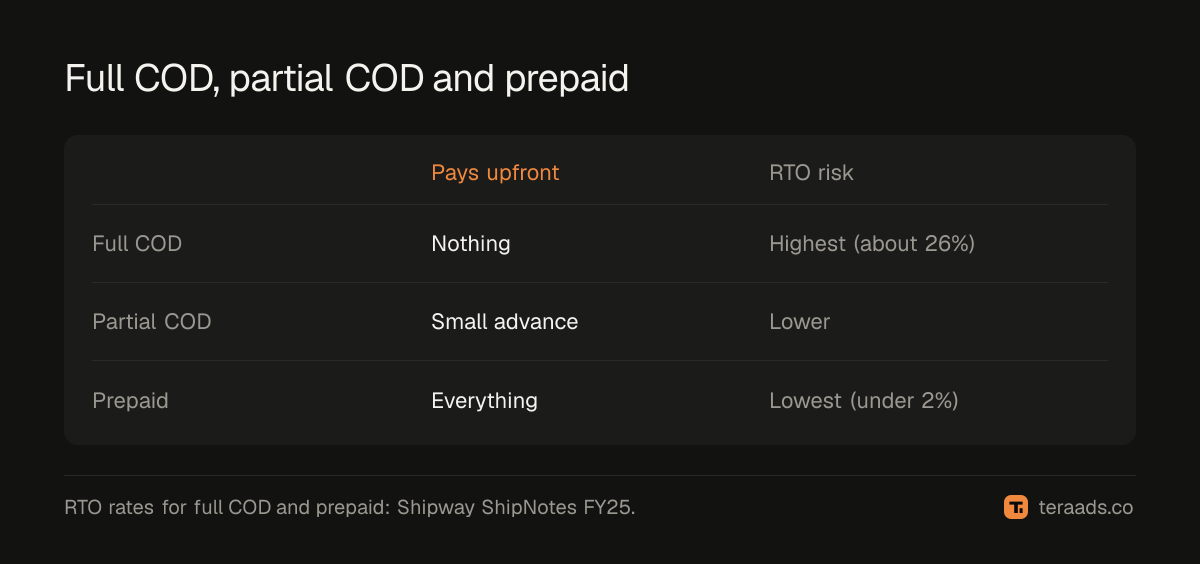
Full COD carries no commitment. A buyer can order on impulse, forget, and refuse at the door at no cost. Shipway's FY25 data puts COD orders at about 26% RTO against under 2% for prepaid (Shipway's FY25 RTO findings), and many of those returns come from orders that were never serious.
Paying even a small amount changes behaviour. The buyer has made a decision, entered payment details and has money to lose. Fake orders and pranks largely disappear, because they don't survive a payment step. And if the parcel still comes back, the advance offsets part of your cost.
Full COD, partial COD and prepaid
| Full COD | Partial COD | Prepaid | |
|---|---|---|---|
| Buyer pays upfront | Nothing | A small advance | Everything |
| Trust needed from buyer | Lowest | Low | Highest |
| Fake and impulse orders | Common | Rare | Rare |
| RTO risk | Highest | Lower | Lowest |
| Your cost if returned | Two shipping legs and packaging | Partly covered by the advance | Rare |
| Conversion at checkout | Highest | Slightly lower | Lower for new brands |
How big should the advance be?
Big enough to signal commitment, small enough not to feel like full prepayment. Common approaches:
- A fixed token amount, such as ₹99 or ₹149, the same for every order. Simple to explain and easy for buyers to accept.
- A share of the order, such as 10% to 20%. Scales with value, but awkward amounts can feel fussy.
- Shipping cost as the advance: "Pay ₹99 shipping now, the rest on delivery." It frames the advance as something the buyer understands.
Start with a fixed amount near your forward shipping cost. If the parcel comes back, the advance roughly covers one leg.
A worked example
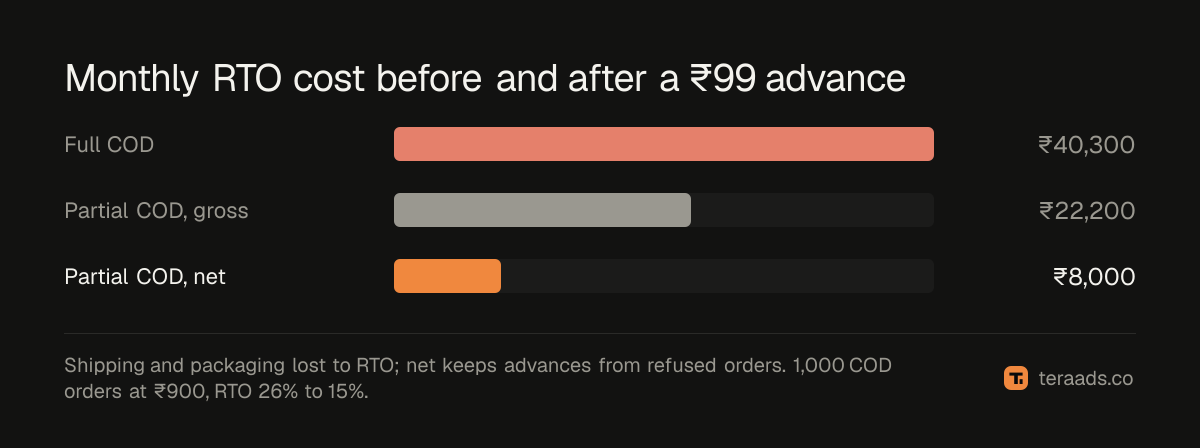
Take 1,000 COD orders a month at ₹900 each, with ₹70 shipping each way and ₹15 packaging, and a 26% RTO rate. RTO costs about 260 × ₹155 ≈ ₹40,300 a month in shipping and packaging, before lost revenue and damaged stock.
Suppose a ₹99 advance cuts the RTO rate on those orders to 15%, and 5% of buyers drop off at checkout. Now 950 orders, 143 returns, costing about ₹22,200, and the advances on returned orders bring in about ₹14,200 if you keep them. Net RTO cost falls from about ₹40,300 to about ₹8,000, and you deliver about 807 orders instead of 740.
These numbers are illustrative; the point is that a modest drop in RTO more than pays for a small fall in checkout conversion. Run your own figures with the RTO cost calculator.
Setting it up
- Pick a payment tool that supports it. Several Shopify checkout and COD apps, and payment gateways, offer partial payment options. Check fees and how refunds of the advance work.
- Write a clear refund policy. Say whether the advance is refunded, kept or credited if the buyer cancels or refuses. Show it at checkout.
- Explain it in one line. "Pay ₹99 now, the rest when it arrives" at checkout and on the product page.
- Test on part of your traffic. Offer partial COD to a share of buyers, or in high-RTO pin codes first, and compare.
- Measure kept orders. Compare delivered orders, RTO rate and revenue kept, not just orders placed.
Where partial COD fits
Partial COD is one of several levers. Confirmation calls and messages catch bad orders after checkout (COD order confirmation); prepaid incentives move some buyers fully online; fast delivery and quick NDR follow-up reduce returns on the orders you ship. The COD vs prepaid guide shows how these combine. With COD still about 60–65% of Indian e-commerce orders (Razorpay on cash on delivery), most brands need several of them at once.
Common mistakes
An advance that's too large. Asking for a big share of the order turns partial COD into prepaid, and buyers who wanted COD leave. Keep it small and round.
Unclear refund rules. Buyers who don't know whether they'll get the advance back hesitate. State the policy in one line at checkout.
Offering it everywhere at once. Start where RTO is highest, using your own pin code analysis, and measure before rolling it out to every buyer.
Measuring orders, not kept orders. Partial COD will lower orders placed a little. The real result is in delivered orders and RTO, which take weeks to settle.
Forgetting the courier. If the courier still makes slow or fake attempts, buyers who paid an advance get frustrated. Pair partial COD with fast dispatch and quick NDR follow-up, as covered in the NDR guide.
Tera Ads shows profit after returns from your Shopify orders, RTO from Shiprocket and ad spend from Meta Ads and Google Ads, with each RTO counted in the month the order was placed. It is free for one business.
Frequently asked questions
What is partial COD?
A payment option where the buyer pays part of the order value online at checkout and the rest in cash on delivery.
Does partial COD reduce conversions?
Some buyers drop off at the payment step, but the orders you keep are much more likely to be accepted. Test it and compare delivered orders and revenue kept, not just orders placed.
Should the advance be refundable?
Decide and say so clearly at checkout. Many brands refund the advance on cancellations before dispatch and keep or credit it on refusals at the door. Check consumer rules and your payment provider's terms.
How much should the advance be?
A small fixed amount, often close to your forward shipping cost, is easiest for buyers to accept. Test a couple of amounts rather than guessing.
Is partial COD better than a COD fee?
They do different things. A COD fee charges for the convenience; partial COD asks for commitment. Partial COD tends to cut fake and impulse orders more directly.