Free Shipping Threshold: How to Set One That Raises Profit
A free shipping threshold nudges buyers to add more to the cart. How to pick the number from your order data, what it costs, and how to test it.
On this page
A free shipping threshold offers free delivery on orders above a set value, such as ₹999, so buyers just below it add another item. Set it a little above your current typical order value, often around 20–30% higher, where the extra margin from bigger carts covers the shipping you give away. Test it against your current setup and judge it on contribution margin per order, not on conversion rate alone.
Key takeaways
- A threshold works by moving orders that sit just below it up past it.
- Start around 20–30% above your typical order value, then test.
- The cost is shipping on orders already above the threshold; the gain is margin on extra items.
- Measure contribution margin per visitor, not just conversion rate or order value.
- Suggest add-ons that bridge the gap, so buyers can reach the threshold easily.
How a threshold works
Most buyers dislike paying for shipping. A threshold turns that dislike into a reason to buy more: if the cart is ₹780 and delivery is free above ₹999, a ₹249 add-on feels like it costs nothing extra. Orders cluster just above the threshold once it's set.
It has a cost too. Buyers who already ordered above the threshold now get free shipping they would have paid for, and a threshold set too high can put off buyers who only want one item.
Picking the number
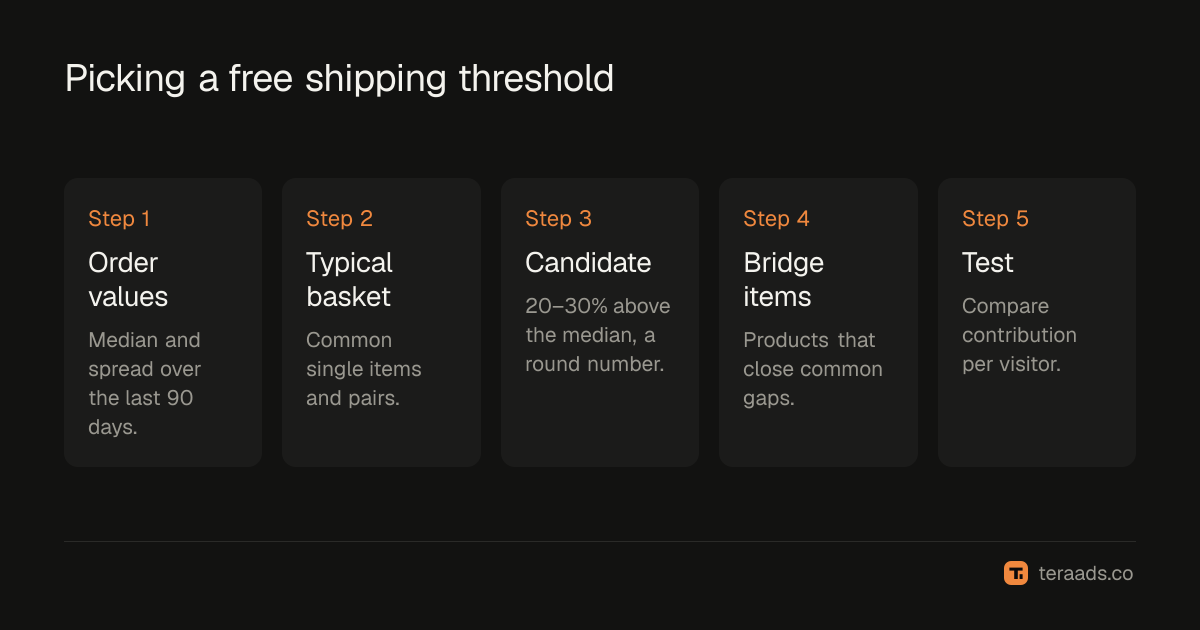
- Look at your order values. Export the last 90 days of orders and find the median order value and the spread.
- Find your typical basket. Note the price of your most common single item and common pairs.
- Set a candidate threshold. About 20–30% above the median order value, at a round number, close to the price of a typical two-item order.
- Check the gap. Make sure there are products priced to bridge the gap from common single-item orders.
- Test it. Run it for a few weeks against your previous setup, or on part of your traffic, and compare.
The economics, worked through
An illustrative brand with a median order value of ₹800, 50% CM1 margin, and ₹70 shipping per order sets a threshold at ₹999.
| Before (₹49 shipping on every order) | With free shipping above ₹999 | |
|---|---|---|
| Orders per 1,000 visitors | 20 | 19 |
| Average order value | ₹820 | ₹980 |
| Product margin per order (50%) | ₹410 | ₹490 |
| Shipping paid by you | ₹70 on all orders | ₹70 on all orders |
| Shipping charged to buyer | ₹49 on all orders | ₹49 only below ₹999 (about 30% of orders) |
| Contribution per order | ₹389 | ₹435 |
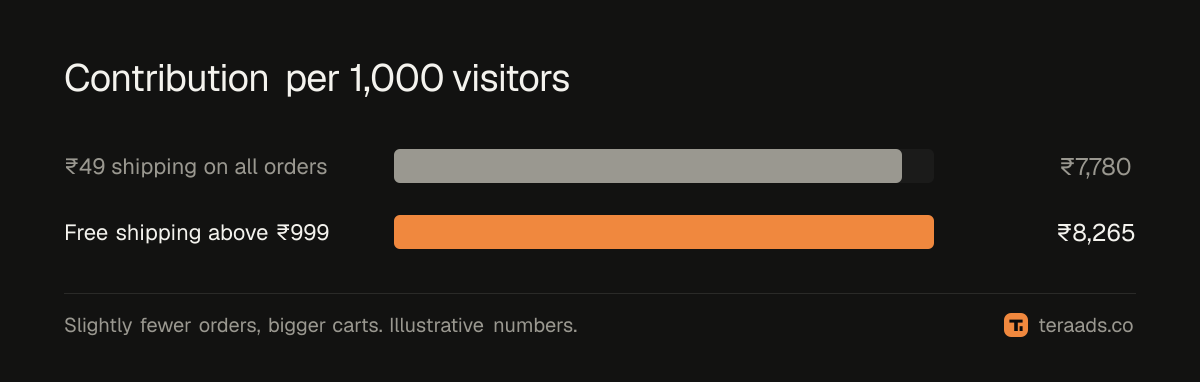
| Contribution per 1,000 visitors | ₹7,780 | ₹8,265 |
Conversion dipped slightly, but bigger carts lifted contribution per visitor by about 6%. Your numbers will differ; the method is what matters: compare contribution per visitor, not conversion rate or order value alone. Contribution margin explains which costs to include.
Helping buyers reach the threshold
- Show progress in the cart: "Add ₹219 more for free delivery."
- Suggest bridge products priced near common gaps: small accessories, refills, gift wrap.
- Bundle popular pairs so a single click clears the threshold.
- Keep it visible on product pages and the cart, not hidden in shipping policies.
Thresholds, COD and RTO
In India, bigger carts on cash on delivery can mean bigger losses when a parcel comes back. Watch RTO on threshold orders; if larger COD orders return more often, consider offering free shipping only on prepaid orders, or a lower threshold for prepaid. The COD vs prepaid guide covers how to price COD honestly.
Thresholds and ad targets
A higher average order value improves the economics of every ad. With more margin per order, your break-even cost per purchase rises, and campaigns that were marginal can become profitable. It also lowers effective acquisition cost per rupee of margin; see blended CAC. Update your ad targets after a threshold change rather than judging new results against old targets.
Common mistakes
Setting it too high. A threshold far above what most buyers spend doesn't change behaviour; buyers simply pay for shipping or leave. If few orders cluster just above the threshold after a few weeks, it's probably too high.
No bridge products. If your cheapest add-on costs more than the typical gap, buyers can't reach the threshold without a big jump. Low-priced accessories, refills or gift wrap make it easy.
Judging on order value alone. Average order value always rises with a threshold. The question is whether contribution per visitor rises too, after the shipping you give away and any fall in conversion.
Ignoring returns. Buyers who add items only to reach the threshold may return or refuse more often. Check RTO and return rates on threshold orders after the test.
Forgetting the ads. Ad platforms optimise to purchase value. A higher order value changes the targets that make sense, so revisit cost-per-purchase limits and ROAS targets after the change.
Communicating the threshold
A threshold only works if buyers know about it before checkout. Show it in a slim bar at the top of the site, repeat it on product pages near the price, and show progress in the cart. Use a concrete number ("Free delivery above ₹999") rather than vague wording. If you run ads with a free shipping message, make sure the landing page shows the same condition, so buyers aren't surprised at checkout. Surprises at checkout raise cart abandonment and, for cash-on-delivery orders, refusals at the door.
Tera Ads shows profit after ad spend and returns on one screen, from your Shopify orders, your Meta Ads and Google Ads spend, and RTO from Shiprocket, free for one business.
Frequently asked questions
What is a good free shipping threshold?
A common starting point is 20–30% above your median order value, at a round number reachable with a typical second item. Test it and keep the version with the best contribution per visitor.
Does free shipping increase conversion?
Usually, but a threshold mainly works by raising order value. Some buyers with small orders may leave, so measure contribution per visitor rather than conversion alone.
Should I offer free shipping on all orders instead?
Only if your margins can absorb shipping on every order. Many brands build shipping into prices instead; test both against contribution per visitor.
Should free shipping apply to COD orders?
Consider limiting it to prepaid orders, or setting a higher COD threshold, if larger COD orders return more often.
How long should I test a free shipping threshold?
At least two to four weeks, and long enough to include RTO outcomes on COD orders, so the comparison reflects kept orders.