COD vs Prepaid Orders: The Real Cost Difference for Indian D2C Brands
Cash on delivery sells more but returns far more. What a COD order really costs against a prepaid one, and the nudges that move buyers to prepaid without losing sales.
On this page
A cash-on-delivery order costs an Indian D2C brand far more than a prepaid one, because COD orders are returned to origin much more often. Shipway's FY25 data puts RTO at about 26% for COD orders against under 2% for prepaid. Each RTO costs shipping both ways, packaging and often damaged stock, so the same ₹800 COD order can be worth much less than a prepaid one. Keep COD, but price and nudge it honestly.
Key takeaways
- COD returns to origin roughly ten times more often than prepaid, per Shipway's FY25 data.
- COD is still most of Indian e-commerce orders, so switching it off usually costs sales.
- The real cost of COD is expected RTO loss plus COD fees, spread across every COD order.
- Prepaid discounts, partial COD and order confirmation move the mix without losing most buyers.
- Measure ad performance on kept orders, because COD inflates ROAS in Ads Manager.
Why COD still dominates
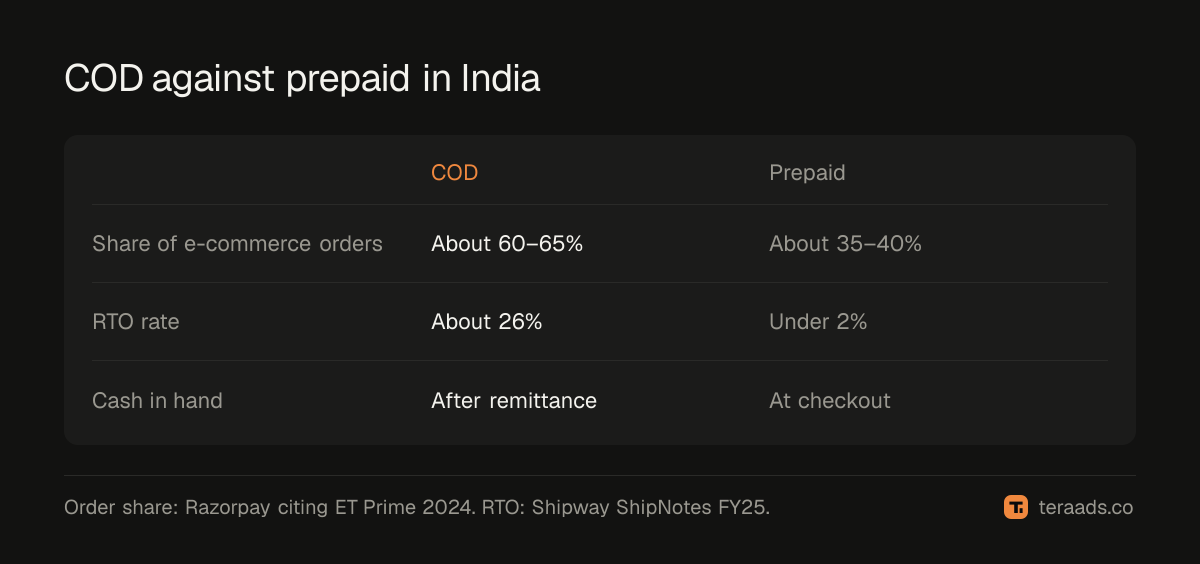
Indian shoppers use COD because it removes risk: they don't pay until the parcel arrives, and they don't need to trust a new brand with their card. Razorpay, citing ET Prime, puts COD at about 60–65% of Indian e-commerce orders (Razorpay on cash on delivery). For new D2C brands without a known name, the share can be even higher.
That's why simply turning off COD is rarely the answer. It cuts RTO, but it also cuts orders from buyers who would have paid and kept the product.
The return gap
Shipway's ShipNotes FY25 analysis of shipments found COD orders were returned to origin at about 26%, against under 2% for prepaid orders (Shipway's FY25 RTO findings). Your numbers will differ by category, region and courier, but the gap is large everywhere.
| COD | Prepaid | |
|---|---|---|
| Share of Indian e-commerce orders | About 60–65% | About 35–40% |
| RTO rate (Shipway FY25) | About 26% | Under 2% |
| Cash in hand | After delivery and remittance | At checkout |
| Extra fees | COD handling fee per order | Payment gateway fee |
| Fake or impulse orders | Common | Rare |
What a COD order really costs
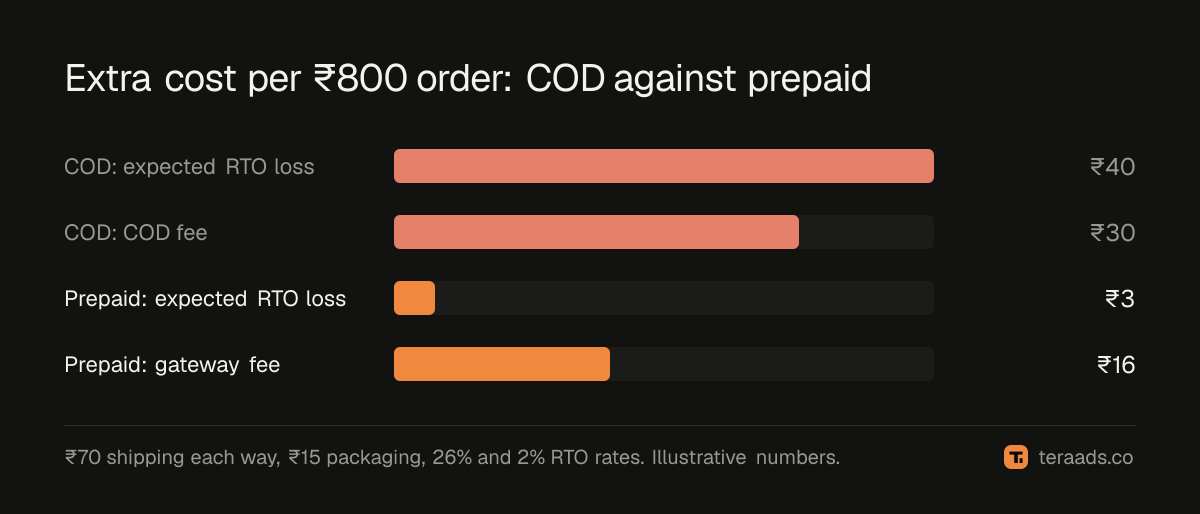
Take an illustrative ₹800 order with a ₹320 product cost. Forward shipping is ₹70, the return leg on an RTO is another ₹70, packaging is ₹15, and the COD fee is ₹30. A prepaid order pays a gateway fee of about ₹16 (2%) instead.
On a prepaid order with a 2% RTO rate, expected RTO loss is small: 2% × (₹70 + ₹70 + ₹15) ≈ ₹3.
On a COD order with a 26% RTO rate, expected RTO loss is 26% × ₹155 ≈ ₹40, before counting stock damaged in transit. Add the ₹30 COD fee and each COD order carries about ₹70 of RTO risk and fees, against about ₹19 for a prepaid order (₹3 of RTO risk plus the ₹16 gateway fee). The difference, about ₹51 an order, adds up to about ₹51,000 a month across 1,000 COD orders.
The RTO cost calculator works this through line by line with your own numbers.
How to move buyers to prepaid
Prepaid discount
A small discount for paying online, such as 5% or a fixed ₹50, is the most common nudge. It costs margin on every prepaid order, including buyers who would have paid online anyway, so test the smallest discount that moves the mix.
COD fee
Charging a small COD fee does the same job from the other side. It is honest, because COD really does cost more, but it can feel like a penalty. Frame it as a handling fee and keep it modest.
Partial COD
Ask for a small advance online (often a fixed token amount) and the rest on delivery. A buyer who has paid something is much less likely to refuse the parcel.
Order confirmation
Confirm COD orders by call, SMS or WhatsApp before dispatch. Unconfirmed orders can be held or cancelled before you pay to ship them. This catches fake and impulse orders cheaply.
Limit COD where it fails
Some pin codes, order values and repeat refusers return far more often. Switching off COD only for those keeps most of the sales and removes much of the loss.
The RTO reduction guide covers these and the delivery-side fixes, including fast handling of failed attempts, explained in the NDR guide.
COD and your ad numbers
Ad platforms count a COD purchase the moment the order is placed. If a quarter of those orders come back, the platform's ROAS overstates what you keep. Campaigns that attract impulse COD buyers can look like winners while losing money. Measure each campaign on kept orders; true ROAS after RTO and COD shows how.
Tracking your own COD numbers
Benchmarks are a starting point. The numbers that decide your COD policy are your own, tracked monthly:
- COD share of orders, overall and by campaign.
- RTO rate for COD and prepaid, separately.
- RTO rate by pin code and order value, to find where COD fails.
- Prepaid conversion after a nudge, to see whether a discount or fee is working.
Tera Ads shows profit after returns from your Shopify orders, RTO from Shiprocket and ad spend from Meta Ads and Google Ads, with each RTO counted in the month the order was placed. It is free for one business.
Frequently asked questions
Should I stop offering COD?
Usually not. COD is most of Indian e-commerce orders, and turning it off costs sales. Price it honestly, nudge buyers to prepaid, and limit COD only where it consistently fails.
What is a good prepaid share for a D2C brand?
It depends on category, price and how well known the brand is. Track your own share over time and aim to raise it steadily with incentives, rather than chasing a benchmark.
Does a prepaid discount pay for itself?
It does when the RTO savings and lower fees on switched orders exceed the discount given to buyers who would have paid online anyway. Test a small discount and measure kept orders, not just order count.
What is partial COD?
The buyer pays a small amount online at checkout and the rest in cash on delivery. The advance makes refusals much less likely.
Why is my COD RTO rate higher than average?
Common causes are slow delivery, impulse buyers from broad ads, high-RTO regions, unclear product pages and no order confirmation. Check RTO by campaign, pin code and days to first delivery attempt.