Lookalike Audiences on Meta: Do They Still Work, and How to Build Them
Lookalike audiences find people similar to your best customers. How to pick a source and size, how they compare with broad targeting, and how to test them.
On this page
A lookalike audience is a group of people Meta judges similar to a source audience you provide, such as your best customers. They were once the core of Meta prospecting. Today broad targeting and Advantage+ audiences often match or beat them, because Meta's delivery system finds similar people on its own. Lookalikes still help as a signal, especially from a high-value customer list, but test them against broad rather than assuming they win.
Key takeaways
- The source matters most: a list of your best customers beats all visitors or all buyers.
- Meta requires a source of at least 100 people from one country and suggests larger sources for better matches.
- Smaller percentages are closer matches; larger ones reach more people but look less like your source.
- In Advantage+ campaigns, audiences like lookalikes act more as suggestions than hard limits.
- Test lookalikes against broad targeting on kept orders before committing budget.
How lookalikes work
You give Meta a source: a customer list, a pixel audience such as purchasers, or an engagement audience. Meta finds people in a chosen country whose characteristics and behaviour resemble the source. You choose a size from 1% to 10% of that country's eligible users; 1% is the closest match, 10% the broadest.
Meta's rules require a source of at least 100 people from a single country, and larger sources usually produce better matches. In India, even a 1% lookalike is millions of people, so size is rarely the constraint; quality of the source is.
Choosing a source
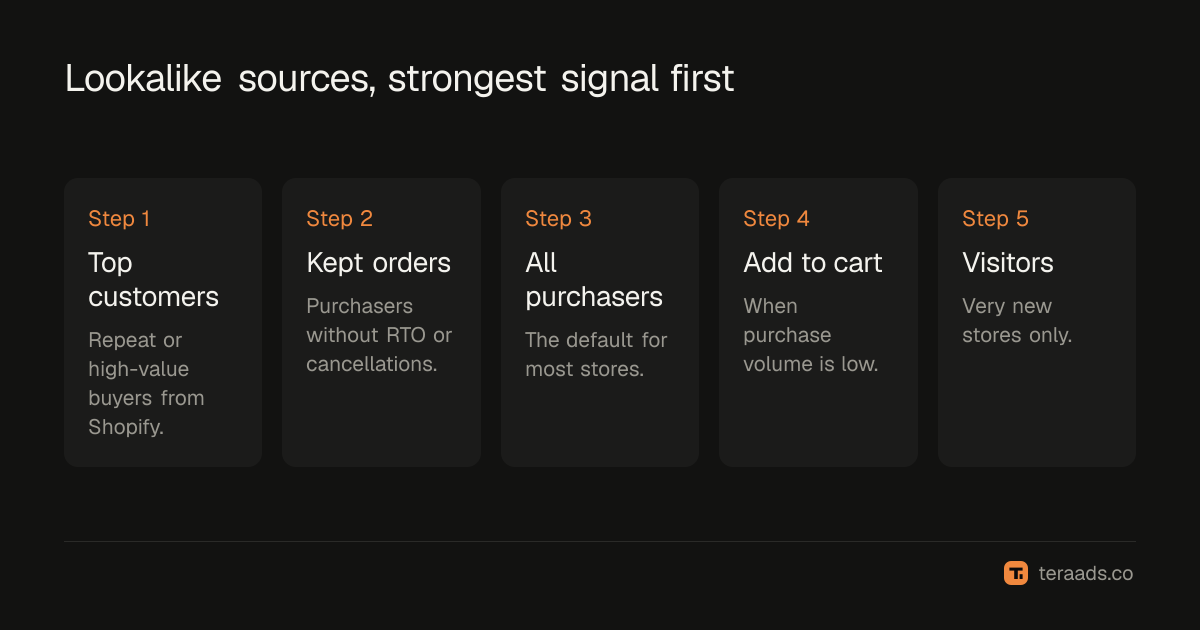
| Source | Quality of signal | When to use |
|---|---|---|
| Top customers by value (CSV from Shopify) | Highest | You have a few hundred or more repeat or high-value buyers |
| All purchasers (pixel or list) | High | Default choice for most stores |
| Kept orders only (no RTO, no cancellations) | High, and avoids impulse buyers | COD-heavy stores where returns distort "purchasers" |
| Add to cart | Medium | Low purchase volume |
| Site visitors or engagers | Low | Very new stores only |
For Indian COD stores, building the source from customers who accepted their orders matters. A lookalike of all purchasers includes people who refused delivery; Meta will happily find more of them.
Lookalikes vs broad and Advantage+ audiences
Meta's delivery system has become good at finding buyers from broad targeting, using conversion data from your pixel and Conversions API. With Advantage+ audiences, the audiences you add, including lookalikes, are treated as suggestions that Meta can go beyond when it finds better results. That narrows the gap between lookalikes and broad.
| Lookalike | Broad / Advantage+ audience | |
|---|---|---|
| Starting signal | Your chosen source | Pixel and conversion data |
| Reach | Fixed by percentage | As wide as the country and filters allow |
| Learning speed | Can be faster for new pixels | Faster with plenty of conversion data |
| Control | More | Less |
| Best for | New accounts, high-value seed lists | Accounts with strong conversion data |
How to test lookalikes
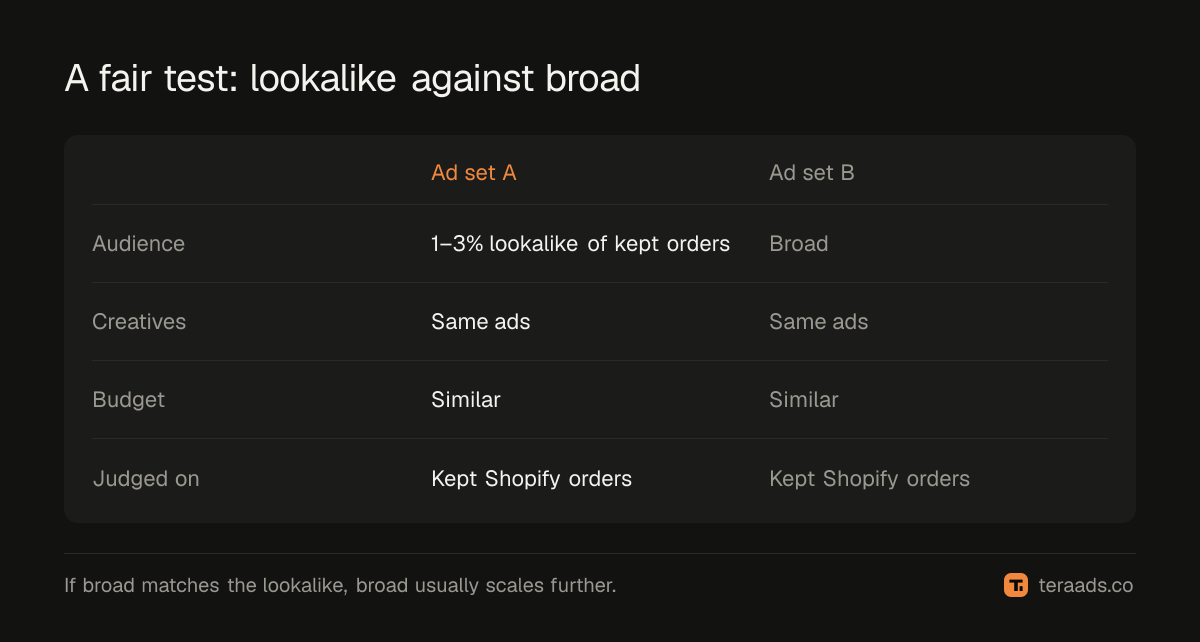
- Build one strong lookalike from your best customers or kept orders, at 1–3%.
- Run it against broad in separate ad sets with the same creatives and similar budgets, or as a suggestion inside an Advantage+ audience compared with no suggestion.
- Give it time. Each ad set needs enough conversions to exit learning; see the learning phase guide.
- Judge on kept orders. Compare UTM-tagged Shopify orders after cancellations and RTO, not just Ads Manager purchases.
- Keep the winner. If broad matches the lookalike, broad usually scales further.
Avoid overlapping lookalikes
Running 1%, 2–3% and 4–5% lookalikes from the same source in separate ad sets often means the ad sets bid against each other for overlapping people. Combine them or use one range. The audience overlap guide shows how to check.
Value-based lookalikes and fresh sources
If you upload a customer list with a value column, such as each customer's total spend, Meta can build a value-based lookalike that leans toward people similar to your highest-value buyers. It's worth trying when spend varies a lot between customers, for example when some buy a single item and others buy sets. Use the value of kept orders, so customers who refused delivery count as zero.
Sources go stale. A list exported a year ago doesn't include your recent best customers, and your range may have changed since. Refresh uploaded lists every month or two; pixel-based sources update by themselves. Updating the existing customer list, rather than uploading a new one each time, keeps the lookalikes built on it current without starting new ad sets.
Keep lookalikes in proportion. They're one way of telling Meta who to look for, and with strong conversion data, broad targeting often does just as well. For new accounts, small catalogues or high-value seed lists, a good lookalike can still speed up the early weeks. The test above is the only reliable way to know which applies to your account.
Common mistakes
Weak sources. All visitors or all engagers produce weak lookalikes; use purchasers or your best customers.
Including returned orders. For COD stores, a lookalike of everyone who ordered includes buyers who refused delivery.
Stale lists. Refresh customer-list sources every few months as your customer base grows.
Too many small ad sets. Several lookalike ad sets splitting a small budget keeps all of them in learning.
Assuming lookalikes always win. Test against broad; many accounts find broad matches or beats them.
Lookalikes are one input to prospecting. Fresh creative usually matters more; the Advantage+ Sales guide covers how automated campaigns use audience suggestions.
Tera Ads shows every Meta Ads and Google Ads campaign in one table with profit worked out from your Shopify orders after returns, and its Meta deep dive covers funnel, audience overlap and creatives that still work. It is free for one business.
Frequently asked questions
Do lookalike audiences still work in 2026?
They can, especially from strong customer lists, but broad targeting and Advantage+ audiences often perform as well for accounts with good conversion data. Test both.
What is the best lookalike percentage?
Start with 1–3% for the closest match. In large countries such as India, even 1% is a big audience, so wider percentages are rarely needed.
How big should my source audience be?
Meta requires at least 100 people from one country; larger sources of real customers, ideally in the thousands, usually produce better matches.
Should I use value-based lookalikes?
If you can upload customer value, value-based lookalikes help Meta find people similar to your best buyers rather than all buyers.
How often should I refresh a lookalike source?
Every few months for customer lists. Pixel-based sources update automatically.