Meta Ads CPM in India: What Drives It and When It Actually Matters
CPM is what Meta charges per 1,000 impressions. What pushes it up in India, why cost per order matters more, and how to tell whether a CPM rise is hurting you.
On this page
CPM is what you pay Meta for 1,000 impressions, and in India it moves with competition for your audience, the season, your placements and how engaging your ads are. It's only one link in the chain: cost per order equals CPM divided by how many impressions turn into clicks and then purchases. A higher CPM with better click and conversion rates can still mean cheaper orders. Watch CPM as a diagnostic, but judge campaigns on cost per kept order.
Key takeaways
- Cost per order = CPM ÷ (1,000 × click-through rate × conversion rate).
- CPM rises when more advertisers want the same people, such as during festivals, and when your audience is narrow.
- Ads that people engage with tend to win auctions more cheaply, so creative affects CPM.
- A 30% better click-through rate offsets a 30% higher CPM.
- Benchmarks from other brands vary widely; compare your own CPM over time instead.
The chain from CPM to cost per order
Every purchase from Meta passes through three rates:
Cost per order = CPM ÷ 1,000 ÷ CTR ÷ conversion rate
With an illustrative CPM of ₹150, a 1.5% link click-through rate and a 2% conversion rate:
- Cost per click = ₹150 ÷ (1,000 × 1.5%) = ₹10.
- Cost per order = ₹10 ÷ 2% = ₹500.
| Change | CPM | CTR | Conversion rate | Cost per order |
|---|---|---|---|---|
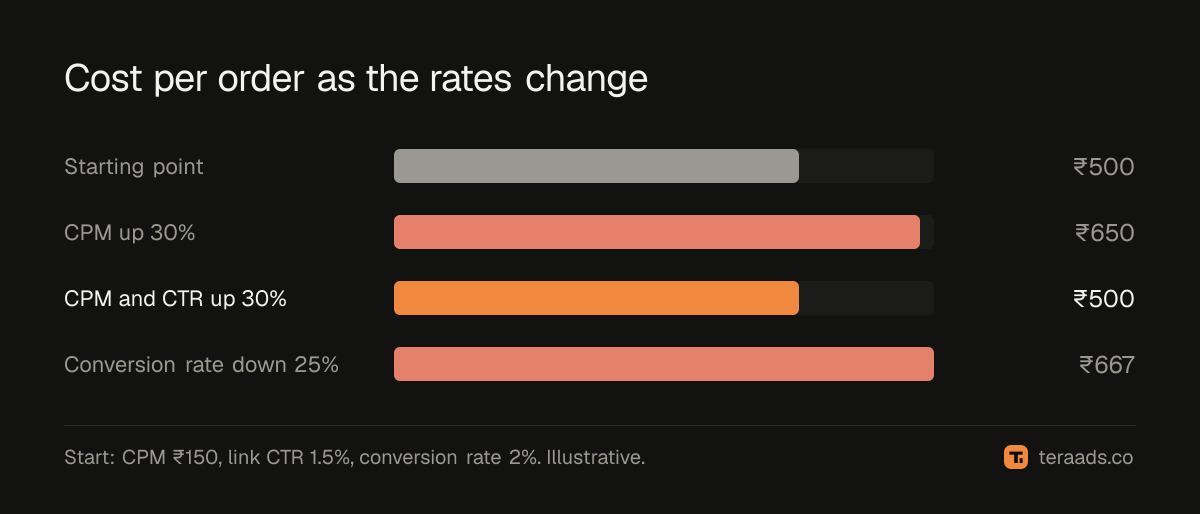
| Starting point | ₹150 | 1.5% | 2.0% | ₹500 |
| CPM up 30% | ₹195 | 1.5% | 2.0% | ₹650 |
| CPM up 30%, CTR up 30% | ₹195 | 1.95% | 2.0% | ₹500 |
| CPM same, conversion rate down 25% | ₹150 | 1.5% | 1.5% | ₹667 |
A CPM rise matters only if the other rates don't move. A weaker product page can hurt more than an expensive auction.
What drives CPM in India
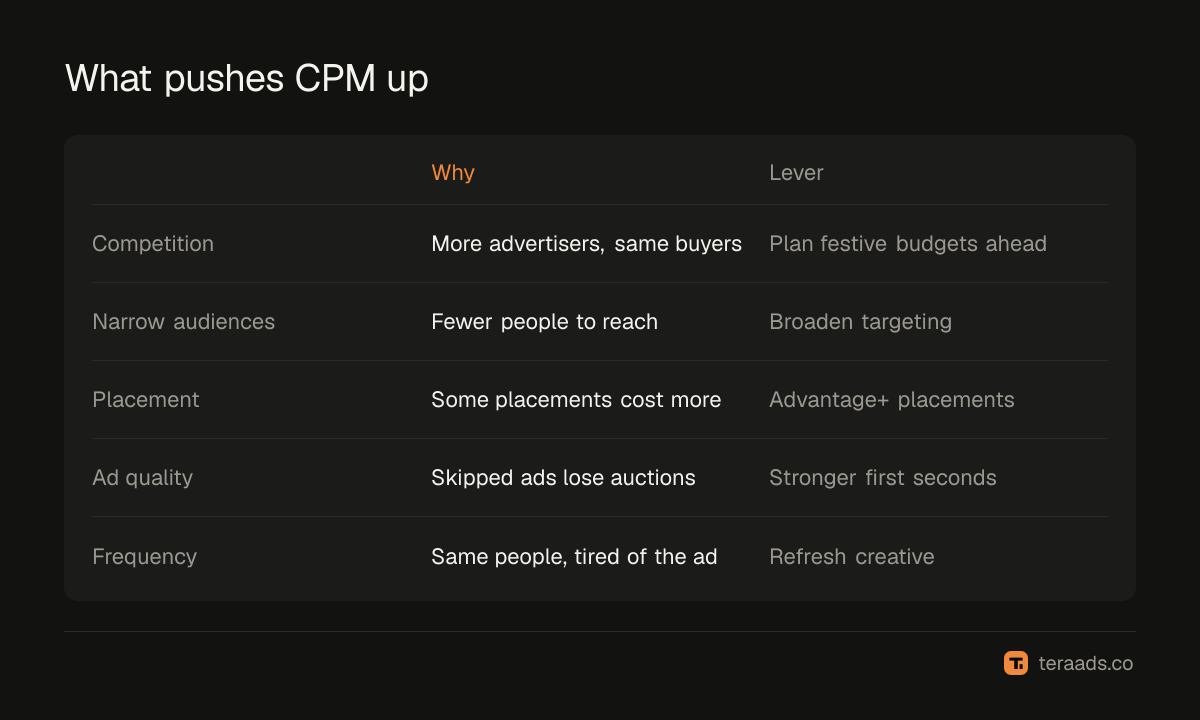
Competition for your audience. CPM is set in an auction. When more advertisers target the same people, prices rise. That's most visible in festive months; festive season ads planning covers how to prepare.
Audience size and targeting. Narrow audiences and tight interest stacks leave fewer people to reach, so each impression costs more. Broad targeting usually lowers CPM.
Placement. Different placements, such as Feed, Stories and Reels on Instagram and Facebook, price differently. Advantage+ placements let Meta find cheaper inventory.
Geography. Metro audiences are often more contested than smaller cities, though your conversion and RTO rates by region matter more than CPM alone.
Ad quality and engagement. Meta's auction considers how relevant and engaging an ad is likely to be, not just your bid. Ads people skip lose auctions or pay more.
Frequency. Showing the same ads to the same people raises frequency and usually lowers engagement, which can raise CPM; see Meta ads frequency.
When a CPM rise is a problem
Check three things before reacting:
- Did cost per kept order rise? If CTR and conversion rate held or improved, a higher CPM may be harmless.
- Is it the whole market or your account? If CPM rose across all campaigns in the same week, it's probably seasonal competition. If it rose only on one ad set, look at its audience, frequency and creative.
- Is frequency climbing? Rising CPM with rising frequency and falling CTR is the classic sign of creative fatigue.
Lowering CPM, and cost per order
- Broaden targeting where results allow, so delivery has more people to choose from.
- Use Advantage+ placements unless a placement clearly converts badly for you.
- Refresh creative before fatigue sets in; new ads usually earn better engagement.
- Make the first seconds count in video, because early drop-off signals low relevance.
- Fix the landing page, which doesn't change CPM but can do more for cost per order than any auction trick.
Benchmarks
Published CPM benchmarks for India vary widely by source, category, season and objective, and most aren't comparable with your account. Your own history is the best benchmark: track weekly CPM, CTR, conversion rate and cost per kept order for each campaign, and investigate changes rather than levels.
Placements, audiences and CPM
CPM differs a lot by where ads appear and who they reach, and the cheapest impressions aren't always the best value.
Placements. Reels, Stories, Feed and the Audience Network are priced differently. Some placements deliver impressions cheaply but bring clicks that rarely buy, often accidental taps. Use the placement breakdown in Ads Manager to compare cost per purchase, not just CPM, by placement. If a placement's CPM is low but its purchases are near zero, it isn't cheap.
Audience size. Narrow audiences, such as a small interest stack or a tiny retargeting pool, give Meta fewer people to choose from, which tends to push CPM up and frequency with it. Broad targeting lets Meta find cheaper impressions among people likely to buy. That's one reason consolidated, broad prospecting often beats many narrow ad sets on cost per order.
Retargeting. Retargeting audiences usually cost more per thousand impressions, because they're small and other advertisers want them too, but they convert at higher rates. Judge them on cost per kept order, and watch frequency; see Meta ads frequency.
Creative. Ads that people watch and engage with tend to win auctions more cheaply. Tired creative is one of the most common hidden causes of rising CPM; creative fatigue shows how to spot it.
When CPM rises, check these four before blaming the market. A shift in placement mix or a fatigued ad can explain a jump that looks like seasonal competition.
Common mistakes
Judging campaigns on CPM. Cost per kept order is what decides profit.
Narrowing audiences to "save money". Smaller audiences often cost more per impression.
Panicking during festivals. Everyone's CPM rises; check whether your cost per order still clears break-even.
Ignoring frequency. Fatigue raises CPM and lowers results together.
Comparing with other brands' benchmarks. Different categories and goals make them misleading.
Tera Ads shows Meta Ads and Google Ads spend beside Shopify orders, with profit after RTO from Shiprocket for every campaign, so you can see whether a CPM change touched what you earn. It is free for one business.
Frequently asked questions
What is CPM in Meta ads?
The cost of 1,000 impressions. It's set in an auction and changes with competition, audience, placement and ad quality.
Why is my Meta CPM high?
Usually more competition for your audience, a narrow audience, high frequency or ads people don't engage with.
Does a high CPM mean my ads are failing?
Not on its own. If click-through and conversion rates are good, cost per order can still be fine.
Does CPM rise during Diwali?
Generally yes, because more advertisers compete for the same buyers in the festive season.
How do I lower my CPM?
Broaden targeting, use Advantage+ placements, refresh creative and keep frequency in check.