Festive Season Ads Planning for Diwali 2026: A Profit-First Calendar
Plan Meta and Google ads for Diwali 2026 around costs that rise, buyers who browse early and COD orders that refuse late. A week-by-week calendar with budget rules.
On this page
Plan festive ads backwards from Diwali, which falls on Sunday 8 November 2026 with Dhanteras on Friday 6 November, according to Drik Panchang. Build audiences and test creative in October, spend hardest in the 10 to 14 days before Dhanteras when gifting intent peaks, account for last delivery dates by region, and judge every campaign on profit after RTO rather than festive ROAS. Ad costs rise for everyone in the season, so the brands that win are the ones that know their break-even before it starts.
Key takeaways
- Diwali is on 8 November 2026 and Dhanteras on 6 November; gifting purchases peak in the days before.
- Ad auctions get more expensive in the festive season, so calculate break-even ROAS and CPA before raising budgets.
- Prepare creative and offers in October; launching new ads in peak week means learning when costs are highest.
- Stop promising delivery by Diwali once couriers can't make it, and switch to post-Diwali or gift-card messages.
- Festive COD orders can be refused more, so watch RTO and confirm high-value COD orders.
The calendar
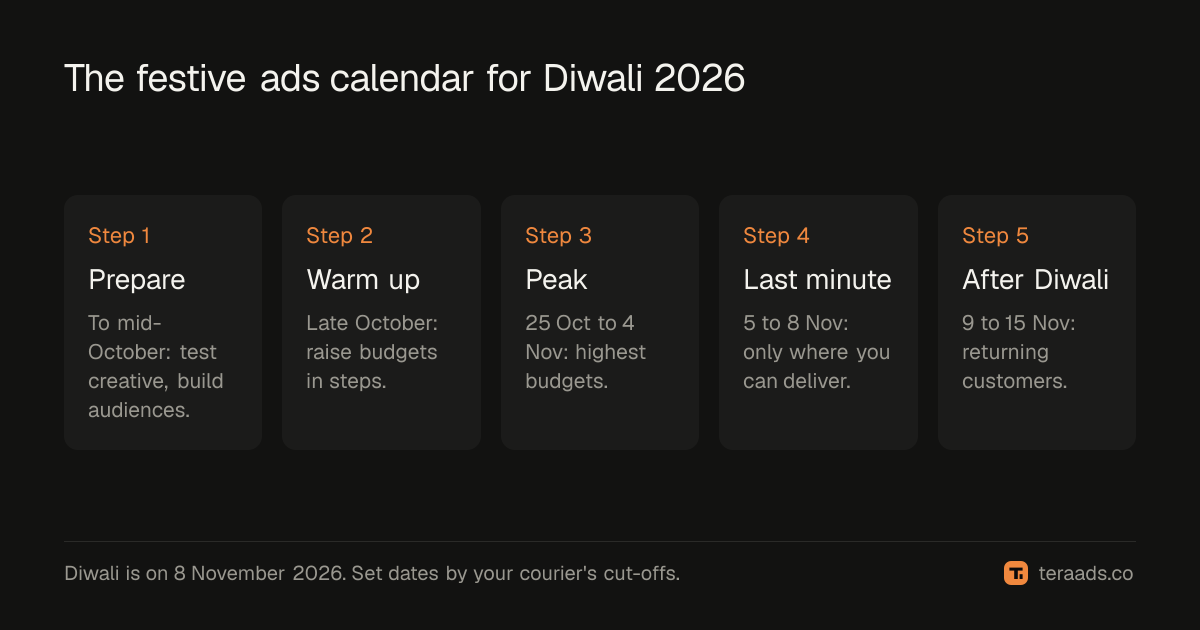
Here's a working calendar for a brand selling gifts, fashion or jewellery. Adjust the dates to your delivery times.
| When | Focus | Ads |
|---|---|---|
| Now to mid-October | Prepare | Test creatives and offers at current spend; build warm audiences with content and video |
| Mid-October to late October | Warm up | Raise budgets in steps on proven campaigns; launch festive creative |
| About 25 October to 4 November | Peak gifting | Highest budgets; delivery-date messages; retargeting cart and product viewers |
| 5 to 8 November | Last minute | Only for areas you can still deliver to; promote gift cards or same-city options |
| 9 to 15 November | After Diwali | Lower budgets; returning customers; clearance of festive stock |
Know your numbers before costs rise
When many brands compete for the same buyers, costs per impression rise, and so does the risk of buying sales at a loss. Before the season:
- Calculate break-even ROAS on kept revenue after RTO; break-even ROAS has the formula.
- Set a maximum cost per order for each campaign, based on profit per order after RTO.
- Know your cash position. Festive stock and ad spend go out before COD money comes back; the COD remittance cycle shows how much is tied up.
A campaign that's profitable at normal costs may not be at festive costs. Decide in advance what you'll pause if costs pass your limits.
Preparing in October, step by step
- Refresh creative. Make festive versions of your best ads: gifting angles, packaging, family occasions. Launch them early enough to exit learning before peak week; Meta's learning phase explains why timing matters.
- Decide offers with the calculator. Use the discount cost calculator to set the depth of any festive discount, and consider bundles or gift sets instead.
- Fix the feed. Check Merchant Center for disapproved products and add festive keywords to titles where they're accurate; see disapproved Shopping products.
- Build audiences. Grow video viewers and site visitors now, so retargeting has people to reach in peak week.
- Set delivery cut-offs. Ask your couriers for the last order date for delivery before Dhanteras and Diwali, by zone.
- Prepare COD rules. Decide when to confirm high-value COD orders and where to require partial payment.
Budgets through the season
Raise budgets in steps from mid-October, and watch what each step brings in Shopify orders rather than platform ROAS. Scaling ad spend profitably explains how to judge each step. A simple illustrative plan for a brand spending ₹1,00,000 a month normally:
- First half of October: about ₹25,000 a week, the normal level.
- Second half of October: ₹35,000 to ₹40,000 a week on proven campaigns.
- Peak gifting window: ₹50,000 to ₹60,000 a week, if marginal returns stay above break-even.
- Diwali week: spend drops as delivery cut-offs pass.
- After Diwali: back near normal, focused on returning customers.
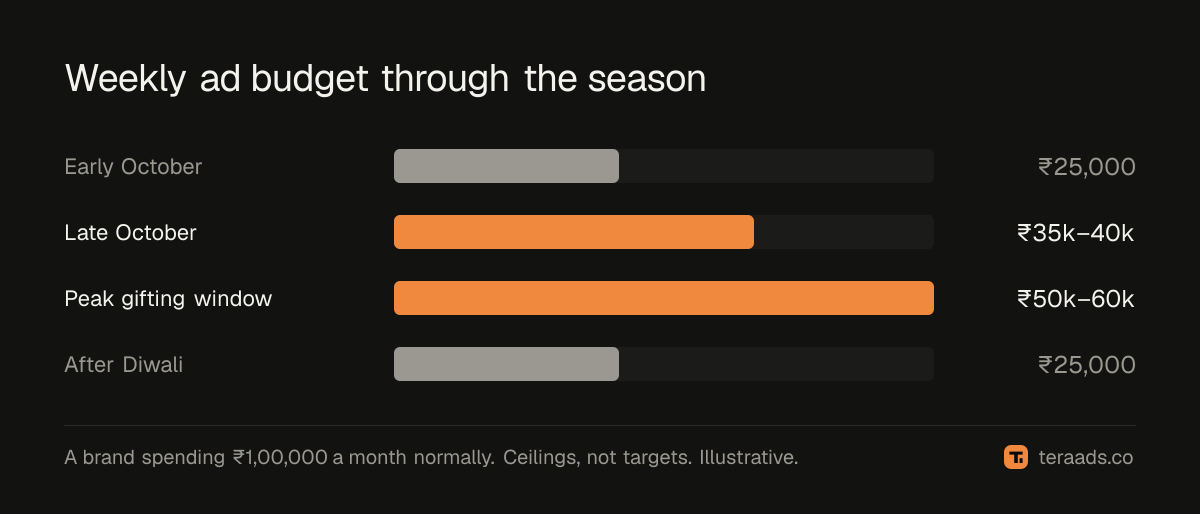
Treat these as ceilings, not targets. If a step's extra spend brings back less than your break-even ROAS, hold or pull back, whatever the calendar says.
Delivery cut-offs and messages
Promising delivery before Diwali and missing it creates refusals, refunds and angry buyers. Once the last safe order date passes for a region, change ad copy and site banners: drop "delivered by Diwali", promote gift cards or "order now, delivered after Diwali" offers, and exclude regions you can't reach in time if your platforms allow. Check your courier's cut-off dates rather than guessing.
RTO in the festive season
Festive orders include more impulse buys and gifts sent to other addresses, both of which can raise refusals on COD. Keep the basics running:
- Confirm COD orders above a value before dispatch; the COD order confirmation guide has scripts.
- Check addresses on gift orders, especially when the recipient's phone number differs from the buyer's.
- Offer a prepaid incentive on large orders.
- Watch RTO by campaign weekly, because festive campaigns that bring many COD orders can look strong on ROAS and weak on kept revenue.
After Diwali
Wait about three weeks after peak week before judging the season, so RTO settles. Then compare each campaign's profit after RTO with its spend, note which creatives and offers worked, and write down the cut-off dates and cost levels you saw. Next year's plan starts from those notes.
Common mistakes
Launching new creative in peak week. It learns when costs are highest.
Judging on festive ROAS. Platform numbers don't count RTO, and festive RTO can be higher.
Promising delivery you can't make. Late gifts get refused or refunded.
Deep discounts by default. Many festive buyers would have paid full price.
No cash plan. Stock and ad spend go out weeks before COD money returns.
Tera Ads shows Shopify sales, Meta Ads and Google Ads spend and profit after RTO from Shiprocket for every campaign, counted in the month each order was placed, so you can see what the festive season really earned. It is free for one business.
Frequently asked questions
When is Diwali in 2026?
Diwali (Lakshmi Puja) is on Sunday 8 November 2026, and Dhanteras on Friday 6 November, according to Drik Panchang.
When should I start festive ads?
Prepare and test in early October, raise budgets in steps from mid-October, and peak in the 10 to 14 days before Dhanteras.
Do ad costs rise during Diwali?
Yes. More advertisers compete for the same buyers, so costs per impression rise. Calculate break-even before raising budgets.
Should I run discounts for Diwali?
Only after calculating how many extra orders the discount needs. Bundles and gift sets often protect margin better.
How do I handle delivery deadlines in ads?
Get cut-off dates from your couriers by zone, and change ad messages once delivery before Diwali isn't possible.