NDR Management: How to Save Failed Deliveries Before They Become RTO
An NDR is the courier telling you a delivery attempt failed. Why the first 24 hours decide whether it becomes an RTO, the common reasons, and a simple daily routine.
On this page
An NDR (non-delivery report) is the courier's notice that a delivery attempt failed: the buyer wasn't home, refused the parcel, gave a wrong address or didn't have cash ready. Every NDR is a parcel on its way to becoming an RTO. Acting within a day, by contacting the buyer and asking for a reattempt or address fix, saves many of them, because each extra day in transit makes a return to origin more likely.
Key takeaways
- An NDR is a failed attempt, not a lost order; many can be saved with a quick call or message.
- Speed matters: Shipway's FY25 data shows RTO rising as delivery takes longer.
- Classify each NDR by reason, because each reason has a different fix.
- Fake or disputed attempts are common; ask the buyer before believing the courier's reason.
- Track your NDR save rate weekly, by courier, so you know where delivery is breaking down.
What an NDR is
When a courier can't deliver a parcel, it records the attempt with a reason code and tells the seller, usually through the shipping platform's NDR panel. Couriers generally make a limited number of attempts, often up to three, depending on the courier, before marking the shipment for return. Once it's marked RTO, you pay for the trip back and lose the sale.
The time between the first failed attempt and the return decision is your window. What you do in it decides most outcomes.
Why speed matters
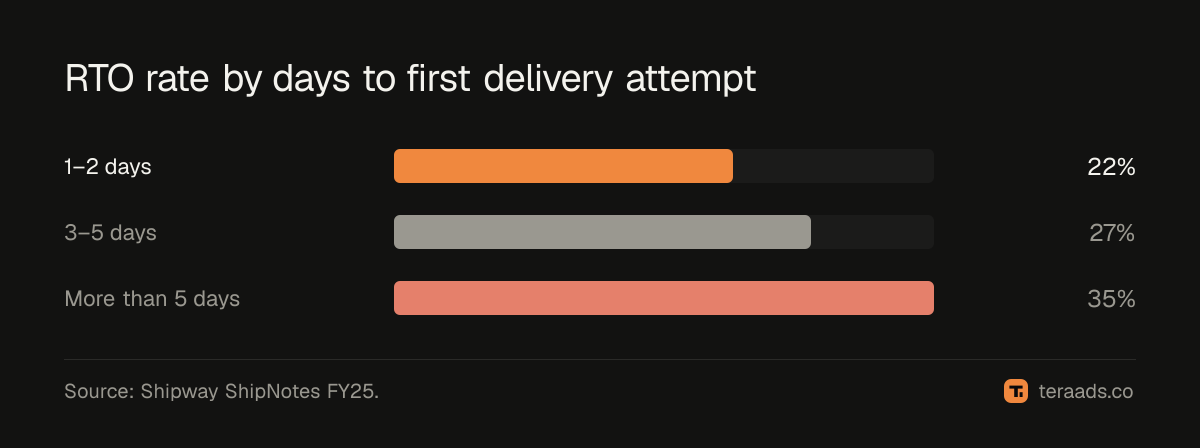
Shipway's ShipNotes FY25 analysis found RTO rates rising with the time it takes to reach the buyer: about 22% when the first delivery attempt happened in 1–2 days, 27% at 3–5 days and 35% beyond 5 days (Shipway's FY25 RTO findings). Buyers lose interest, buy elsewhere or forget they ordered. Every day an NDR sits unanswered adds to that delay.
Common NDR reasons and what to do
| Reason the courier gives | What it often means | What to do |
|---|---|---|
| Customer not available | Genuinely out, or no attempt was made | Call the buyer; schedule a reattempt at a time they'll be home |
| Customer refused | Changed mind, impulse COD order, or never ordered | Call to confirm; if the buyer wants it, reattempt; if not, accept the return early |
| Incomplete or wrong address | Missing landmark, flat number or pin code | Get the corrected address and update it with the courier |
| Cash not ready (COD) | Buyer didn't expect the amount | Confirm the amount; offer to switch to prepaid with a payment link |
| Contact number unreachable | Wrong or switched-off number | Try the alternate number or email; if nothing works, hold |
| Delivery area issue | Outside serviceable area or restricted entry | Arrange pickup point delivery or a different courier next time |
Ask the buyer before you trust the reason. "Customer not available" is sometimes recorded when no real attempt was made. If the buyer says nobody came, raise it with the courier; repeated cases point to a courier or hub problem.
A daily NDR routine
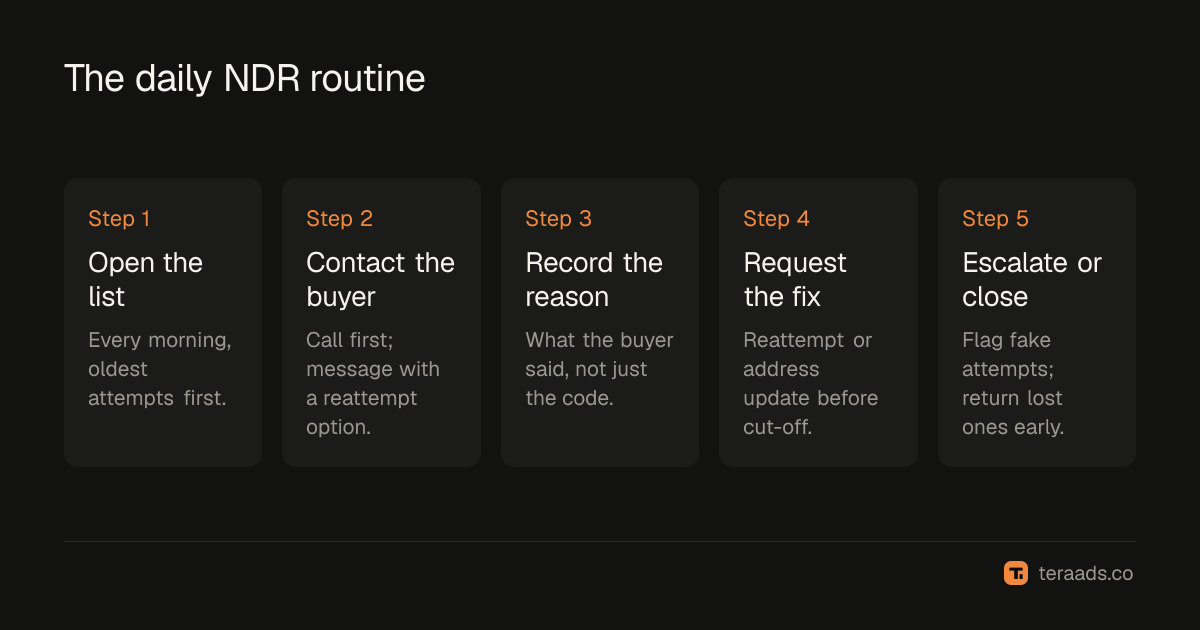
- Open the NDR list every morning. Sort by attempt number, with the oldest first.
- Contact every buyer the same day. A call works best; a WhatsApp or SMS with a reattempt option reaches more people.
- Record the real reason. Note what the buyer said, not just the courier's code.
- Request the reattempt or update. Submit reattempts and address corrections through your shipping platform before the courier's cut-off.
- Escalate disputed attempts. Flag cases where the buyer was home and nobody came.
- Close the lost ones early. If the buyer clearly doesn't want the parcel, mark it for return so it doesn't sit in transit.
Measuring NDR performance
Track three numbers each week:
- NDR rate: share of shipments with at least one failed attempt.
- Save rate: share of NDR shipments that were eventually delivered.
- NDR by courier and region: where attempts fail most.
A rising NDR rate on one courier usually means a hub or staffing problem; move volume while it's fixed. A low save rate usually means slow follow-up. The full set of fixes, including order confirmation and prepaid nudges, is in the RTO reduction guide, and COD vs prepaid explains why COD orders produce most NDRs.
What a saved NDR is worth
Each saved NDR avoids the return shipping, packaging and handling of an RTO, and keeps the revenue. On an illustrative ₹800 order with ₹70 each way and ₹15 of packaging, one save keeps ₹800 of revenue and avoids about ₹85 of extra cost. Saving 50 NDRs a month is roughly ₹40,000 of kept revenue. The RTO cost calculator shows how to run these numbers for your own store.
Preventing NDRs before dispatch
The cheapest NDR is the one that never happens. Before shipping:
- Confirm COD orders by call or message, and hold the ones nobody confirms.
- Check addresses for missing house numbers, landmarks and wrong pin codes.
- Verify phone numbers so the courier can reach the buyer.
- Ship fast. Every day in your warehouse is a day added to delivery.
Working with your courier and shipping platform
Shipping platforms such as Shiprocket collect NDRs from many couriers into one panel, with reattempt and address-update actions. Use them daily, and use the courier comparison they provide: if one courier's NDR rate on your orders is consistently higher, route more volume to the one that delivers. Keep a short log of disputed attempts with dates and order numbers; it makes escalations faster and gives you evidence when you renegotiate rates.
Tera Ads shows profit after returns from your Shopify orders, RTO from Shiprocket and ad spend from Meta Ads and Google Ads, with each RTO counted in the month the order was placed. It is free for one business.
Frequently asked questions
What does NDR mean in shipping?
Non-delivery report. It's the courier's record that a delivery attempt failed, with a reason such as buyer not available, refused or wrong address.
How many delivery attempts do couriers make?
It varies by courier and service, but up to three attempts is common in India before a shipment is marked for return to origin.
How fast should I act on an NDR?
The same day, ideally within a few hours. RTO rates rise as delivery takes longer, and couriers schedule the next attempt quickly.
Can I change the delivery address after an NDR?
Usually yes, through your shipping platform's NDR action, within the courier's limits. Large changes, such as a different city, may need a new shipment.
Are fake delivery attempts common?
They happen. If buyers say nobody came, record it and raise it with the courier. A pattern on one courier or region is a reason to move volume.