What RTO Really Costs: A Line-by-Line Calculator for D2C Brands
RTO costs more than lost sales: freight both ways, packaging, damage, ad spend and COD fees. A line-by-line calculator with a worked example in rupees.
On this page
The real cost of an RTO is the forward shipping, the return shipping, the packaging, any damaged or unsellable stock, payment and COD charges, and the ad spend that bought the order, all for a sale that never happened. For a typical Indian D2C order the total is often ₹250 to ₹600 per returned parcel, before counting the margin you lost. This calculator shows how to work out your own number.
Key takeaways
- An RTO is not a cancelled sale: it is a sale you paid to acquire, pack and ship twice, and then lost.
- The biggest line is usually the ad spend that bought the order, not the freight.
- Multiply your cost per RTO by your monthly RTO count to see what returns cost you each month.
- Count RTO against the month the order was placed, so each month's profit is right.
- Small cuts in RTO rate are often worth more than the same cut in ad costs.
Why RTO cost is underestimated
Most brands track RTO as a percentage: "our RTO is 22%". The percentage hides the money. A returned parcel is a full cost cycle with no revenue at the end: you paid an ad platform to win the order, a warehouse to pack it, a courier to carry it out and back, and often a fee to the COD collection service. Then the product comes back, sometimes damaged, sometimes in a season it no longer sells in.
Because these costs land in different places (Meta's invoice, Shiprocket's wallet, the warehouse bill, the inventory count), nobody sees them added up. That is the job of the calculator below.
The seven lines of an RTO
| Cost line | What it is | Typical range per RTO (example) |
|---|---|---|
| Forward freight | Shipping the parcel out | ₹50–₹90 |
| Return freight | The courier bringing it back (often the same as forward, sometimes higher) | ₹50–₹90 |
| COD handling | Fee for the collection attempt, if your courier charges it on failed COD | ₹0–₹40 |
| Packaging and labour | Box, filler, label, picking and packing time | ₹20–₹50 |
| Damage and write-off | Share of returned stock you can't resell at full price | ₹0–₹150 |
| Ad spend to acquire | Your cost per purchase (CPA) for that order | ₹150–₹500 |
| Reprocessing | Inspecting, repacking and restocking the returned unit | ₹10–₹30 |
The first five lines are cash you spent on the parcel. The ad spend is cash you spent to win an order that turned out to be worthless. Some finance teams leave ad spend out because "we would have spent it anyway". That is true for the ad budget overall, but not for your unit economics: when you calculate what each kept order costs to acquire, the money spent on returned orders has to be spread over the orders that stayed.
How to calculate your cost per RTO
- Pull your forward and return freight. From your shipping partner's invoices (for example the Shiprocket wallet statement), take the average forward charge and the average RTO charge per parcel for last month.
- Add COD and handling fees. Check whether your courier charges a COD fee on failed deliveries, and what your warehouse charges per pick, pack and return inspection.
- Estimate damage. Over the last three months, what share of returned units could not be sold as new? Multiply by the average product cost.
- Add the acquisition cost. Use your blended cost per purchase: total ad spend divided by total orders placed (not delivered).
- Add it up. That is your cost per RTO. Multiply it by your RTO count for the month.
A worked example
These numbers are an illustration for a brand with an average order value of ₹900 and 1,000 orders a month, 60% of them cash on delivery:
- Forward freight: ₹70
- Return freight: ₹70
- COD handling on failed delivery: ₹20
- Packaging and labour: ₹30
- Damage: 10% of returned units, product cost ₹300, so ₹30 per RTO
- Reprocessing: ₹15
- Ad spend per order placed: ₹250
Cost per RTO: ₹485. At a 25% RTO rate on 600 COD orders plus 2% on 400 prepaid, the brand has 158 RTOs a month. Monthly RTO cost: ₹76,630, of which ₹39,500 is the ad spend on orders that came back.
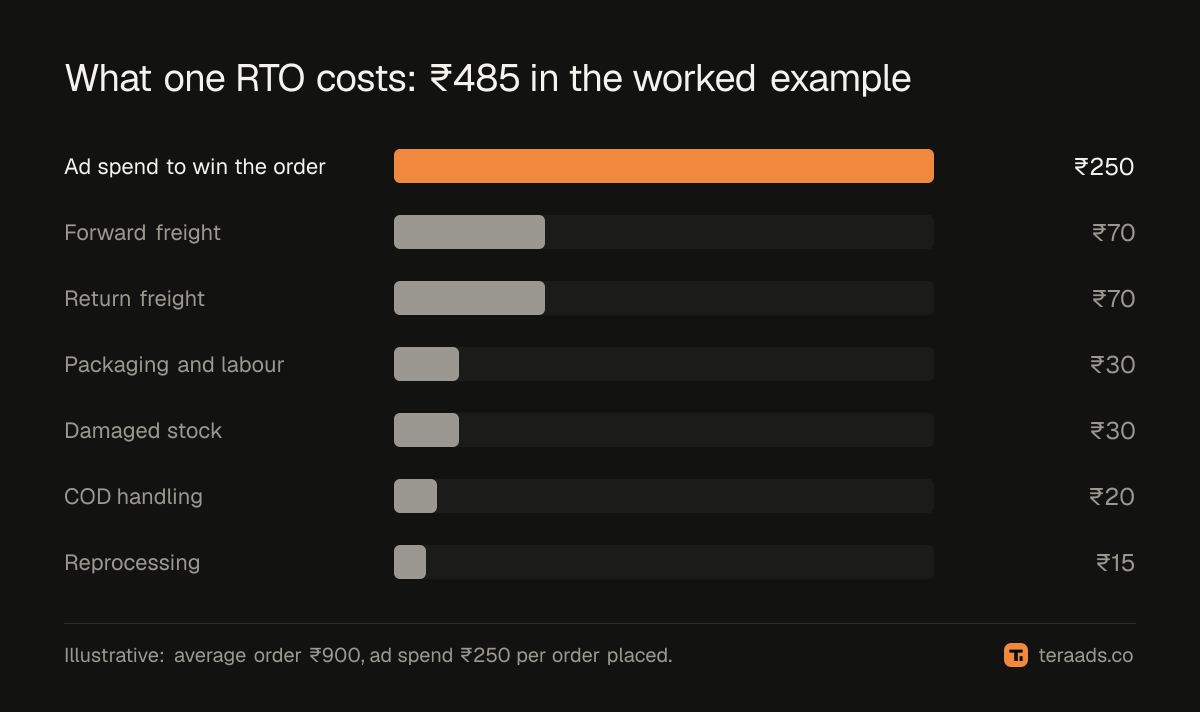
The figure that usually surprises people is the ad spend: it is about half the total. That is why RTO is a marketing problem, not only an operations problem. The campaigns and audiences that bring in high-RTO orders are spending real money on parcels that come back, which the true ROAS guide explains in detail.
What a lower RTO rate is worth
Run the same example at different RTO rates on COD orders:
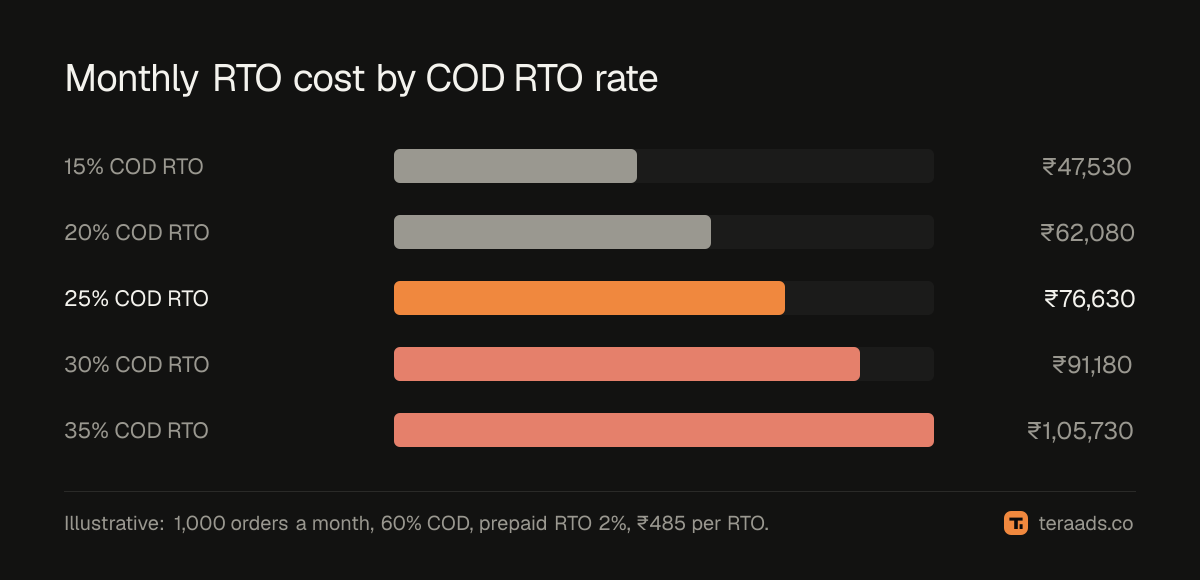
Every 5 points of COD RTO in this example is worth about ₹14,500 a month, before counting the margin on orders that are now delivered instead of returned. If each delivered order earns ₹350 of contribution margin, 30 extra delivered orders add another ₹10,500. Together that is ₹25,000 a month from a 5-point improvement, which is often cheaper to achieve than a 5% cut in ad costs. The playbook for that is in how to reduce RTO in India.
Put RTO in the right month
RTO arrives late. An order placed on 27 September might be marked RTO on 12 October. If you book the loss in October, September's profit is overstated and October's is understated, and neither month tells you whether that month's ads worked.
The fix is to attribute every RTO back to the month (and ideally the campaign) of the original order. This is called cohort accounting, and it changes how you read your numbers:
- Recent months always look better than they will end up, until their RTOs come in.
- A month should be treated as provisional for 30 to 45 days.
- Comparing this week with last week is only fair if both weeks are equally mature.
Common mistakes in RTO costing
- Using a flat percentage. A blanket deduction hides which products, pincodes and campaigns cause the returns. Use real shipment outcomes.
- Leaving out ad spend. It makes RTO look like a courier problem, and the marketing team never sees its share.
- Ignoring stock damage. Fragile, perishable and seasonal products lose value on every trip.
- Counting RTO in the wrong month. It distorts both months.
- Treating every RTO as the same. A ₹3,000 order that returns costs the same freight as a ₹500 one, but the lost margin and ad spend are very different.
How to keep this number current
The calculation is simple; keeping it current is the hard part. Shipment outcomes update daily, freight rates change by zone and weight, and the RTO for last month keeps moving for weeks.
Tera Ads does this from the data you already have: it reads your Shopify orders and the delivery outcomes from Shiprocket, takes off ad spend from Meta Ads and Google Ads, and shows profit after returns, with each RTO counted in the month the order was placed. It is free for one business. If you prefer a spreadsheet, the steps above are all you need; just refresh it every week. Then feed the result into your break-even ROAS, because a higher RTO rate raises the ROAS you need.
Frequently asked questions
What is a normal RTO rate for cash-on-delivery orders in India?
Industry data puts it at about a quarter of COD shipments. Shipway's ShipNotes report found about 26% of non-prepaid orders returned in FY2025, against under 2% of prepaid orders (coverage of the report). Your category, price and regions can move this a lot.
Should ad spend be included in the cost of RTO?
Yes, for unit economics. The money spent to acquire an order that returns buys you nothing, so it raises the true cost of every order that is kept. Leave it out only if you are calculating pure logistics cost.
Do couriers always charge for the return leg?
Most do, and the RTO charge is often similar to the forward charge. Check your contract: some charge extra for RTO beyond a threshold or by zone.
How do I find which products or campaigns cause the most RTO?
Join each order's shipment outcome to its product, pincode and the campaign that brought it in (UTM parameters help). Then compare RTO rate and cost per RTO across those groups.
Is it better to stop offering COD?
Rarely as a first step. COD is how many Indian buyers prefer to pay. It is usually better to confirm COD orders, offer a prepaid incentive and block repeat refusers than to remove COD entirely.
How often should I recalculate my cost per RTO?
Monthly for the cost inputs, weekly for the RTO count. Freight rates change less often than your RTO rate.