How to Reduce RTO in India: 12 Tactics That Work for D2C Brands
RTO on cash-on-delivery orders runs near a quarter of shipments. Twelve tactics to cut it, from faster first attempts to COD confirmation and smarter ad targeting.
On this page
You reduce RTO by stopping bad orders before they ship, delivering the good ones faster, and making refusal less likely at the door. In practice that means confirming cash-on-delivery orders, checking addresses at checkout, nudging buyers to prepaid, attempting delivery within one to two days, handling failed deliveries quickly, and changing the ads and audiences that bring in high-RTO orders. Most brands can cut RTO by several points without hurting sales.
Key takeaways
- RTO comes mostly from cash on delivery: about 26% of COD orders returned in FY2025 data, against under 2% of prepaid.
- Speed matters: RTO rose from 22% to 35% when the first delivery attempt slipped past five days.
- Confirming COD orders and checking addresses stop the worst orders before you pay to ship them.
- Prepaid incentives work better than removing COD.
- Fix the ads too: campaigns that win cheap COD orders often bring the highest RTO.
Know your numbers first
Before changing anything, measure RTO by payment method, product, pincode, courier and campaign. Averages hide the problem: a brand with 18% overall RTO may have 8% in metros and 35% in a few regions, or 10% from one campaign and 30% from another. The RTO cost calculator turns each returned parcel into a rupee cost, which helps you decide which fixes are worth the effort.
Industry data gives a useful reference. Shipway's ShipNotes report, covering millions of D2C shipments in FY2025, found:
| Factor | RTO rate (FY2025) |
|---|---|
| Prepaid orders | Under 2% |
| Cash-on-delivery orders | About 26% |
| First attempt within 1–2 days | 22% |
| First attempt in 3–5 days | 27% |
| First attempt after 5+ days | 35% |
| Intra-city (zone 1) | 20% |
| Inter-state, non-metro (zone 4) | 27% |
| Special zones such as the North East and J&K (zone 5) | 28% |
Source: coverage of the ShipNotes report, July 2025. Your own rates will differ; the patterns usually don't.
Before the order ships
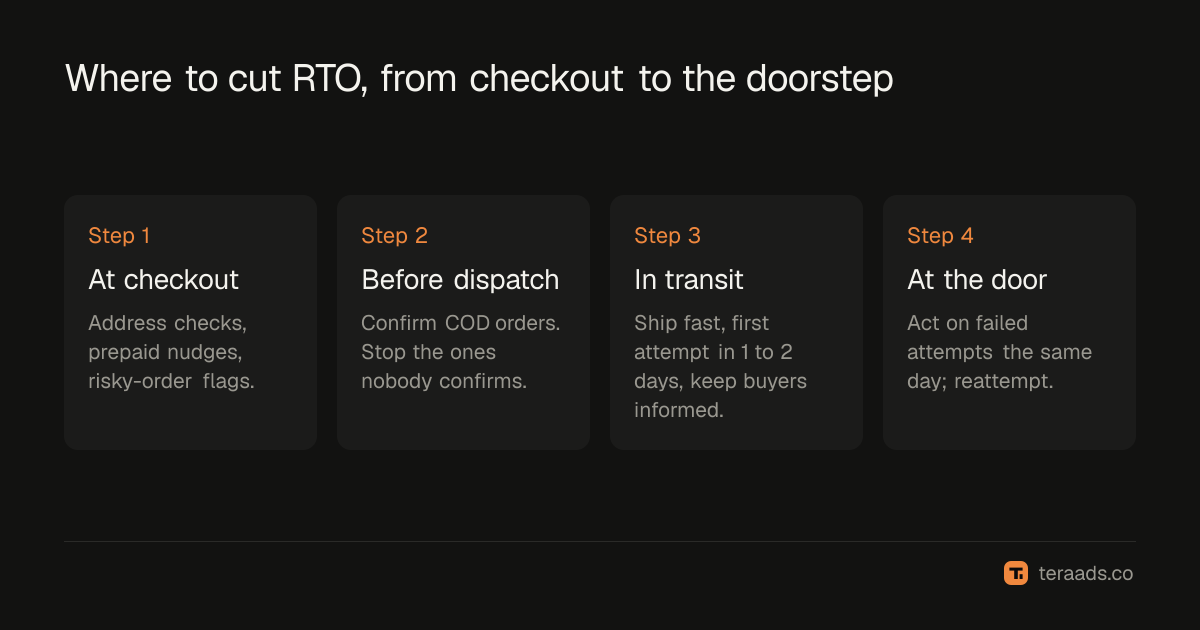
1. Confirm COD orders
Call, send an SMS or a message on a chat app, or use an automated confirmation flow for cash-on-delivery orders before dispatch. Orders that can't be confirmed, or that the buyer cancels, are far cheaper to stop now than to ship and take back.
2. Check addresses at checkout
Incomplete addresses, missing landmarks and wrong pincodes are a large share of failed deliveries. Use pincode lookup, require a house number and a landmark field, and flag addresses that are obviously incomplete.
3. Flag risky orders
Patterns that predict RTO: repeat refusers (same phone number), unusually high order values on first COD orders, many orders from one number, and orders placed at odd hours from new customers. Hold these for confirmation rather than blocking them.
4. Offer a reason to prepay
Small prepaid incentives (a modest discount, faster dispatch, a free gift) move a share of buyers to prepaid, where RTO is a fraction of COD. Many brands also charge a small COD fee. Both work better than removing COD, which many Indian buyers still prefer.
5. Consider partial COD for high-value orders
Asking for a small advance on high-value cash-on-delivery orders turns a no-risk order into a committed one. It reduces conversion a little; test whether the RTO saving is worth it for your price points.
While the order is moving
6. Ship fast and attempt delivery early
The data is clear that every extra day before the first delivery attempt raises RTO. Dispatch the same or next day, pick couriers by their real speed in each region, and avoid letting orders sit at the warehouse over weekends.
7. Keep the buyer informed
Dispatch and out-for-delivery updates with tracking links remind the buyer the order is coming, and give them a chance to reschedule instead of refusing.
8. Handle failed deliveries (NDR) within hours
When a courier reports a failed attempt (non-delivery report, NDR), contact the buyer the same day to fix the address or time, and push a reattempt. Unhandled NDRs usually become RTOs.
Fix the source: products and ads
9. Look at RTO by product
Some products return more: impulse items, sizing-sensitive apparel, products that look different from their photos. Better photos, size guides and honest descriptions reduce "not as expected" refusals.
10. Change the campaigns that bring high-RTO orders
Ad platforms optimise for the purchase event you send. Cash-on-delivery purchases are easy to win, and some audiences, creatives and placements bring in many orders that are later refused. Measure RTO by campaign, using UTM tags joined to shipment outcomes, and judge campaigns on true ROAS after RTO, not Ads Manager ROAS. Shifting budget from a high-RTO campaign to a low-RTO one often raises profit more than any courier change.
11. Adjust by region
If a few regions have very high RTO, consider prepaid-only or partial COD for those pincodes, or exclude them from cold prospecting while keeping them for retargeting and repeat buyers.
12. Block repeat refusers
Keep a list of phone numbers and addresses with repeated refusals and require prepayment from them. It is a small group that causes a disproportionate share of RTO.
How to know it's working
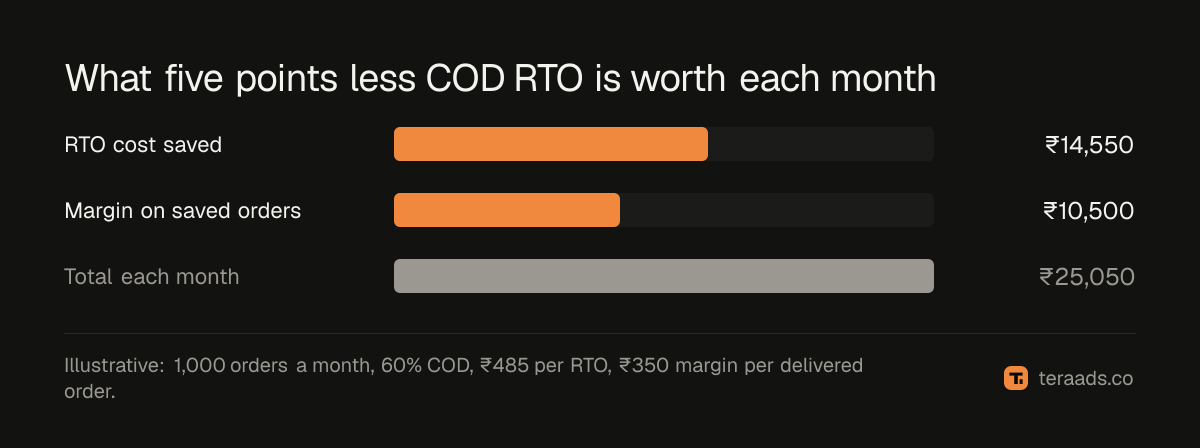
Measure RTO by the month the order was placed, not the month it returned, and wait 30 to 45 days for a month to settle. Compare like with like: the same products, regions and campaigns, before and after. Then check profit, not just the RTO rate: a tactic that halves RTO but loses a third of orders may not be worth it. Your break-even ROAS falls as RTO falls, which gives your ads room to grow.
Tera Ads shows profit after returns from your Shopify orders, RTO from Shiprocket and ad spend from Meta Ads and Google Ads, with each RTO counted in the month the order was placed and every campaign in one table. It is free for one business, and it makes the "which campaigns bring the returns?" question a matter of reading a column.
Frequently asked questions
What is a good RTO rate in India?
Lower than your category's norm, and falling. As a reference, FY2025 industry data shows about 26% RTO on cash-on-delivery orders and under 2% on prepaid; overall RTO depends heavily on your COD share.
Should I stop offering cash on delivery?
Rarely. COD is how many Indian buyers prefer to pay, and removing it usually loses more sales than it saves. Confirm COD orders, add a prepaid incentive, and restrict COD only for high-risk pincodes or repeat refusers.
Does faster delivery really reduce RTO?
Yes. In FY2025 data, RTO was 22% when the first attempt happened within one to two days and 35% when it took more than five days. A buyer who waits a week is more likely to have changed their mind or bought elsewhere.
What is NDR and why does it matter?
NDR is a non-delivery report: the courier tried and failed to deliver. Acting on it the same day, by confirming the address or time with the buyer, saves many orders that would otherwise return.
Can my ads cause high RTO?
Yes. Campaigns that optimise for purchases can find buyers who order easily on cash on delivery and refuse later. Measure RTO by campaign and move budget toward campaigns whose orders get delivered.