UGC Ads for D2C Brands: Briefing Creators and Testing What Sells
User-generated content ads feel like recommendations, not adverts. How to brief creators, get usage rights in writing, edit the first three seconds and test UGC.
On this page
UGC ads are short videos made by real customers or paid creators, filmed on a phone in their own words, that look like recommendations rather than adverts. They often hold attention better than polished studio ads on Instagram and Facebook, and they're cheap enough to make in volume. Brief creators on one problem and one proof point, get written rights to use the content in ads, edit hard for the first three seconds, and test each video on cost per kept order.
Key takeaways
- UGC works because it looks native to the feed and shows the product being used by someone relatable.
- A good brief gives one problem, one product benefit, one proof and a clear hook, not a script.
- Get written permission for paid ads, including duration, platforms and whether you can edit.
- The first three seconds decide whether anyone watches; test several hooks on the same body.
- Judge UGC like any ad: cost per kept order after RTO, not views or likes.
Why UGC works
People scrolling Instagram and Facebook are watching friends and creators, not ads. A creator talking to camera, unboxing a parcel or showing a product in daily use blends in, and the honest tone carries more trust than a studio voice-over. UGC is also quick and cheap to produce, so you can make enough variations to fight creative fatigue.
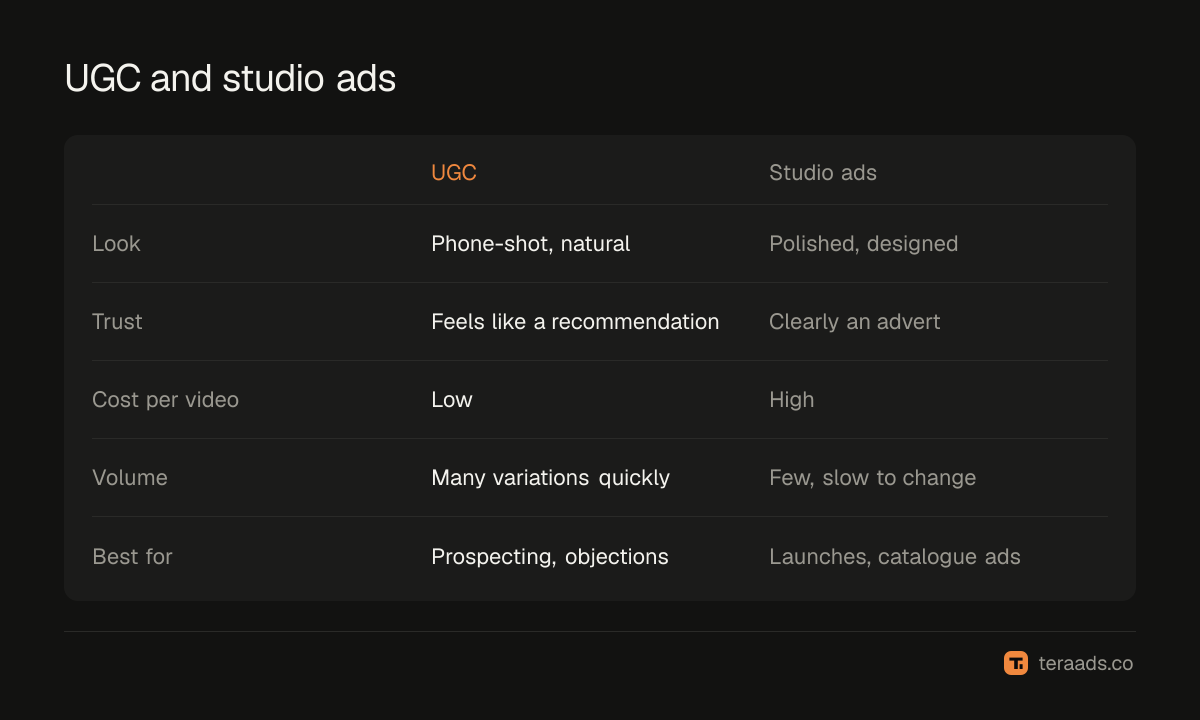
UGC and studio ads compared
| UGC | Studio ads | |
|---|---|---|
| Look | Phone-shot, natural | Polished, designed |
| Trust | High, feels like a recommendation | Lower, clearly an advert |
| Cost per video | Low | High |
| Volume | Many variations quickly | Few, slow to change |
| Best for | Prospecting, objection handling | Brand launches, premium positioning, catalogue ads |
Most brands need both: UGC to find buyers and handle objections, and clean product visuals for catalogue and Shopping placements.
Briefing creators, step by step
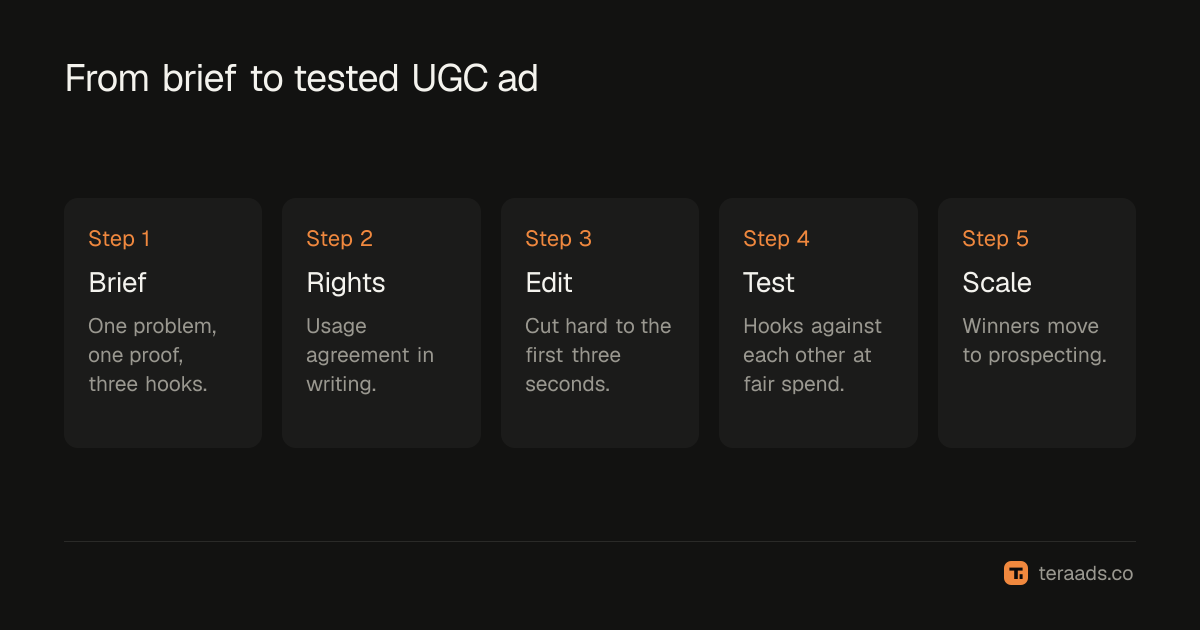
- Pick one problem. The everyday situation your product solves, in the buyer's words. Read reviews and support messages for phrases.
- Pick one proof. A visible result, a detail of material or packaging, or a comparison. Proof beats adjectives.
- Suggest hooks, not a script. Give three possible opening lines and let the creator say them naturally.
- List must-shows. The product in hand, in use, and the packaging; the price or offer only if it's current.
- List must-not-says. No claims you can't support, no competitor names, no medical or guaranteed-result promises.
- Specify format. Vertical 9:16, 20 to 45 seconds, raw files plus one edit, with captions burned in or supplied.
AI creative briefs shows how to draft briefs faster from your own reviews and results.
Rights and payments
Write down, before filming:
- What you can do: run it as a paid ad, on which platforms, for how long, and whether you can edit or cut it.
- Whether you can run it from the creator's handle, which needs their permission and setup on their side.
- Payment: a flat fee per video is simplest; product-only deals suit small creators but should still be written down.
- Disclosure: creators posting on their own accounts should mark paid partnerships according to platform rules and Indian advertising guidelines for influencers.
A one-page agreement or a clear email thread saves disputes when a video becomes a winner and runs for months.
Editing for performance
- Open with movement or a face, not a logo.
- Put the hook on screen as text, because many people watch without sound.
- Cut pauses, and keep the product visible early.
- End with a clear next step, such as an offer or "shop now", without a hard sell.
- Make three hook versions of every good video: same body, different first three seconds.
Testing UGC
Run new UGC in a testing campaign with a fixed budget, so each video gets a fair chance; Meta ads testing framework explains how. Read hook rate (the share of viewers who watch past three seconds) for early signals, then cost per purchase, and finally cost per kept order once RTO settles. Move winners into prospecting and keep losers for learning.
Finding creators
Good UGC creators aren't always the ones with the biggest followings. What matters is that they look and sound like your buyers and are comfortable on camera.
Places to look:
- Your own customers. Post-purchase emails, review requests and Instagram tags often surface people who already love the product. Their content is the most credible kind.
- Micro-creators on Instagram in your niche, with audiences that match your buyers. Check their recent posts for natural delivery, not just polished photos.
- UGC creator marketplaces and agencies, which make it easier to brief several creators at once, at a higher cost.
What to check before booking:
- Past brand work, to see whether their videos feel like recommendations or like ads.
- Delivery and lighting, because you'll be cutting the first three seconds hard.
- Willingness to sign a usage agreement that covers paid ads, the duration and platforms.
A practical starting point is three to five creators, each making two or three versions of the opening. That gives you enough variety to test hooks, angles and faces without spending the whole budget on one person's style. Keep the creators whose videos win, and brief them again with what you learned. Over time, a small group of reliable creators produces more winners than a constant search for new ones.
Common mistakes
Over-scripting. Creators reading lines sound like adverts.
No usage rights. A winning video you can't legally run is worthless.
One hook per video. The opening decides most of the result; test several.
Judging on views. Engagement doesn't pay bills; kept orders do.
Unsupported claims. They risk ad rejection and buyer trust.
Tera Ads shows every Meta Ads and Google Ads campaign in one table with profit after returns from Shopify orders and RTO from Shiprocket, so you can see which creative-led campaigns really earn. It is free for one business.
Frequently asked questions
What are UGC ads?
Ads made from user-generated or creator content: short, phone-shot videos that look like recommendations rather than studio adverts.
Do UGC ads work better than studio ads?
Often for prospecting on Instagram and Facebook, because they look native and feel trustworthy. Most brands use both.
How much should I pay UGC creators?
It varies by creator and usage. A flat fee per video with written usage rights is the simplest arrangement.
Do I need permission to use customer videos in ads?
Yes. Get written permission covering paid use, platforms, duration and editing.
How do I test UGC ads?
In a testing campaign with a fixed budget, comparing hook rate, cost per purchase and cost per kept order after RTO.