Meta Ads Testing Framework: Test Creative Without Wasting Budget
A simple testing system for Meta ads: what to test first, how to give each ad a fair budget, when to call a winner, and how to judge on kept orders, not clicks.
On this page
A good Meta ads testing framework tests one big idea at a time, gives each new ad a fixed budget in a separate testing campaign, sets the winning criteria before launch, and moves winners into your main campaigns. Test concepts and hooks before small details, because they cause the biggest differences. Judge on cost per purchase first and cost per kept order once RTO settles, and stop losers by rule rather than by mood.
Key takeaways
- Test in a separate campaign with a fixed budget, so new ads aren't starved by proven winners.
- Test the biggest levers first: concept and angle, then hook, then format, then details.
- Decide the budget, duration and winning metric before launch.
- Give each ad enough spend to judge, roughly two to three times your target cost per purchase.
- Graduate winners into prospecting and record every result, including losers.
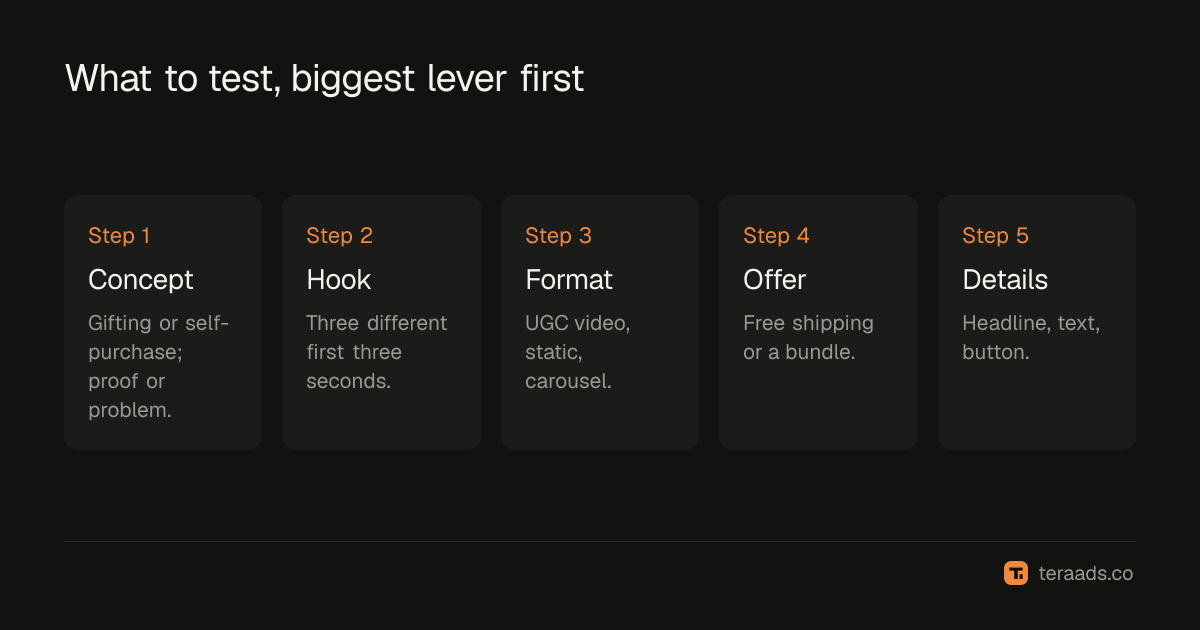
What to test, in order
| Order | What | Example |
|---|---|---|
| 1 | Concept or angle | Gifting versus self-purchase; problem-solution versus social proof |
| 2 | Hook | Three different first three seconds on the same video |
| 3 | Format | UGC video, static image, carousel |
| 4 | Offer | Free shipping versus a bundle |
| 5 | Details | Headline, primary text, button |
Small details rarely change results enough to measure on a small budget. A new angle can halve cost per purchase.
Setting up a test, step by step
- Write the hypothesis. "A gifting angle will lower cost per purchase for women 25 to 44" is testable; "try new ads" isn't.
- Use a testing campaign. A fixed daily budget with ad set budgets, so each new concept gets its own share. Meta ads account structure shows where testing fits.
- Keep the audience the same as your main prospecting, usually broad, so results transfer.
- Launch three to five ads per concept with different hooks.
- Set the stop and win rules before launch: budget per ad, minimum days, target cost per purchase.
- Read results on Shopify too. Compare UTM-tagged orders from the test with Meta's reported purchases.
How much to spend per ad
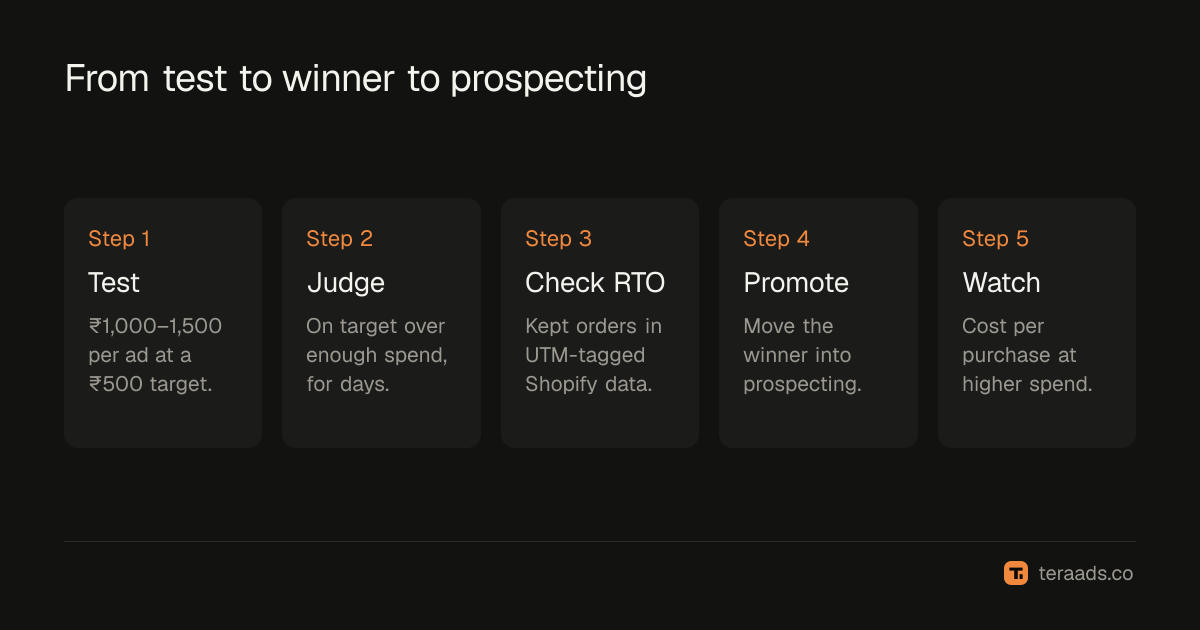
Each ad needs enough spend to show whether it can hit your target. A common rule is two to three times your target cost per purchase before judging. With a target of ₹500, that's ₹1,000 to ₹1,500 per ad. Ads that spend that much without a purchase are unlikely to become winners; ads with purchases near target deserve more.
Small budgets can't test many ads at once. If your testing budget is ₹3,000 a day, test one concept with three hooks per week rather than ten ads that each get too little.
Calling a winner
A winner is an ad that:
- Reaches your target cost per purchase over enough spend.
- Holds it for at least several days, not one lucky day.
- Brings orders that stay delivered once RTO settles, checked on UTM-tagged Shopify orders; RTO by campaign shows how.
Move the winner into prospecting as a new ad, keep it running in the test until the move settles, and watch its cost per purchase at higher spend.
Early signals
Before purchases arrive, early metrics help you spot obvious losers:
- Hook rate: share of video viewers past three seconds.
- Link click-through rate.
- Cost per add to cart.
Use them to cut clear failures early, not to crown winners. Plenty of ads with great hook rates never sell.
Keeping a test log
Record every test: date, hypothesis, ads, spend, purchases, cost per purchase, kept orders and the conclusion. After a few months, the log shows which angles and formats work for your buyers, which is worth more than any single winner. It also stops you re-testing ideas that already failed.
A worked example: testing three hooks
Say your target cost per purchase is ₹500 and your testing budget is ₹3,000 a day. You have one new concept, a customer review video from a creator (UGC ads covers the brief), and three ways to open it:
- Hook 1: the product in use in the first second.
- Hook 2: a bold claim from the review as on-screen text.
- Hook 3: a question that names the buyer's problem.
Put all three in one testing ad set and run them for a week, about ₹21,000 in total. Meta won't split spend evenly, and that's fine; it's telling you something. After seven days:
- Hook 1 spent ₹11,000 for 24 purchases, about ₹460 each.
- Hook 2 spent ₹7,000 for 11 purchases, about ₹640 each.
- Hook 3 spent ₹3,000 with 2 purchases.
Hook 1 is the candidate winner: below target over meaningful spend. Hook 2 is above target but has enough purchases to judge, so it's out. Hook 3 got ₹3,000, six times the target, for two purchases at ₹1,500 each, so it's out too.
Before moving Hook 1 to prospecting, check its UTM-tagged Shopify orders after a week or two of refusals. If its kept-order cost still beats your break-even, move it. Next week, test a new concept, or new hooks on the same review if you think the concept has more to give. Log all of it.
When nothing wins
Some weeks, every ad misses the target. That's normal, and it's still useful: it tells you the concept or angle didn't land with your buyers. Before testing the next idea, check whether the problem is the ads or the page they lead to. If click-through is healthy but purchases are scarce, the landing page, price or offer may be the bottleneck, and no new hook will fix it. If click-through is weak across every ad, the concept itself needs rethinking. Record the result either way, so the log shows what your buyers ignore as well as what they respond to.
Common mistakes
Testing inside prospecting. Proven ads take the budget and new ones never get a fair chance.
Too many ads at once. Each gets too little spend to judge.
Changing ads mid-test. Edits restart learning and blur results.
Judging on clicks. Cheap clicks don't mean cheap orders.
No kept-order check. Some winners on purchases bring high RTO.
Tera Ads shows every Meta Ads and Google Ads campaign beside your Shopify orders, with profit after RTO from Shiprocket, so test winners are judged on what they really earn. It is free for one business.
Frequently asked questions
How do I test Meta ads properly?
In a separate testing campaign with a fixed budget, one concept at a time, with win and stop rules set before launch.
How much should I spend testing a Meta ad?
Roughly two to three times your target cost per purchase per ad before judging it.
What should I test first on Meta?
The concept or angle, then the hook. Small details like button text rarely move results measurably.
How long should a Meta ad test run?
Long enough to reach the planned spend per ad, and at least several days to smooth out daily swings.
How do I know a test winner is real?
It hits your target cost per purchase over enough spend, holds for several days and its orders stay delivered after RTO.