YouTube Ads for D2C Brands: Shorts, In-Stream and What to Measure
YouTube ads for online sales now run through Demand Gen and Performance Max. Which formats suit D2C brands, what videos to make, and how to judge YouTube.
On this page
For D2C brands chasing sales, YouTube ads now run mainly through Demand Gen campaigns, which cover in-stream, in-feed and Shorts placements, and through Performance Max, which includes YouTube among all Google channels. Vertical, creator-style videos that show the product in the first seconds tend to suit Shorts and mobile viewers. YouTube influences many buyers who never click, so judge it on Shopify orders and store-level changes, not on Google's view-based conversions alone.
Key takeaways
- Video Action Campaigns were upgraded to Demand Gen; Demand Gen is the main home for conversion-focused YouTube ads.
- Placements include in-stream (before or during videos), in-feed (in search results and the home feed) and Shorts.
- Make vertical, square and horizontal versions; Shorts needs vertical.
- Show the product and the problem in the first five seconds, before viewers can skip.
- Measure with UTM-tagged Shopify orders, holdout tests and RTO, because view-through credit flatters YouTube.
Where YouTube ads run now
Google moved conversion-focused video ads into Demand Gen: it stopped new Video Action Campaigns and upgraded existing ones, as its upgrade help page describes. Demand Gen's channel controls let you run on YouTube in-stream, in-feed and Shorts, alone or alongside Discover, Gmail and the Display Network; Demand Gen campaigns covers the setup.
Performance Max also serves on YouTube, using the videos in your asset groups. If you don't upload any, Google may generate them from your images, which rarely looks as good as real footage; Performance Max asset groups explains what to upload.
Placements and formats
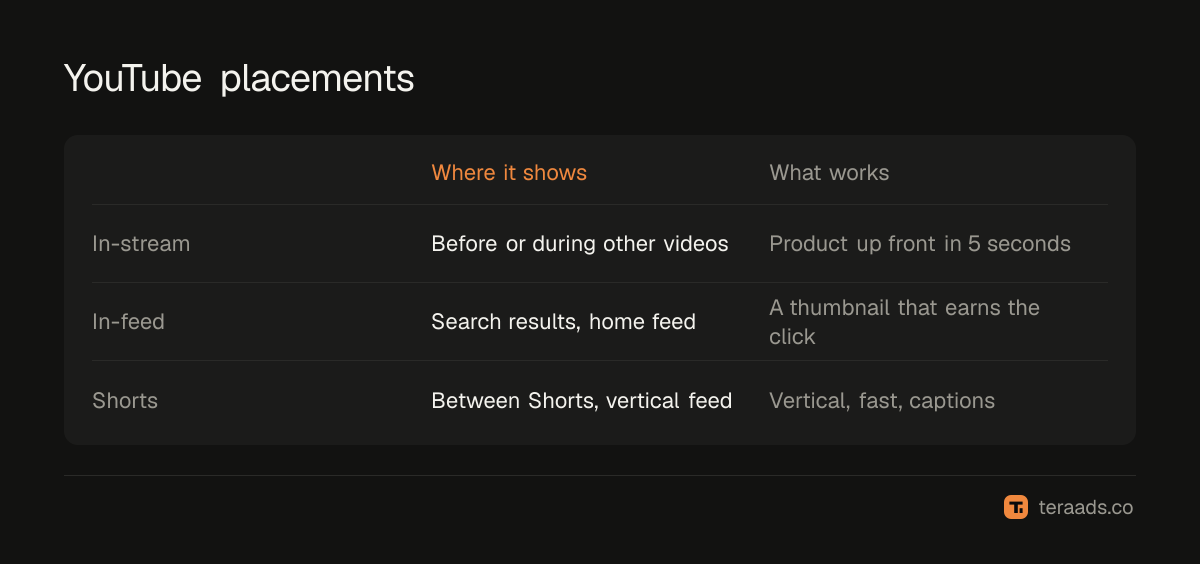
| Placement | Where it shows | What works |
|---|---|---|
| In-stream | Before, during or after other videos | Strong first five seconds; product and problem up front |
| In-feed | YouTube search results, home feed and watch-next | A clear thumbnail and title that earn the click |
| Shorts | Between Shorts in the vertical feed | Vertical, fast, native-looking, sound on and captions |
Making videos that sell
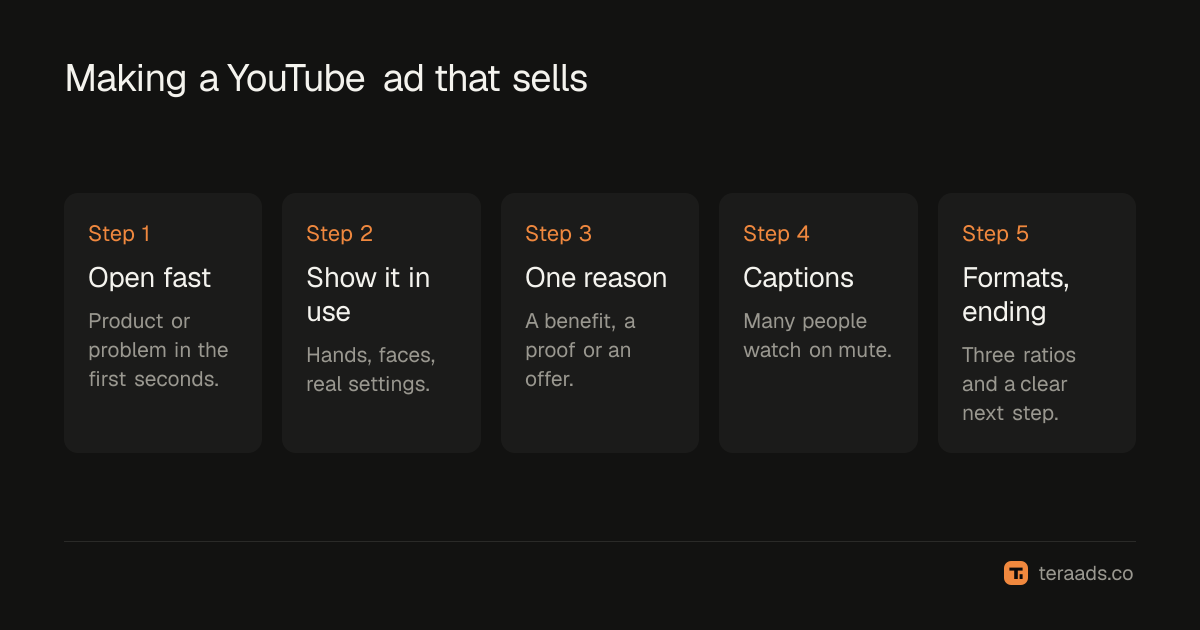
- Open with the product or the problem. Viewers can skip in-stream ads after a few seconds; earn the next ten.
- Show it in use. Hands, faces and real settings beat rotating product shots.
- Give one reason to buy. A benefit, a proof point or an offer, not all three at once.
- Add captions. Many people watch on mute.
- Make three aspect ratios. Vertical for Shorts, square and horizontal for in-feed and in-stream.
- End with a clear next step and the brand name on screen.
Creator-style videos that work on Instagram Reels often work on Shorts with little change; UGC ads covers briefing creators and getting usage rights.
Budgets and bidding
Start with a budget large enough for the campaign to get conversions regularly, using a conversion-based bid strategy on purchases. Tiny budgets spread over many audiences rarely learn. Use your customer list and site visitors as audience signals or seeds, and give the campaign two to four weeks before judging, since video often influences purchases days later.
Measuring YouTube honestly
YouTube is where people discover products, not where they usually buy. Google credits many conversions to views, some of which would have happened anyway. Check three things:
- UTM-tagged Shopify orders from YouTube clicks, which give a floor.
- Store-level change. Compare total Shopify revenue and branded search volume in weeks with and without YouTube spend.
- A holdout test. Run YouTube in some regions and not others, then compare; incrementality testing explains how.
Also check RTO on orders from YouTube campaigns, because prospecting audiences can refuse COD orders more often.
When YouTube makes sense
YouTube suits brands with products that benefit from demonstration, video creative that already works elsewhere, and a budget that can sustain a few weeks of learning. If Search and Shopping aren't profitable yet, fix those first; they capture demand that already exists.
A starter test
A first YouTube test should be small enough to afford and long enough to read. One approach:
- One Demand Gen campaign with YouTube channels only (in-stream, in-feed and Shorts), optimising for purchases.
- Two ad groups: one using your customer list and site visitors as the audience basis, one using interest or lookalike audiences.
- Three or four videos in each, in vertical and horizontal versions.
- Three to four weeks, with a daily budget large enough to get conversions regularly.
At the end, read three numbers together: UTM-tagged Shopify orders and their RTO, the change in branded search and direct traffic, and total store revenue compared with similar weeks. If all three moved, YouTube is probably adding buyers. If only Google's reported conversions moved, be sceptical.
Videos from what you already have
You don't need a production budget to start. Reels and UGC videos that already work on Meta are often the best first YouTube ads, recut so the product appears in the first seconds. Product demos, unboxings and customer reviews filmed on a phone work too, especially on Shorts, where polished ads can feel out of place.
Add captions, a brand name on screen and a clear end card. Then let the results tell you whether more production is worth it.
As results come in, refresh the videos that fade. YouTube audiences, especially on Shorts, see the same ads repeatedly, and view rates and clicks drop as people tire of them. Keep a steady pipeline of new cuts: a different opening, a different creator or a different reason to buy. The brands that do well on YouTube usually treat it like Meta, as a channel that needs new creative every few weeks rather than one hero video that runs for months.
Common mistakes
Slow intros. Logos and music before the product lose most viewers.
Horizontal only. Shorts needs vertical video.
Judging on view-through conversions. They overstate YouTube's effect.
Tiny budgets. Campaigns can't learn without regular conversions.
No UTMs. Shopify can't see YouTube's clicks without them.
Tera Ads shows Google Ads and Meta Ads spend beside Shopify orders, with profit after RTO from Shiprocket for every campaign, so YouTube is judged on kept orders. It is free for one business.
Frequently asked questions
Which campaign type should I use for YouTube ads?
Demand Gen for conversion-focused YouTube ads, or Performance Max, which includes YouTube among all Google channels.
Do YouTube Shorts ads work for ecommerce?
They can, especially with vertical, creator-style videos that show the product quickly. Measure on Shopify orders.
How long should a YouTube ad be?
Long enough to show the product and one reason to buy; put the essentials in the first five seconds.
How do I measure YouTube ads?
UTM-tagged Shopify orders, store-level changes in revenue and branded search, and holdout tests by region.
Are YouTube ads worth it for small D2C brands?
Once Search and Shopping are profitable and you have video creative that works, YouTube can add new buyers.