CAC Payback Period: How Long Until a New Customer Pays Back?
CAC payback is the months a customer's contribution takes to repay what you spent to acquire them. How to calculate it for a D2C brand, and what's healthy.
On this page
CAC payback period is the number of months it takes for the contribution from a new customer's orders to repay the cost of acquiring them. Divide customer acquisition cost by the monthly contribution a typical new customer brings, and count months until the running total covers CAC. For a D2C brand, paying back on the first order is ideal; within three to six months is workable if you can fund the gap. Use contribution after returns, not revenue.
Key takeaways
- Payback measures speed: how long cash is tied up in each new customer.
- Use contribution margin after product cost, shipping, fees and returns, not revenue.
- First-order payback means growth funds itself; longer payback needs cash to bridge the gap.
- Measure it by acquisition month (cohort), because repeat behaviour changes over time.
- Pair it with the LTV to CAC ratio: one tells you how much, the other how fast.
The formula
The simple version, when repeat purchases are steady:
CAC payback (months) = CAC ÷ monthly contribution per customer
The more accurate version for D2C, where the first order is large and repeats are smaller and irregular, is to add up contribution month by month from the acquisition month until the running total reaches CAC.
Contribution per order is the order value minus product cost, shipping, payment fees, packaging and the expected cost of returns and RTO. The contribution margin guide shows how to calculate it.
A worked example
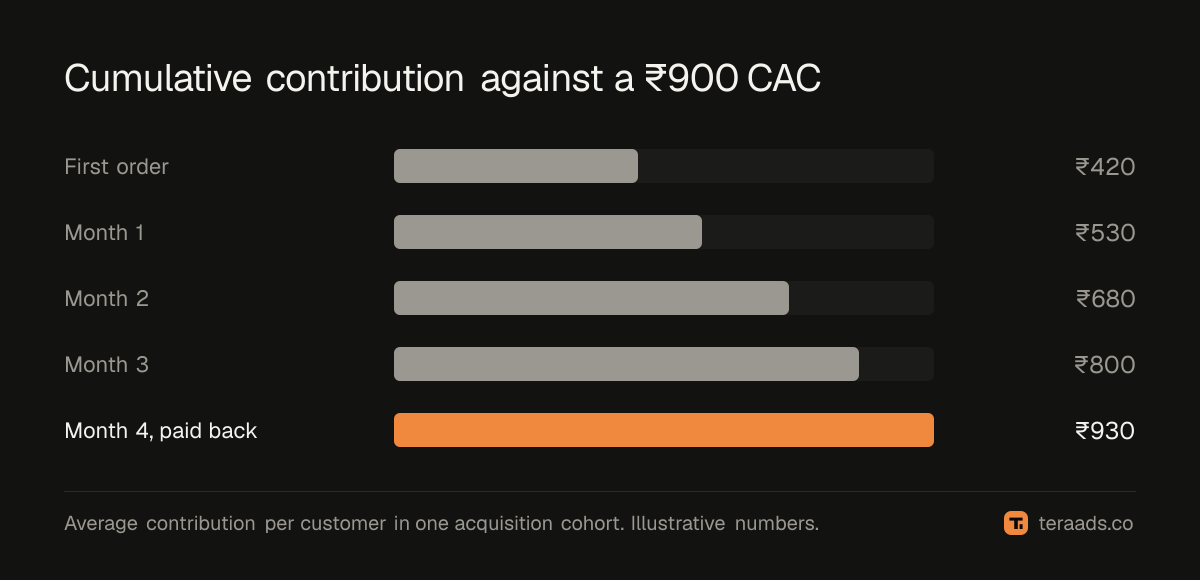
A skincare brand acquires new customers at a blended CAC of ₹900. Its numbers, measured on customers acquired in one month:
| Month | Average contribution per customer | Running total | Paid back? |
|---|---|---|---|
| Month 0 (first order) | ₹420 | ₹420 | No |
| Month 1 | ₹110 | ₹530 | No |
| Month 2 | ₹150 | ₹680 | No |
| Month 3 | ₹120 | ₹800 | No |
| Month 4 | ₹130 | ₹930 | Yes |
The first order covers less than half of CAC. Repeat orders from the customers who come back close the gap in month 4. Until then, the brand has paid out more than it has earned from that cohort.
What's a healthy payback period?
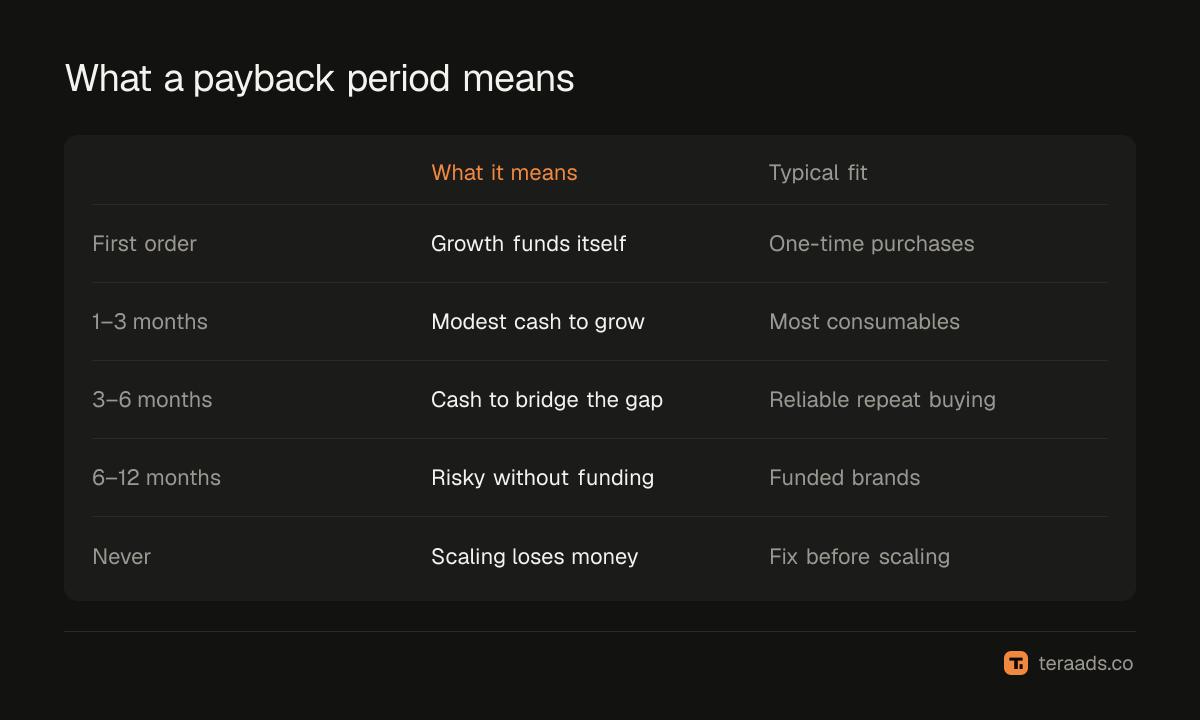
There's no universal number, but these ranges are useful for D2C brands:
| Payback | What it means |
|---|---|
| On the first order | Every new customer is profitable immediately; growth funds itself |
| 1–3 months | Healthy for most consumables; modest cash needed to grow |
| 3–6 months | Workable if repeat rates are reliable and you have cash to bridge |
| 6–12 months | Risky for most brands without funding; small changes in retention hurt |
| Never | Customers don't repay their acquisition cost; scaling loses money |
Products bought once, such as jewellery, furniture or electronics, usually need first-order payback, because repeat purchases are rare. Consumables can afford longer payback, because repeat buying is predictable.
Why payback matters for cash
Two brands can have the same LTV to CAC ratio and very different cash needs. If one pays back in month 1 and the other in month 9, the second must fund nine months of acquisition before it sees the money back. When it scales spend, its cash need grows fast. Payback is what tells you how much growth your bank balance can support.
Measure it by cohort
Calculate payback for customers acquired each month, not for all customers together. Customers acquired during a big sale often repeat less than those acquired at full price. A new channel can bring customers with different habits. Cohorts show these differences; one blended number hides them. The LTV to CAC guide uses the same cohort approach.
Recent cohorts haven't had time to repeat, so their payback is unknown. Compare cohorts at the same age, such as contribution after 90 days.
Shortening payback
- Raise first-order contribution: bundles, free shipping thresholds and fewer discounts on the first order.
- Cut returns and RTO: for cash-on-delivery stores, refused orders eat first-order contribution; confirmation calls and prepaid nudges help.
- Lower CAC: cut campaigns that bring buyers who never repeat, and creative that brings only discount hunters.
- Bring repeats forward: timely reminders for consumables, and a second-order offer at the right moment.
Payback for cash-on-delivery brands
Cash on delivery stretches payback in two ways. First, the money arrives later: the courier collects cash at the door and remits it to you, often a week or more after delivery, so even first-order contribution isn't in your account the day the order is placed. Second, refused orders cost money and bring nothing back. You pay shipping out and back, plus packaging, and the customer you paid to acquire hasn't really been acquired.
A simple way to include both is to calculate CAC on delivered customers only. If you spent ₹90,000 and gained 120 new customers by orders placed, but only 100 accepted delivery, your real CAC is ₹900, not ₹750. Then take first-order contribution after deducting the cost of the refused orders, spread across the delivered customers. Payback built this way is slower than the version based on placed orders, but it matches what your bank balance actually does.
Prepaid nudges help payback directly: a prepaid first order is usually refused less often, and the money arrives at checkout. Even a small shift from COD to prepaid can bring payback forward for a COD-heavy brand. The COD vs prepaid guide covers the trade-offs.
Common mistakes
Using revenue instead of contribution. Revenue makes payback look several times faster than it is.
Ignoring RTO. Refused COD orders have a cost and no contribution.
Blending all customers. Cohorts acquired in sales and at full price behave differently.
Counting immature cohorts. Customers acquired last month haven't had time to repeat.
Using platform CAC. Meta and Google attribute generously; use total spend divided by new customers from Shopify.
Tera Ads works out profit after product costs, shipping and returns from your Shopify orders, beside Meta Ads and Google Ads spend, which gives you the contribution and spend figures payback is built from. It is free for one business.
Frequently asked questions
How do you calculate CAC payback period?
Divide CAC by monthly contribution per customer, or more accurately, add up contribution per customer month by month from acquisition until it reaches CAC.
What is a good CAC payback period for D2C?
Paying back on the first order is ideal. One to three months is healthy for consumables; beyond six months is risky without funding.
Should payback use revenue or profit?
Contribution: revenue minus product cost, shipping, fees and returns. Revenue makes payback look much faster than it really is.
What's the difference between CAC payback and LTV to CAC?
LTV to CAC says how much a customer returns compared with their cost; payback says how quickly. A brand needs both to be healthy.
How do returns affect CAC payback?
Returns and refused cash-on-delivery orders reduce contribution, so payback takes longer. Include them in contribution per customer.