Chargebacks and Profit: What a Dispute Really Costs a Shopify Store
A lost chargeback costs the order, a $15 Shopify Payments fee, the product and the shipping. Card network limits, how to count disputes in profit, and how to cut them.
On this page
A lost chargeback costs a Shopify store the full order amount, a dispute fee of $15 in the US with Shopify Payments, and the product and shipping it already paid for, so one dispute can wipe out the profit of several good orders. Card networks and Shopify also watch your dispute rate and act when it climbs. Count each chargeback against the month of the original order, and cut them with a clear statement name, tracking and fast refunds.
Key takeaways
- A chargeback takes the order amount and a fee out of your payout straight away. In the US, Shopify Payments charges $15.
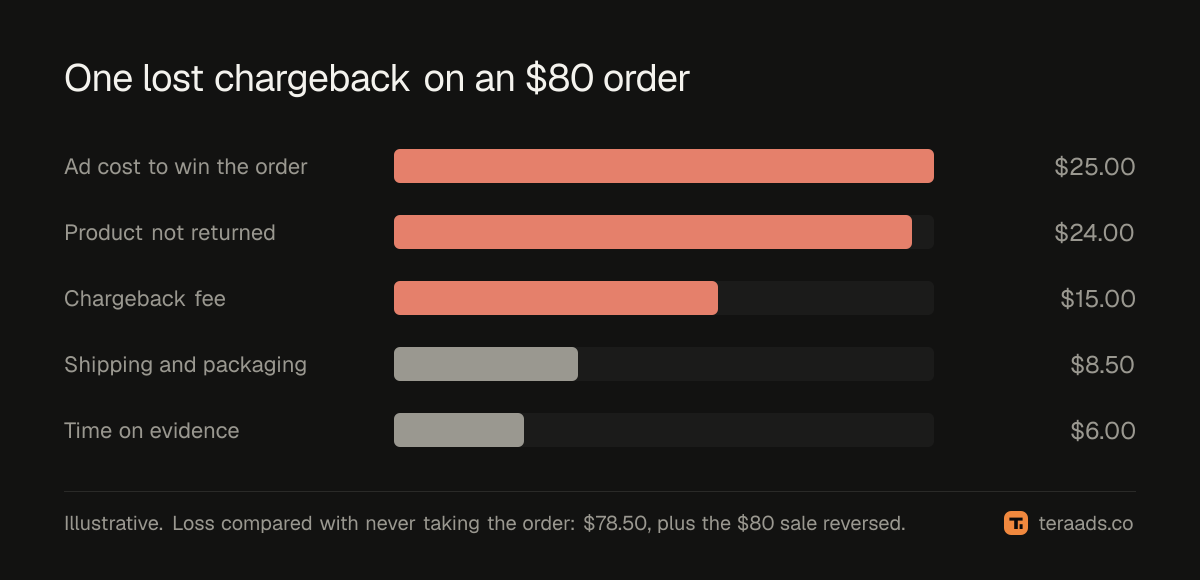
- In the worked example, one lost dispute on an $80 order costs $78.50 more than never taking the order, about four good orders' profit after ads.
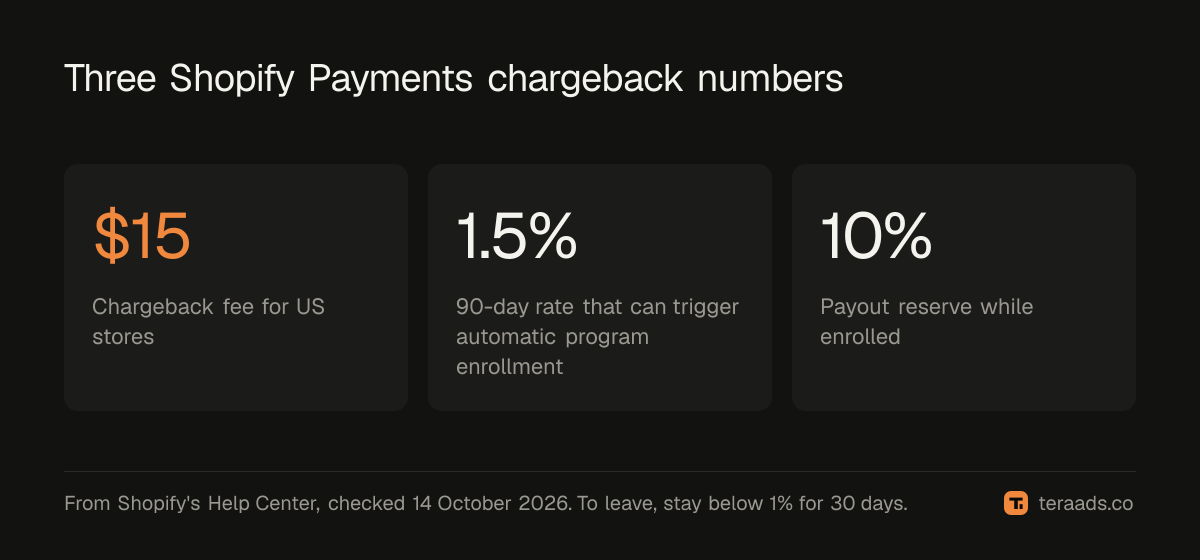
- Shopify counts every dispute customers open, won or lost. At 1.5% over 90 days, it can enroll you in a dispute program with a 10% payout reserve.
- Count chargebacks against the month the order was placed, like returns.
- A recognizable statement name, tracking, easy contact and fast refunds prevent most avoidable disputes.
What a chargeback is
A chargeback happens when a cardholder asks their bank to reverse a payment. With Shopify Payments, the disputed amount and a chargeback fee are withdrawn right away, and you usually have 7 to 21 days to build a response (Shopify: chargeback process). Your response goes to the card company on the due date even if you haven't added evidence.
If you win, you get the disputed amount back. Shopify's chargeback process page says the fee is returned too, while its overview says that can depend on your country or region (Shopify: chargebacks). An inquiry is the earlier, softer step: the bank asks questions but doesn't take the money or a fee yet.
Common reasons for disputes:
- Fraud. Someone used a stolen card, and the real cardholder disputes it.
- Item not received. The parcel was late, lost or delivered somewhere the buyer didn't check.
- Not as described. The product didn't match the page.
- Not recognized. The buyer doesn't recognize the name on their statement.
- Refund not processed. The buyer returned the item or canceled, and didn't get the money back in time.
What one chargeback costs
Take an illustrative $80 order, price before tax. Product cost is $24, shipping and packaging $8.50, and the order came from an ad with a $25 cost per purchase. A normal order leaves $44.88 of contribution before ads, after a $2.62 card fee, or $19.88 after the ad cost. Here's what a lost dispute on it costs:
| Line | Amount |
|---|---|
| Order amount reversed by the bank | $80.00 |
| Shopify Payments chargeback fee (US) | $15.00 |
| Product shipped and not returned | $24.00 |
| Shipping and packaging already paid | $8.50 |
| Time to gather evidence, 20 minutes at $18 an hour | $6.00 |
| Ad cost to win the order | $25.00 |
| Cash taken from your payout | $95.00 |
| Loss compared with never taking the order | $78.50 |
The $78.50 is $15 + $24 + $8.50 + $6 + $25. Against the $19.88 a normal order makes after ads, one lost chargeback cancels the profit of about four good orders. This leaves out the card fee on the original sale, so it's on the low side.
PayPal has its own fee. For payments through PayPal's checkout, it lists a standard dispute fee of $15 for US dollar transactions (PayPal merchant fees).
Dispute-rate limits: card networks and Shopify
The cost per dispute is only half the risk. Card networks and payment providers also watch your rate.
| Who | What they measure | Level that triggers action |
|---|---|---|
| Visa (VAMP) | Fraud reports plus disputes, divided by settled card-not-present transactions, each month | 1.5% with at least 1,500 fraud reports and disputes in the month, for merchants in the US, Canada, EU and Asia Pacific from 1 April 2026 (Visa) |
| Mastercard (Excessive Chargeback Program) | Chargebacks in a month divided by the previous month's Mastercard transactions, in basis points | Set in Mastercard's monitoring manual for acquirers (Mastercard) |
| Shopify Payments | All disputes customers open, won or lost, over the last 90 days | 1.5% or higher can mean automatic enrollment in a dispute resolution program with a 10% payout reserve (Shopify) |
What this means for a small store: Visa's merchant level needs at least 1,500 fraud reports and disputes in a month, which a store taking a few thousand orders won't reach. Shopify's own 1.5% over 90 days applies at any size. At 2,000 orders a month, that's about 90 disputes in three months.
Shopify says your chargeback rate is based on all disputes customers open, not just the ones you lose (Shopify: chargeback monitoring). A high rate can bring an account health notice and actions such as a reserve on payouts. In the dispute resolution program, US stores pay $15 for each dispute resolved through it, and to leave, the 90-day rate has to fall below 1.00% and stay there for 30 days in a row.
How to count chargebacks in monthly profit
Chargebacks arrive weeks after the sale, sometimes months. Treat them like returns:
- Count them against the month the order was placed. Otherwise the month of the sale looks better than it was and a later month takes the hit. The monthly P&L guide shows the layout.
- Keep open disputes provisional. Until they're decided, estimate the loss from your win rate.
- Count the fee and the reversed revenue. If your P&L already counts product cost and shipping for every order shipped, a lost chargeback removes the revenue and adds the fee and your time.
- Track the rate both ways. Disputes opened ÷ card orders, monthly and on a rolling 90 days, because that's how Shopify looks at it.
- Split them by reason. Fraud, item not received and not recognized have different fixes.
An illustrative month: 2,000 orders and 6 disputes, a 0.3% rate. The brand wins 2 and loses 4. Each lost one removes $80 of revenue and adds the $15 fee and $6 of time, so $101. Each won one still costs $6 of time. The month's profit is $416 lower than if those six orders had gone smoothly: 4 × $101 + 2 × $6.
Chargebacks belong in contribution margin too, as an expected cost per order. Here, $416 over 2,000 orders is about 21¢ an order. Small, until a fraud wave doubles it.
How to reduce chargebacks
- Make your charge easy to recognize. In Shopify Payments, go to Settings > Payments, click Manage, and set the statement name and phone number under Customer billing statement. The name must be 2 to 19 characters and include your shop name, legal name, store name or URL (Shopify: configuring Shopify Payments).
- Ship with tracking and send it to the customer. Tracking and delivery confirmation are your evidence for item-not-received disputes, and they stop many of them from starting.
- Refund fast when a customer asks. A refund loses the sale and the card fee, but there's no dispute fee and nothing added to your chargeback rate.
- Make contact easy. Put an email address and phone number in the order confirmation and on the site. A buyer who can reach you rarely calls the bank.
- Write a clear return policy and follow it. Late refunds on returned items are a common reason for disputes.
- Check risky orders before you ship. Review orders flagged by fraud analysis and hold or cancel the ones you can't verify. Canceling before shipping costs far less than a fraud chargeback.
- Respond to every inquiry and dispute. Send tracking, delivery proof, product photos and messages before the deadline.
When to fight and when to accept
Fight when you have evidence: proof of delivery to the right address, messages with the buyer, a product that matches the page. On an $80 order, winning recovers $95 with the fee. If you win four in ten disputes like it, each response is worth about 0.4 × $95 = $38 for $6 of time.
Accept when the customer has a point, then fix the cause: a slow refund, a confusing statement name, a misleading photo. And refund faster next time, before it becomes a dispute.
Tera Ads works out profit for the whole store from Shopify sales, product cost (from the margin you set, 70% by default), Meta Ads and Google Ads spend, shipping, payment fees, returns and refunds, with returns counted in the month the order was placed. It also shows every Meta Ads and Google Ads campaign in one table with the ROAS each platform reports and the money-wasters marked. It's free for one business, with no card needed. For card fees and refunds, see payment fees and profit and what one return really costs.
Frequently asked questions
How much is the Shopify chargeback fee?
$15 for stores in the United States using Shopify Payments. It varies by country: Shopify lists £10 in the UK, for example. The fee and the disputed amount are withdrawn when the chargeback opens.
Do I get the chargeback fee back if I win?
You get the disputed amount back. Shopify's chargeback process page says the fee is returned if you win, while its overview says that can depend on your country or region, so check your payout after the decision.
What chargeback rate is too high?
For Shopify Payments, a chargeback rate of 1.5% or higher over 90 days can mean automatic enrollment in a dispute program with a 10% payout reserve, and leaving it needs a rate below 1.00% for 30 days. Aim to stay well below 1%.
Should I refund instead of waiting for a chargeback?
If the customer is likely to win, yes. A refund costs the sale and the card fee, but no dispute fee, no time on evidence and nothing on your chargeback rate.
How long do I have to respond to a chargeback?
Shopify says you usually have 7 to 21 days, and it shows the deadline for each dispute. With Shopify Payments, your response is submitted on the due date even if you haven't added evidence.
When should a chargeback count in my P&L?
In the month the original order was placed, the same as returns. Keep open disputes provisional until they're decided.