What One Return Really Costs a Shopify Brand: A USD Breakdown
A return costs more than the refund: shipping both ways, handling, packaging, stock you can't resell and payment fees you don't get back. A USD breakdown, and fixes.
On this page
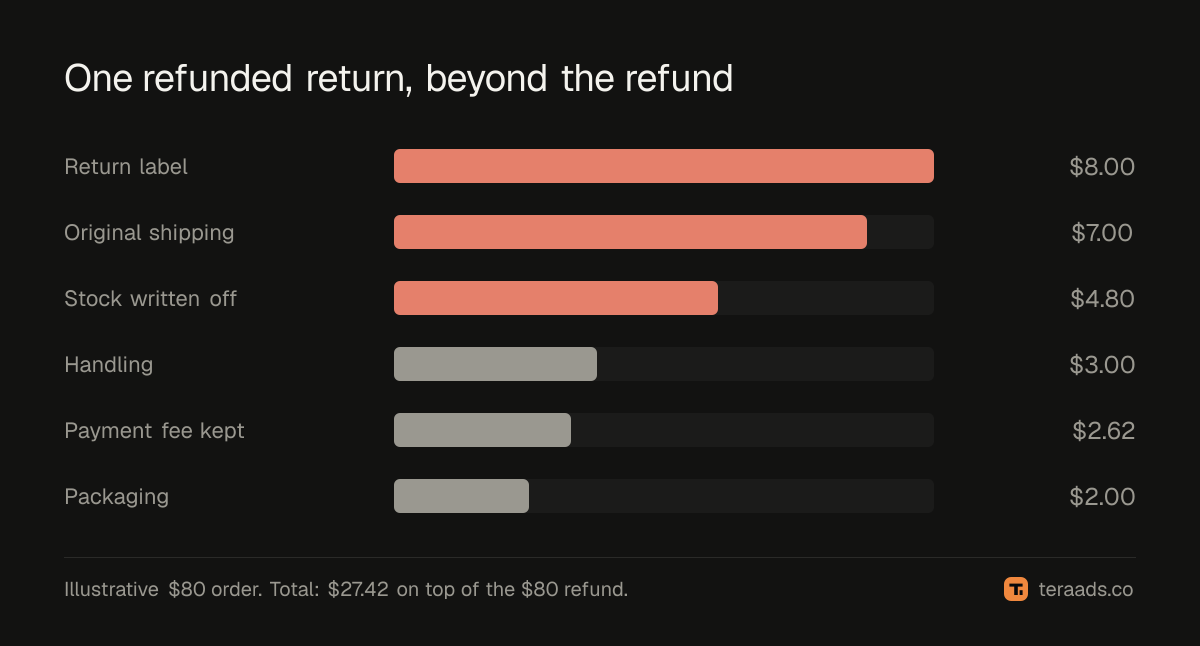
A refunded return costs a Shopify brand far more than the refund: the sale is gone, and you still pay for shipping both ways, handling, packaging, stock you can't resell and payment fees that aren't returned. In the illustrative example below, one return on an $80 order costs $27.42 on top of the refund, turning an order that would have made $44.88 into a loss. Exchanges, clearer product pages and fast restocking bring the cost down.
Key takeaways
- The cost of a return is the lost sale plus shipping both ways, handling, packaging, stock you can't resell and payment fees you don't get back.
- Shopify doesn't refund card fees on refunded Shopify Payments orders, and PayPal keeps the fees on the original payment.
- In the worked example, a refunded $80 order costs $27.42 beyond the refund, plus the ad spend that won it.
- An exchange keeps the revenue and still makes money; offer it before a refund.
- Count return costs against the month the order was placed, so monthly profit stays honest.
What a return costs, line by line
A return touches almost every cost in the order. Here's each one:
- The refund. The revenue goes. If you counted it in ROAS or monthly sales, it has to come back out.
- Original shipping. You paid to send the parcel. With a refund, nothing pays for it now.
- Return shipping. If you send the customer a prepaid label, you pay again. Shopify can create return labels when your primary location and the customer's address are both in the United States (Shopify: creating returns).
- Handling. Someone opens the parcel, inspects the item, restocks it and records the return.
- Packaging. The original mailer is usually lost, and the item may need repacking.
- Stock you can't resell. Some items come back worn, damaged, without tags or out of season.
- Payment fees. Shopify says that if an order was processed through Shopify Payments, you don't get any credit card fees refunded. If you use a third-party gateway in a country where Shopify Payments is available, Shopify's transaction fees aren't refunded either (Shopify: refunding orders). PayPal charges nothing to make a refund, but the fees you paid to receive the payment aren't returned (PayPal merchant fees).
- The ad spend that won the order. It's spent either way.
A worked example in US dollars
An illustrative brand sells an $80 product, price before tax, with free shipping. Product cost is $24. It pays $7 to ship each order and $1.50 for packaging, and takes card payments through Shopify Payments on the Basic plan in the US at 2.9% + 30¢ (Shopify pricing), which is $2.62 on $80. A kept order leaves $80 − $24 − $7 − $1.50 − $2.62 = $44.88 of contribution before ads.
Now the customer sends it back for a refund:
| Cost line | Amount | How it's worked out |
|---|---|---|
| Original shipping, now unpaid for | $7.00 | Paid when the order shipped |
| Return label | $8.00 | Prepaid label sent to the customer |
| Payment fee not returned | $2.62 | 2.9% + 30¢ on $80, kept on refund |
| Packaging | $2.00 | Original mailer lost, plus repacking |
| Handling | $3.00 | 10 minutes at $18 an hour |
| Stock you can't resell | $4.80 | 1 in 5 returns written off × $24 cost |
| Cost of the return | $27.42 | On top of the $80 refund |
Compared with a kept order, the return is a swing of $44.88 + $27.42 = $72.30. If the order came from an ad with a $25 cost per purchase, that $25 is gone too, and the order ends $52.42 in the red.
It adds up quickly. At 1,200 orders a month and a 12% refund rate, that's 144 returns × $27.42, about $3,950 a month in return costs, before the lost revenue and the ad spend on those orders.
Your own numbers will differ, sometimes a lot. Heavy or bulky products cost more to ship back. Products where fit matters, such as clothing and shoes, tend to come back more often. Items that can't be resold, such as opened cosmetics, push the write-off line up. Put your own costs into the table rather than borrowing these.
Refund or exchange: what each costs
An exchange keeps the $80 of revenue. It still costs the return label ($8), a second shipment ($7), handling ($3), repacking ($2) and the same expected write-off ($4.80), which is $24.80 in all. The payment fee stays part of a normal order, because nothing is refunded. So the order still makes $44.88 − $24.80 = $20.08, instead of losing $27.42.
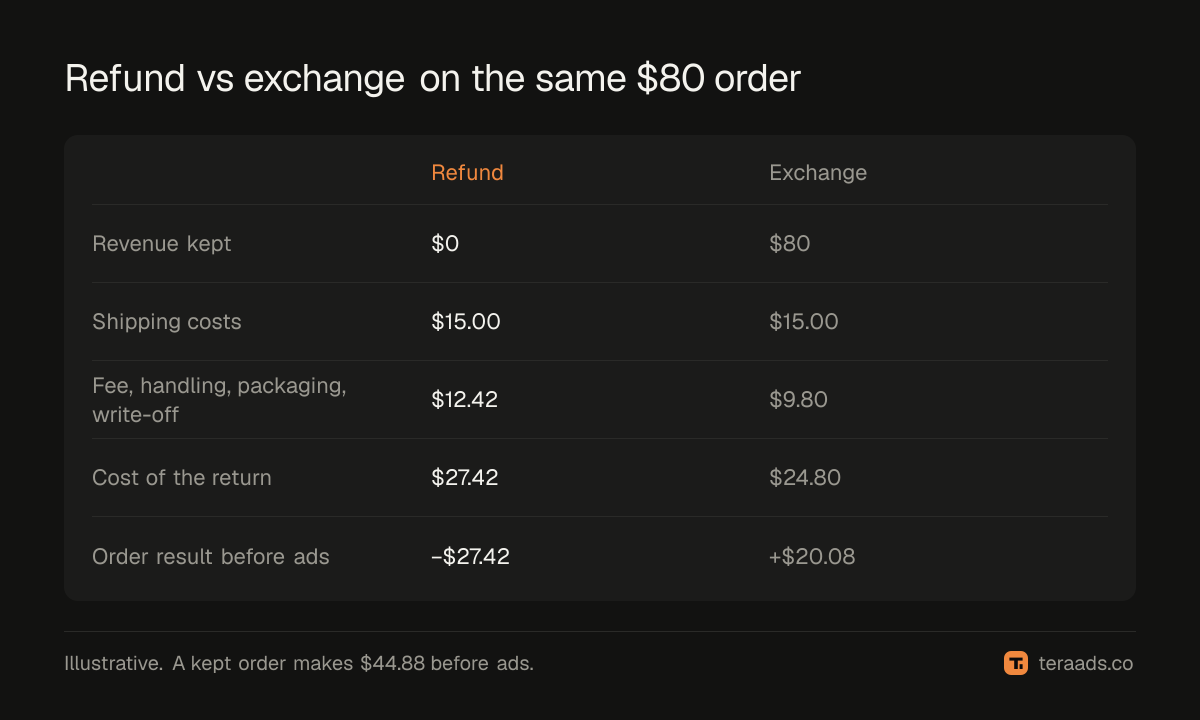
That's why many brands offer an exchange or store credit first, and make it easier than a refund: instant exchanges, free return labels for exchanges only, or a small bonus on store credit. Store credit keeps the cash now, and you ship goods later.
What Shopify and the law let you charge
Shopify's return rules let you set a return window, charge a restocking fee as a percentage of the return, add a flat return shipping fee charged once per return, and mark products or collections as final sale (Shopify return rules).
What you're allowed to charge depends on where your customers are:
- EU. Shoppers can cancel an online order within 14 days of delivery. They usually pay return postage themselves, unless the seller offered to pay or didn't tell them about the cost before they bought (Your Europe).
- UK. You must refund within 14 days of getting the item back, including the cost of standard delivery, and you can't deduct fees unless the item has been used or damaged (GOV.UK).
A return fee recovers part of the cost and discourages ordering three sizes to keep one. It can also put off some buyers. Test it on part of your traffic, and watch conversion rate and repeat purchase as well as return rate.
How to bring the cost down
- Find out why things come back. Record a reason on every return; Shopify's reports that group returned items by reason use those return reasons. Fix the top reason first.
- Fix the product page. Size charts with real measurements, honest photos, materials and care details prevent the "not as expected" returns.
- Offer an exchange or store credit first. In the example, an exchange turns a $27.42 loss into a $20.08 profit.
- Inspect and restock fast. The sooner an item is back on sale, the less you write off, especially seasonal stock.
- Price return shipping into the policy. Where the law allows, a flat return fee or free exchanges with paid refunds.
- Stop advertising the worst offenders. A product with double the return rate has a much lower real margin. Contribution margin by product shows how to find it.
Where returns belong in your numbers
Count return costs against the month the original order was placed, not the month the parcel came back. Otherwise one month looks better and the next looks worse. Shopify's sales report shows returns on the date they were processed (Shopify sales report), so regroup them by order date for your monthly P&L.
Returns also change what your ads really earn. True ROAS after refunds shows the adjustment, and contribution margin shows where return costs sit in the margin stack. In cash-on-delivery markets there's a second kind of return, parcels refused at the door; returns vs RTO covers the difference.
Tera Ads works out profit for the whole store: Shopify sales minus product cost (from the margin you set, 70% by default), Meta Ads and Google Ads spend, shipping, payment fees, returns and refunds. Returns are counted in the month the order was placed, and a month settles after about 45 days. It also shows every Meta Ads and Google Ads campaign in one table with the ROAS each platform reports. It's free for one business, with no card needed.
Frequently asked questions
How much does a return cost an online store?
More than the refund. Add original and return shipping, handling, packaging, the share of returns you can't resell and payment fees you don't get back. In the example above, that's $27.42 on an $80 order, before the ad spend that won it.
Does Shopify refund processing fees when I refund an order?
No. Shopify says that for orders processed through Shopify Payments, you don't get any credit card fees refunded. If you use a third-party gateway where Shopify Payments is available, Shopify's transaction fees aren't refunded either.
Who pays for return shipping?
It depends on your policy and the market. In the EU, shoppers usually pay return postage unless the seller offered to pay or didn't tell them the cost before purchase. If you send prepaid labels, you pay.
Is an exchange cheaper than a refund?
An exchange still costs two shipments and handling, but it keeps the revenue. In the example, the exchanged order still makes $20.08 while the refunded one loses $27.42.
Can I charge a restocking fee on Shopify?
Shopify's return rules let you charge a restocking fee as a percentage of the return and a flat return shipping fee. Check the rules where your customers are first: in the UK, you can't deduct fees from a refund unless the item was used or damaged.
How do I include returns in contribution margin?
Take refunds out of revenue, then add return shipping, handling, packaging, written-off stock and kept payment fees to costs, all against the month the order was placed.