Payment Processing Fees: How Card and Wallet Fees Eat Your Margin
Shopify Payments rates by plan, third-party gateway fees and PayPal: what they cost on a typical order, and how to put them in contribution margin and break-even ROAS.
On this page
Payment processing fees take a percentage of every order plus a fixed charge, and on Shopify's Basic plan in the US they come to about 3.3% of an $80 order. You pay them on every sale, you don't get them back when you refund, and they're higher on small orders, premium and international cards, PayPal and third-party gateways. Put them into contribution margin per order, and your break-even ROAS rises with them.
Key takeaways
- Shopify Payments in the US charges 2.9% + 30¢ per online card payment on the Basic plan, down to 2.25% + 30¢ on Plus.
- A third-party payment provider adds a Shopify fee of 2%, 1%, 0.6% or 0.2% by plan, on top of the provider's own fee.
- The fixed 30¢ makes small orders expensive: about 3.9% of a $30 order against 3.1% of a $150 one.
- Neither Shopify Payments nor PayPal returns its fees when you refund an order.
- Include fees in contribution margin. In the example below they move break-even ROAS from 1.68x to 1.79x.
What Shopify Payments charges in the US
These are the online rates on Shopify's US pricing page, checked on 14 October 2026 (Shopify pricing). Shopify shows the rates for the country you're in, so check the page for your own store's country.
| Plan | Online standard cards | Online premium cards | International cards | Third-party provider fee |
|---|---|---|---|---|
| Basic | 2.9% + 30¢ | 3.5% + 30¢ | +1% | 2% |
| Grow | 2.7% + 30¢ | 3.3% + 30¢ | +1% | 1% |
| Advanced | 2.5% + 30¢ | 3.1% + 30¢ | +1% | 0.6% |
| Plus | 2.25% + 30¢ | 2.95% + 30¢ | +1% | 0.2% |
On the same page, plans cost $39, $105 and $399 a month for Basic, Grow and Advanced on monthly billing, or $29, $79 and $299 a month billed yearly. Plus starts at $2,300 a month.
Rates differ by country
Shopify Payments rates are set country by country. On Basic, the online standard card rate is 2% + 25p in the UK (Shopify UK pricing), 2.8% + 30¢ CAD in Canada (Shopify Canada pricing) and 1.7% + 30¢ AUD in Australia (Shopify Australia pricing). All three pages list the same third-party provider fees as the US: 2%, 1%, 0.6% and 0.2% by plan.
If your store is in one country and most customers are in another, international card rates apply to more of your orders than you might expect. In the US, that's an extra 1% per international card payment.
Third-party gateways and PayPal
Shopify charges its third-party transaction fee when you take payments through another provider instead of Shopify Payments. You then pay two fees on the same order: the provider's, and Shopify's percentage for your plan.
PayPal is the most common extra method. PayPal's US fee page, last updated 1 October 2026, lists PayPal Checkout at 3.49% plus a fixed fee of $0.49 for US dollar payments (PayPal merchant fees). Shopify's US pricing page lists PayPal wallet payments from 3.49% + 49¢.
Refunds don't give fees back. Shopify says that for orders processed through Shopify Payments, you don't get any credit card fees refunded, and that with a third-party gateway in a country where Shopify Payments is available, Shopify's transaction fees aren't refunded either (Shopify: refunding orders). PayPal doesn't charge to make a refund, but the fees you paid to receive the payment aren't returned.
Fees as a share of a typical order
Because of the fixed part, the fee takes a bigger bite out of small orders. Here's what Shopify's US rates and PayPal's rate come to on different orders:
| Order and payment method | Fee | Share of the order |
|---|---|---|
| $30, card on Basic | $1.17 | 3.9% |
| $50, card on Basic | $1.75 | 3.5% |
| $80, card on Basic | $2.62 | 3.3% |
| $150, card on Basic | $4.65 | 3.1% |
| $80, card on Plus | $2.10 | 2.6% |
| $80, international card on Basic | $3.42 | 4.3% |
| $80, PayPal Checkout | $3.28 | 4.1% |
| $80, third-party gateway on Basic | $4.22 | 5.3% |
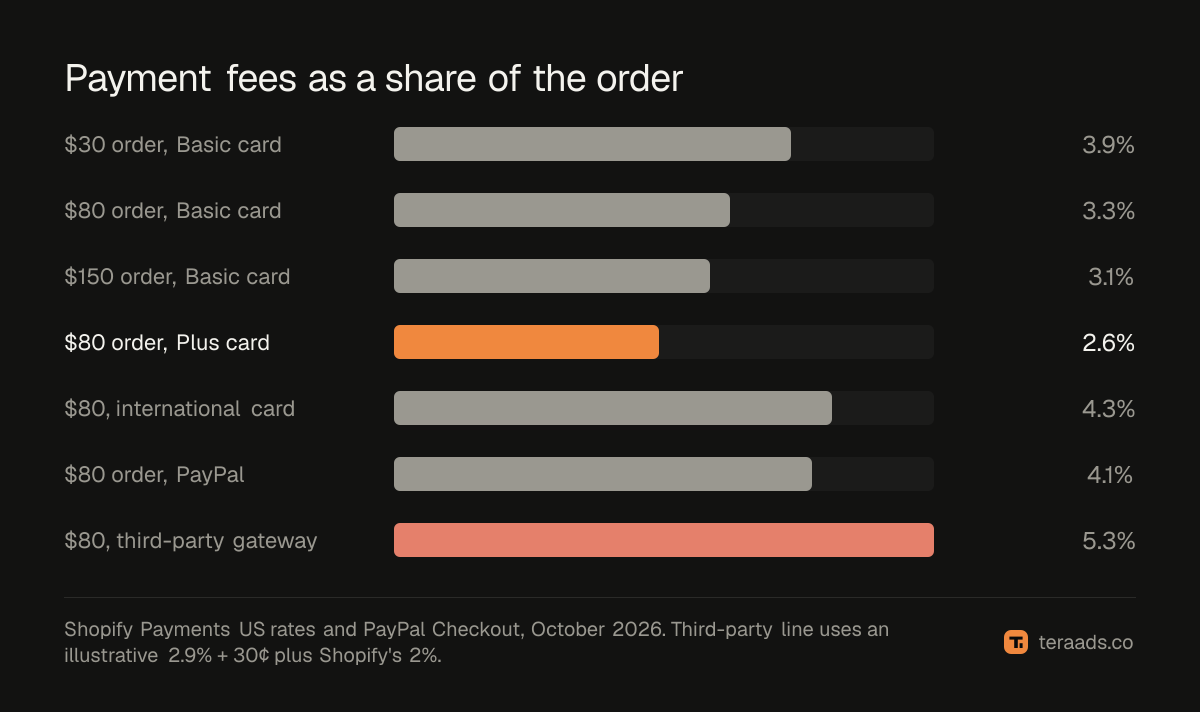
A brand with a $30 average order loses nearly 4% of revenue to fees. One with a $150 average order loses about 3%. On thin margins, that point matters.
Putting fees into contribution margin and break-even ROAS
Fees are a variable cost of every order, so they belong in contribution margin next to product cost, shipping and packaging. The contribution margin guide lists the full stack.
Take an illustrative brand with an $80 average order before tax, $24 product cost, $7 shipping and $1.50 packaging. 85% of orders are paid by card through Shopify Payments on Basic ($2.62 each) and 15% through PayPal ($3.28). The blended fee is 0.85 × $2.62 + 0.15 × $3.28, about $2.72 an order.
- Without fees: $80 − $24 − $7 − $1.50 = $47.50 of contribution, a 59.4% margin. Break-even ROAS is 1 ÷ 0.594, about 1.68x.
- With fees: $47.50 − $2.72 = $44.78, a 56.0% margin. Break-even ROAS is 1 ÷ 0.560, about 1.79x.
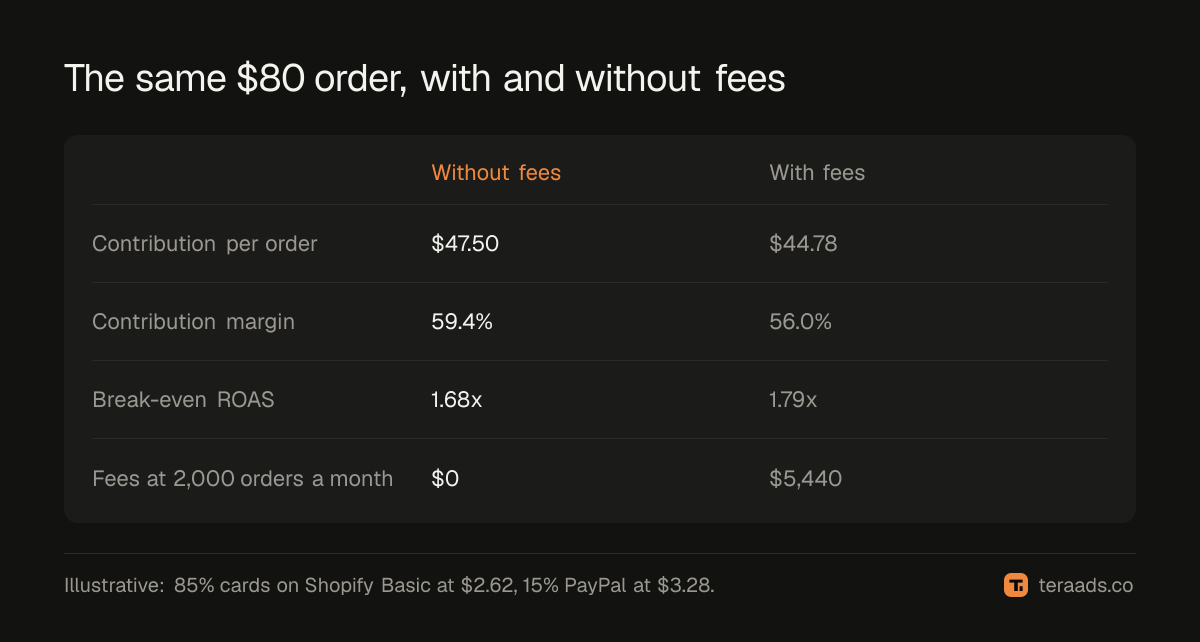
At 2,000 orders a month, that's about $5,440 in fees. Leave them out and the brand thinks it can pay $47.50 to win an order when the real limit is $44.78. On a campaign running at 1.7x ROAS, it's the difference between a small profit and a small loss. The break-even ROAS guide has the formula.
Refunds push the real cost higher. If 10% of orders are refunded and the fees on them are kept, the $2.72 is paid on every order but only nine in ten stay. Spread over kept orders, the fee is $2.72 ÷ 0.9, about $3.02. What one return really costs adds up the rest of a refund.
Is a higher plan worth it for the lower rate?
Each step up a plan cuts the online card rate by 0.2 points in the US until Plus, and costs more per month. Divide the extra monthly cost by the rate saving to find the card sales at which it pays for itself:
- Basic to Grow, billed yearly: ($79 − $29) ÷ 0.2% = $25,000 of card sales a month. On monthly billing, ($105 − $39) ÷ 0.2% = $33,000.
- Grow to Advanced, billed yearly: ($299 − $79) ÷ 0.2% = $110,000 a month. On monthly billing, ($399 − $105) ÷ 0.2% = $147,000.
Above those volumes, the lower rate more than pays for the plan. Below them, it doesn't, unless you need the plan's other features or pay third-party fees, where the gap between plans is wider.
Other ways to keep fees down
- Raise average order value. The fixed 30¢ matters less on a bigger basket; AOV tactics covers bundles and thresholds.
- Use Shopify Payments where it's available. Otherwise you pay a provider's fee plus Shopify's third-party fee on every order.
- Price the mix in. PayPal and international cards cost more. Blocking them usually costs more in lost sales, so include their share in your blended fee instead.
- Cut refunds and disputes. Fees on refunded orders are kept, and disputes add a fee of their own; chargebacks and profit covers those.
- Recheck rates once a year. Plans and rates change. Use the figure on your own pricing page, not last year's.
Tera Ads works out profit for the whole store with payment fees included: Shopify sales minus product cost (from the margin you set, 70% by default), Meta Ads and Google Ads spend, shipping, payment fees, returns and refunds. It also shows every Meta Ads and Google Ads campaign in one table with the ROAS each platform reports and the money-wasters marked. It's free for one business, with no card needed. Paid plans are on the pricing page in your own currency.
Frequently asked questions
What are Shopify Payments fees in the US?
On Shopify's US pricing page in October 2026, online standard card rates are 2.9% + 30¢ on Basic, 2.7% + 30¢ on Grow, 2.5% + 30¢ on Advanced and 2.25% + 30¢ on Plus. Premium and international cards cost more.
What is Shopify's third-party transaction fee?
A fee Shopify adds when you take payments through another provider instead of Shopify Payments: 2% on Basic, 1% on Grow, 0.6% on Advanced and 0.2% on Plus, on top of the provider's own fee.
Does Shopify refund processing fees when I refund an order?
No. Shopify says you don't get any credit card fees refunded on orders processed through Shopify Payments. PayPal also keeps the fees on the original payment.
Are PayPal fees higher than Shopify Payments?
For US dollar payments, PayPal Checkout is 3.49% + $0.49, against 2.9% + 30¢ for a standard card on Shopify's Basic plan. On an $80 order, that's $3.28 against $2.62.
Should payment fees be part of contribution margin?
Yes. They're paid on every order, so they're a variable cost like product and shipping. Leaving them out overstates margin and understates break-even ROAS.
How do I work out my blended payment fee?
Multiply each method's fee on your average order by its share of orders and add them up. In the example, 85% cards at $2.62 and 15% PayPal at $3.28 give about $2.72 an order.