Google Ads Quality Score: What the Three Parts Mean and What to Fix
Quality Score rates your Search keywords from 1 to 10 on expected CTR, ad relevance and landing page experience. How to read it, fix each part, and not chase it.
On this page
Quality Score is Google's 1-to-10 rating of each Search keyword, based on three parts: expected click-through rate, ad relevance and landing page experience. It's a diagnostic, not a target: Google says the score itself isn't used in the auction, though the signals behind it affect how your ads rank and what you pay. Use the three parts to find what's weak: tighten keyword and ad matching, sharpen ad copy, and send clicks to pages that answer the search.
Key takeaways
- Quality Score runs from 1 to 10 at keyword level, for Search campaigns.
- Each part is rated above average, average or below average, compared with other advertisers on the same searches over the last 90 days.
- The 1-to-10 number isn't an auction input, but expected CTR, ad relevance and landing page experience feed into Ad Rank at auction time.
- Fix the part rated below average; don't rewrite everything.
- Judge keywords on cost per kept order, not Quality Score.
The three parts
According to Google's Quality Score help page, checked on 8 October 2026:
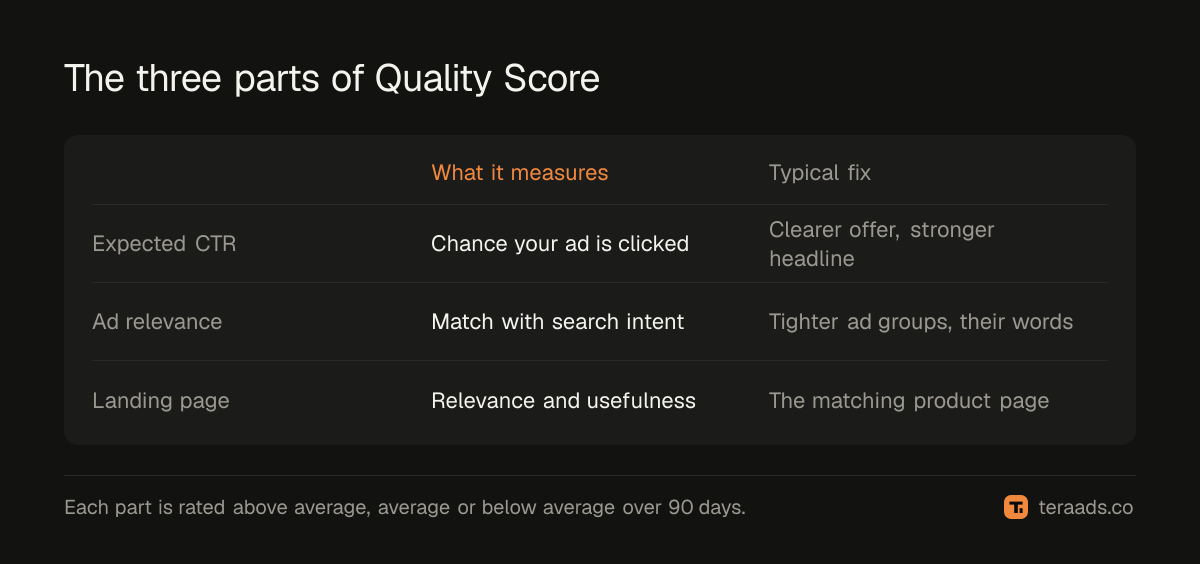
| Part | What it measures | Typical fix |
|---|---|---|
| Expected CTR | How likely your ad is to be clicked when shown | Clearer offer, stronger headline, specific call to action |
| Ad relevance | How closely your ad matches the intent behind the search | Group similar keywords; use their language in ads |
| Landing page experience | How relevant and useful your page is to people who click | Send clicks to the matching product or collection page |
Each part is rated above average, average or below average against other advertisers whose ads showed for the exact same search over the last 90 days.
Is it worth chasing?
Google says Quality Score is a diagnostic tool and shouldn't be treated as a key performance indicator. A keyword with a score of 5 that brings profitable orders is better than a 9 that brings refunds. Use the score to find problems on keywords that matter: high spend, poor results, or both.
Finding and fixing weak keywords, step by step
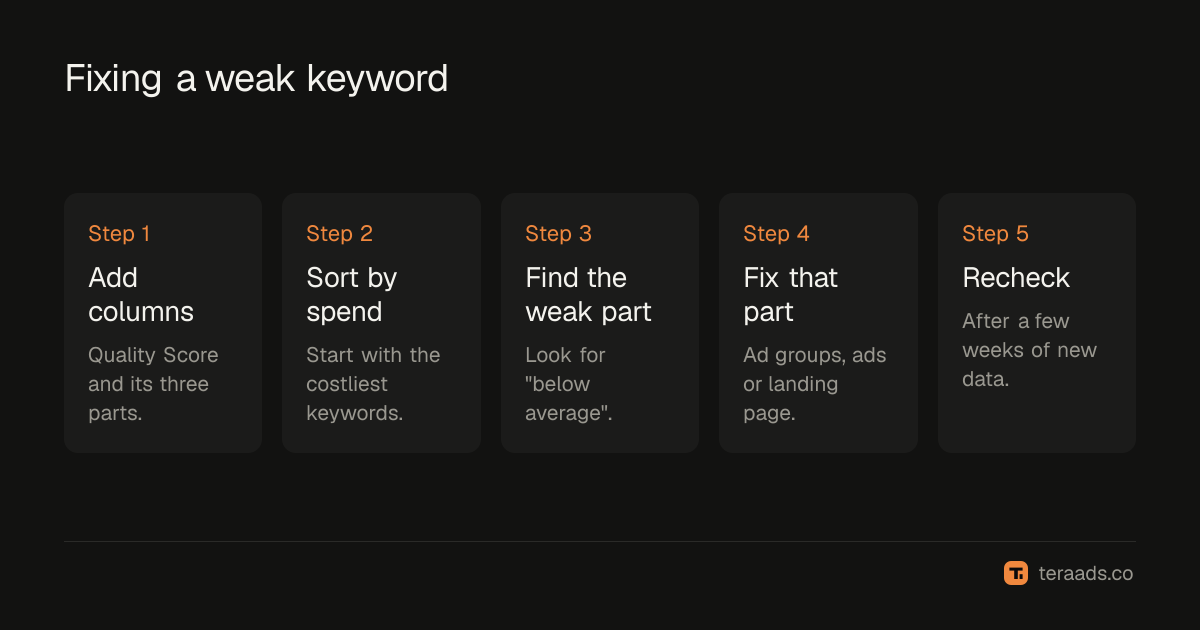
- Add the columns. In the Keywords view, add Quality Score and its three parts from the columns menu.
- Sort by spend. Focus on the keywords that cost the most.
- Find the weak part. Look for "below average" on any of the three.
- Fix ad relevance by splitting ad groups so each contains closely related keywords, and writing ads that use their words.
- Fix expected CTR with a specific benefit, price or offer, and a clear call to action.
- Fix landing page experience by linking to the exact product or collection page, fast on mobile, with price, delivery and returns visible.
- Recheck after a few weeks, since the ratings use recent history.
Quality Score and Shopify stores
Common causes of low scores for Shopify brands:
- Sending every keyword to the home page. Searches for "silver hoop earrings" should land on silver hoops.
- Broad ad groups. One ad group for all products can't be relevant to each search.
- Slow mobile pages. Heavy themes and apps slow product pages.
- Out-of-stock landing pages. Clicks that hit "sold out" waste money and hurt experience.
- Irrelevant searches. Broad match can show your ads for searches you don't serve; use negative keywords and review wasted search terms.
Brand keywords
Your own brand terms usually score highly, because searchers want you. That's why separating brand from non-brand campaigns matters: brand results flatter the account's averages. Brand vs non-brand search explains how to split them.
A worked example
A jewellery brand's keyword "silver hoop earrings" has a Quality Score of 4. The three parts show expected CTR average, ad relevance below average and landing page experience below average.
Looking closer:
- The ad group holds 40 keywords, from hoops to necklaces to rings, so one set of ads serves them all.
- The ads say "Shop beautiful jewellery online", which doesn't mention silver or hoops.
- The final URL is the home page.
The fixes follow the parts that are weak:
- Ad relevance: move hoop keywords into their own ad group, with ads that say "Sterling silver hoop earrings" and mention sizes or prices.
- Landing page experience: send clicks to the silver hoops collection, with prices, delivery times and the returns policy visible on mobile.
- Expected CTR, already average, may improve on its own once the ad matches the search; if not, test an offer or a specific benefit in the headline.
A few weeks later the keyword's score might rise, and more importantly, the cost per order from those searches should fall, because the people clicking found what they searched for.
What Quality Score doesn't tell you
Quality Score knows nothing about your margins, refusals or repeat customers. A keyword with a high score can still bring COD orders that are refused at high rates, and one with a modest score can bring loyal buyers. Treat it as a guide to relevance, then judge keywords on cost per kept order from Shopify and your courier.
Quality Score also exists only for Search keywords. Shopping and Performance Max don't show one, but the same ideas apply: titles that match how people search, product pages that answer the obvious questions, and offers worth clicking. For those campaigns, the product feed does the work that ad relevance does in Search; Google Shopping titles covers how to write titles that match searches. And whichever campaign type you run, the final test is the same: what each kept order costs compared with what it earns.
Common mistakes
Optimising the score instead of profit. It's a diagnostic.
Rewriting everything. Fix the part that's below average.
One landing page for all keywords. Relevance and experience suffer.
Ignoring search terms. Irrelevant searches drag down expected CTR.
Averaging scores across the account. Look at the keywords that spend.
Tera Ads shows every Google Ads and Meta Ads campaign beside your Shopify orders, with profit after RTO from Shiprocket and a deep dive into wasted Google search terms. It is free for one business.
Frequently asked questions
What is Quality Score in Google Ads?
A 1-to-10 rating for Search keywords based on expected CTR, ad relevance and landing page experience.
Does Quality Score affect what I pay?
The score itself isn't an auction input, but the signals behind it feed into Ad Rank, which affects position and cost.
How do I improve Quality Score?
Fix the part rated below average: tighter ad groups for relevance, stronger offers for CTR, matching pages for landing page experience.
Why is my Quality Score low?
Common causes are broad ad groups, generic ads, sending clicks to the home page and slow mobile pages.
Should I pause keywords with low Quality Score?
Not automatically. Judge keywords on cost per kept order; fix the weak part if the keyword matters.