iOS Privacy and Ads: What Apple's Changes Mean for Meta and Google
App Tracking Transparency and Link Tracking Protection limit how ads are measured on iPhones. What changed, how it affects Indian D2C brands, and what to do.
On this page
Apple's privacy features limit how ad platforms track people on iPhones: App Tracking Transparency asks users before apps track them across other companies' apps and websites, and Link Tracking Protection removes some click identifiers from links in certain apps and modes. Ad platforms see fewer conversions from iPhone users and model some of the gap. For Indian brands, where iPhones are a smaller share of buyers but often the higher-value ones, the fix is server events, UTMs and judging results on Shopify orders.
Key takeaways
- App Tracking Transparency, introduced with iOS 14.5 in 2021, requires apps to ask before tracking users across other companies' apps and sites.
- Many users decline, so Meta sees fewer conversions from iPhone users and estimates some of them.
- Link Tracking Protection, introduced in iOS 17, strips known tracking parameters from links in Mail, Messages and Safari Private Browsing.
- UTM parameters aren't removed by Link Tracking Protection, so Shopify can still record campaigns.
- Server-side events, UTMs and Shopify orders are the practical response.
App Tracking Transparency
Since iOS 14.5, apps must ask permission before tracking a user across apps and websites owned by other companies. When someone declines in the Instagram or Facebook app, Meta can't use that tracking to connect an ad view or click in its app with a purchase on your website in the usual way.
Meta responded with aggregated and modelled measurement: it combines the conversions it can observe with statistical estimates for those it can't. Reported results for iPhone users therefore include some modelled conversions, and reporting can be delayed.
Link Tracking Protection
From iOS 17, Safari removes known tracking parameters, such as click identifiers added by ad platforms, from links opened in Mail and Messages and from browsing in Safari Private Browsing. When a click identifier is removed, the platform has a harder time matching the click with a later purchase.
UTM parameters are not on that list, so links tagged with utm_source, utm_medium and utm_campaign keep them. That's one more reason to tag every ad; the UTM guide has the setup.
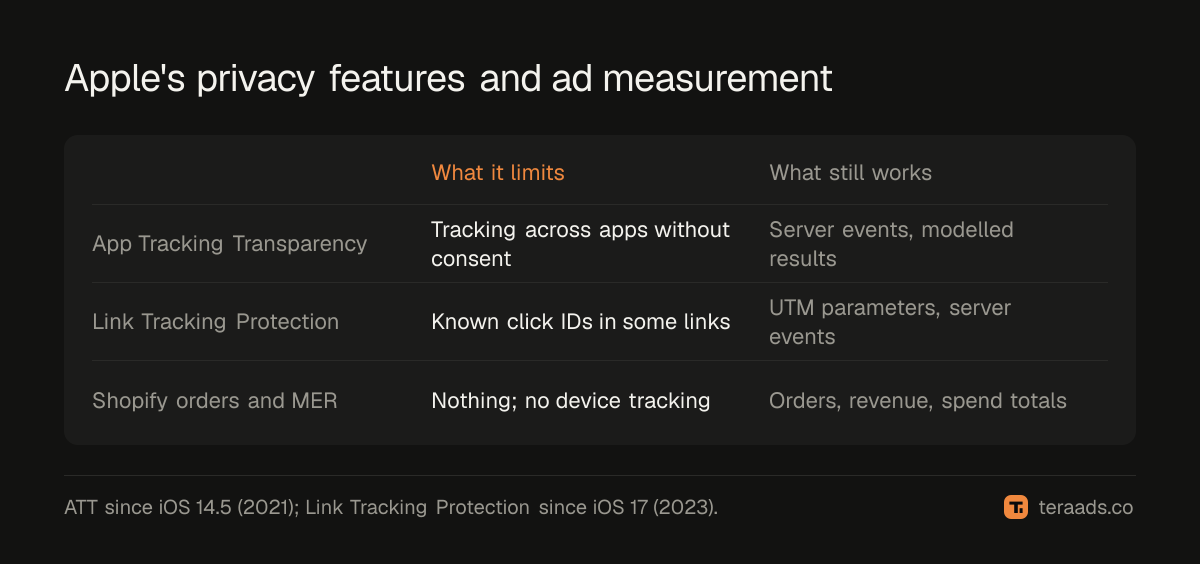
| Feature | Introduced | What it limits | What still works |
|---|---|---|---|
| App Tracking Transparency | iOS 14.5 (2021) | Tracking across other companies' apps and sites without permission | Server events with hashed customer details, modelled conversions |
| Link Tracking Protection | iOS 17 (2023) | Known click identifiers in links in Mail, Messages and Safari Private Browsing | UTM parameters, server events |
How it affects Indian D2C brands
iPhones are a minority of smartphones in India, but iPhone owners often buy more expensive products and place more prepaid orders. A jewellery or premium skincare brand can find that a meaningful share of its revenue comes from iPhone users, even if most visitors use Android. Under-measuring that group can make the campaigns that reach them look weaker than they are.
Android has its own privacy changes, and browsers on all devices increasingly restrict tracking. The direction is the same everywhere: platforms see less, model more and rely on data you share with them directly.
What to do
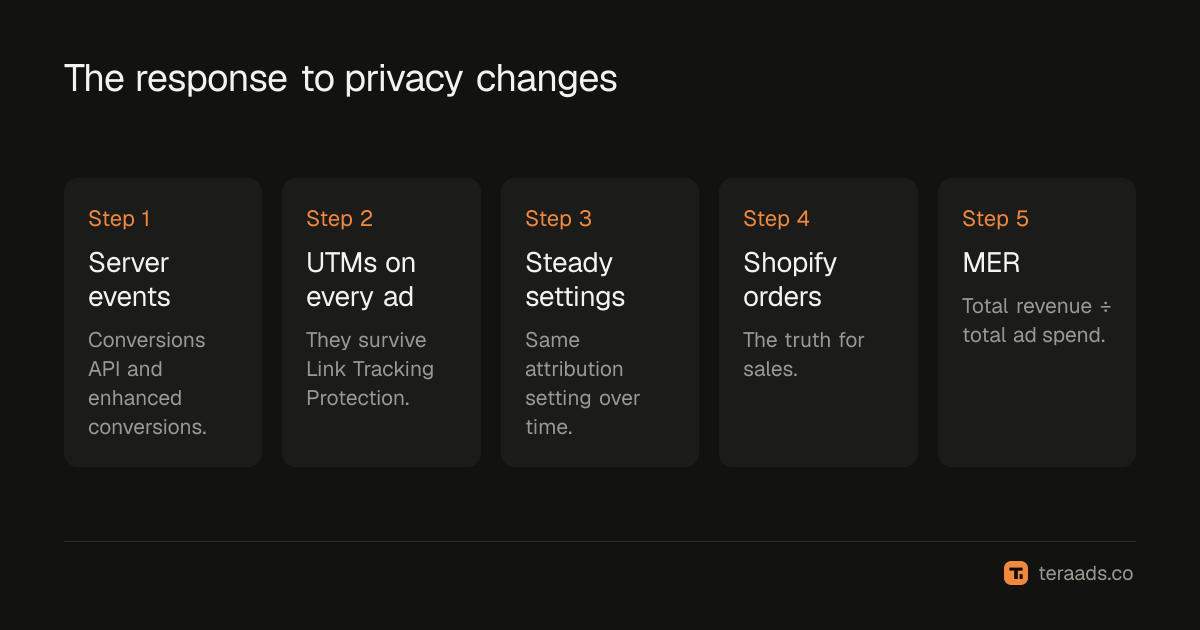
- Send server-side events. Meta's Conversions API and Google's enhanced conversions match purchases using hashed customer details rather than device tracking; see server-side tracking.
- Tag every ad with UTMs. Shopify records campaigns independently of the platforms, and UTMs survive Link Tracking Protection.
- Use standard attribution settings. Compare results on the same setting over time; attribution windows in 2026 covers Meta's options.
- Judge on Shopify orders. Total orders and revenue don't depend on any platform's tracking.
- Watch blended numbers. MER, total revenue divided by total ad spend, isn't affected by device tracking at all.
Reading platform numbers after privacy changes
Expect platform-reported conversions to be lower than real purchases, and some to be estimates. Results can also shift by a day or two as delayed and modelled conversions arrive, so don't judge yesterday's numbers too quickly. When platforms and Shopify disagree, Shopify's orders are the truth for sales; platform numbers are best used to compare campaigns with each other on the same platform.
Checking how much iPhone buyers matter to you
You can estimate the share of your business that comes from iPhone users with your own data. Shopify's analytics show sessions and conversion by device type, and Meta's reporting can break results down by impression device. If iPhone users are, say, a quarter of your revenue but a much smaller share of platform-attributed purchases, the platforms are under-crediting the campaigns that reach them.
Look at average order value and payment method too. If iPhone buyers place larger orders and pay online more often, they're also less likely to refuse delivery, which makes them worth more than their order count suggests. Campaigns that reach them may deserve more budget than platform ROAS implies, a decision worth confirming with a test rather than assuming.
What not to do
Some advice online suggests recovering tracking in ways that conflict with platform rules or user choices, such as fingerprinting devices. Avoid them: they break platform policies, can breach privacy law and put your ad accounts at risk. The legitimate options, server events sent with consent, UTMs and first-party data such as Shopify orders, recover most of what matters. Post-purchase surveys help too, because they ask buyers directly how they found you.
Common mistakes
Blaming creative for a measurement drop. A fall in reported conversions with steady Shopify orders is usually measurement.
Skipping UTMs. They're the simplest data that survives privacy features.
Relying on the browser pixel alone. Add server-side events.
Judging yesterday's results. Delayed and modelled conversions arrive later.
Assuming Android users are unaffected. Browser and platform privacy changes apply widely.
Tera Ads uses Shopify orders as the truth for sales and shows Meta Ads and Google Ads spend beside them, with profit after returns, so results don't depend on how much a platform can track. It is free for one business.
Frequently asked questions
How did iOS 14 affect Facebook ads?
App Tracking Transparency let iPhone users decline cross-app tracking, so Meta sees fewer conversions directly and models some of them, which reduces reporting accuracy.
What is Link Tracking Protection?
An iOS 17 feature that removes known tracking parameters, such as some ad click identifiers, from links in Mail, Messages and Safari Private Browsing.
Does iOS remove UTM parameters?
No. Link Tracking Protection targets known tracking identifiers; standard UTM parameters remain on links.
Do Apple's privacy changes matter in India?
Yes, for brands whose higher-value buyers use iPhones. Their purchases are under-measured by platforms, which can make campaigns reaching them look weaker.
How do I measure ads accurately after iOS changes?
Send server-side events, tag ads with UTMs, and judge results on Shopify orders and blended MER rather than platform numbers alone.