Meta Ads Retargeting for Shopify: Audiences, Windows and Budgets
Retargeting reaches people who visited your store but didn't buy. Which audiences to build, what windows to use, how much to spend and how to judge it honestly.
On this page
Retargeting shows ads to people who already interacted with your store, such as product viewers and cart abandoners, to bring them back to buy. It usually shows the best ROAS in the account, partly because many of those people would have bought anyway. Build a few audiences by intent, size the budget to the audience rather than to a round number, exclude recent buyers, and judge it on extra sales, not on its own ROAS.
Key takeaways
- Retargeting audiences are finite; spend more than they can absorb and frequency soars without more sales.
- Segment by intent: cart and checkout abandoners first, then product viewers, then all visitors.
- Use short windows for hot audiences and longer ones for warmer, broader audiences.
- Exclude recent purchasers, unless you're deliberately selling them something else.
- Retargeting ROAS overstates its value; test what it adds with holdouts or by watching totals.
Why retargeting works, and why it flatters itself
People rarely buy on the first visit. Retargeting reminds them of the product, answers objections and gives a reason to come back. It's cheap per sale because the audience is warm.
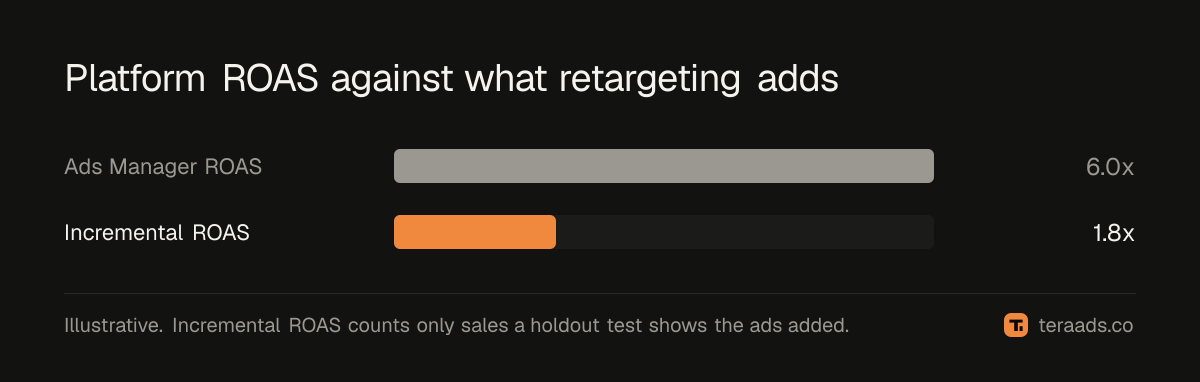
But warm audiences are also the people most likely to buy without an ad. When a cart abandoner returns through a retargeting ad and buys, Meta credits the ad, even if they would have come back on their own. That's why retargeting ROAS is often several times higher than prospecting, and why it shouldn't get budget just because its ROAS looks best.
Audiences to build
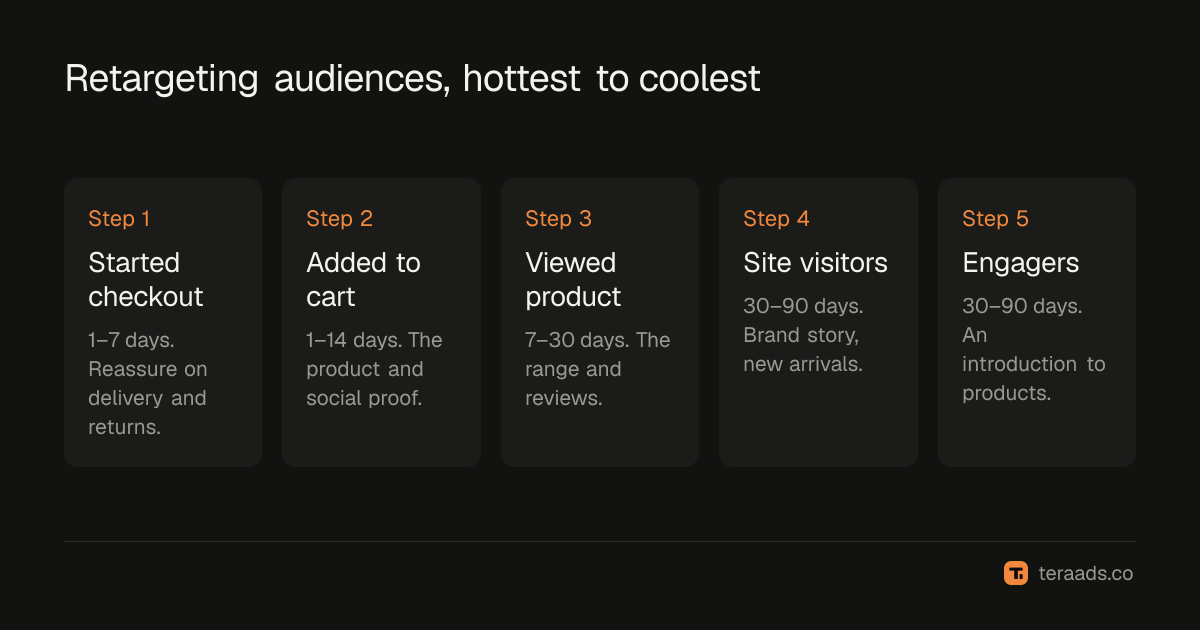
| Audience | Window | Intent | Message |
|---|---|---|---|
| Initiated checkout, no purchase | 1–7 days | Highest | Reassurance: delivery time, returns, COD or prepaid options |
| Added to cart, no purchase | 1–14 days | High | The product they added, social proof |
| Viewed product, no cart | 7–30 days | Medium | The product range, reviews, best-sellers |
| All site visitors | 30–90 days | Lower | Brand story, new arrivals, offers |
| Instagram or Facebook engagers | 30–90 days | Lower | Introduction to products |
Exclude purchasers from the last 30–60 days from all of these unless you're running a deliberate repeat-purchase campaign.
How much to spend
Retargeting budgets should follow audience size, not ambition. A store with 30,000 monthly visitors has a limited pool of cart abandoners; spending heavily on them pushes frequency up fast. Watch frequency on retargeting ad sets: when it climbs and results don't, you're spending more than the audience can absorb.
A practical approach is to start retargeting at a small share of total Meta spend and raise it only while frequency stays reasonable and the extra spend brings extra sales. Most growth comes from prospecting, which fills the retargeting pool in the first place.
Retargeting inside Advantage+ campaigns
Advantage+ Sales campaigns already reach warm audiences and existing customers as part of their optimisation, so a separate retargeting campaign can overlap with them. If you run both, define existing customers and check how much Advantage+ spends on them; see the Advantage+ Sales guide. Overlap between retargeting and prospecting raises costs on both, as the audience overlap guide explains.
Creative for retargeting
Retargeting creative should answer the question "why didn't they buy?":
- Delivery and payment: clear delivery times, COD and prepaid options, easy returns.
- Proof: reviews, customer photos, ratings.
- The exact product: dynamic product ads that show what they viewed.
- A reason to act now: limited stock or a time-bound offer, used sparingly.
Rotate it; small audiences see the same ads often and tire quickly.
How to judge retargeting honestly
Platform ROAS will look great. Better tests:
- Holdout test: exclude a random share of the audience from retargeting for a few weeks and compare their purchase rate with those who saw ads. The difference is what retargeting adds.
- Budget test: cut retargeting spend for two weeks and watch total Shopify revenue. If it barely moves, retargeting was mostly taking credit.
- Kept orders: for cash-on-delivery stores, check retargeting orders after cancellations and RTO; urgency offers can bring impulse orders that come back.
Retargeting for cash-on-delivery stores
For COD-heavy stores, retargeting needs one extra check. Urgency offers and countdown timers can turn hesitant visitors into impulse orders, and impulse COD orders are refused more often than considered ones. A retargeting campaign can then look excellent in Ads Manager while sending back more parcels than any other campaign.
Measure retargeting orders after cancellations and RTO, the same way as other campaigns; the RTO by campaign guide shows how. If its RTO is high, change the message before the budget: reassurance about delivery times, easy returns and a prepaid discount usually bring better orders than pressure. A small discount for paying online works particularly well with retargeted visitors, because they already know the product and only need a reason to commit.
Also check how many retargeting orders are duplicates from buyers who had already ordered. Repeat COD orders from the same person are a common source of refusals, and the fake orders guide covers how to catch them before dispatch.
Common mistakes
Over-funding retargeting because its ROAS is highest, starving the prospecting that feeds it.
Long windows on hot audiences. A cart abandoner from 60 days ago is no longer hot.
Not excluding buyers. Showing an ad for a product someone just bought wastes money and annoys them.
One generic ad for everyone. Different stages need different messages.
Ignoring frequency. Small audiences hit high frequency fast; refresh creative and cap budgets.
Tera Ads shows every Meta Ads and Google Ads campaign in one table with profit worked out from your Shopify orders after returns, and its Meta deep dive covers funnel, audience overlap and creatives that still work. It is free for one business.
Frequently asked questions
What is a good retargeting window?
Short for high intent, longer for low intent: about 1–7 days for checkout abandoners, 7–30 days for product viewers, and 30–90 days for all visitors. Match it to your purchase cycle.
How much of my budget should go to retargeting?
Enough to reach your warm audiences without frequency soaring. For most brands that's a small share of total Meta spend; prospecting fills the pool.
Why is my retargeting ROAS so high?
Warm audiences include many people who would have bought anyway, and Meta credits the ad. Test what retargeting actually adds with a holdout or budget test.
Should I exclude past purchasers?
Usually exclude recent purchasers from retargeting. Target past buyers separately with products they don't have yet, if repeat purchase fits your category.
Is dynamic product retargeting worth it?
For stores with many products, showing people the items they viewed often works well. It needs a connected product catalogue and good product images.