Meta Ads Account Structure for D2C: Fewer Campaigns, Clearer Results
A simple Meta Ads account structure for small D2C brands: one prospecting campaign, one retargeting campaign and a testing campaign, with clear names and budgets.
On this page
For most D2C brands spending up to a few lakh rupees a month, the best Meta Ads structure is small: one prospecting campaign, one retargeting campaign and one testing campaign, with a few ad sets each and clear names. Fewer, larger ad sets get enough purchases to exit learning and give Meta's delivery system room to find buyers. Separate campaigns only when they need different budgets, goals or audiences, and name everything so reports read themselves.
Key takeaways
- Consolidate: each ad set needs roughly 50 optimisation events a week to exit learning, which small budgets can't reach across many ad sets.
- Use three jobs as the backbone: prospecting, retargeting and testing.
- Split campaigns by job or budget, not by every audience idea.
- A naming convention lets you read Ads Manager, Shopify UTMs and your reports the same way.
- Judge structure on profit after RTO, not on how tidy Ads Manager looks.
Why small structures win
Meta's delivery system learns from conversions. The learning phase guide explains that an ad set needs roughly 50 of the event it optimises for in a week to leave learning. A brand getting 300 purchases a week can support about six ad sets that learn properly; split the same budget across 25 ad sets and most never leave learning, results swing and costs rise.
Fragmented accounts also compete with themselves: overlapping audiences in separate ad sets bid against each other; see Meta audience overlap.
A simple structure
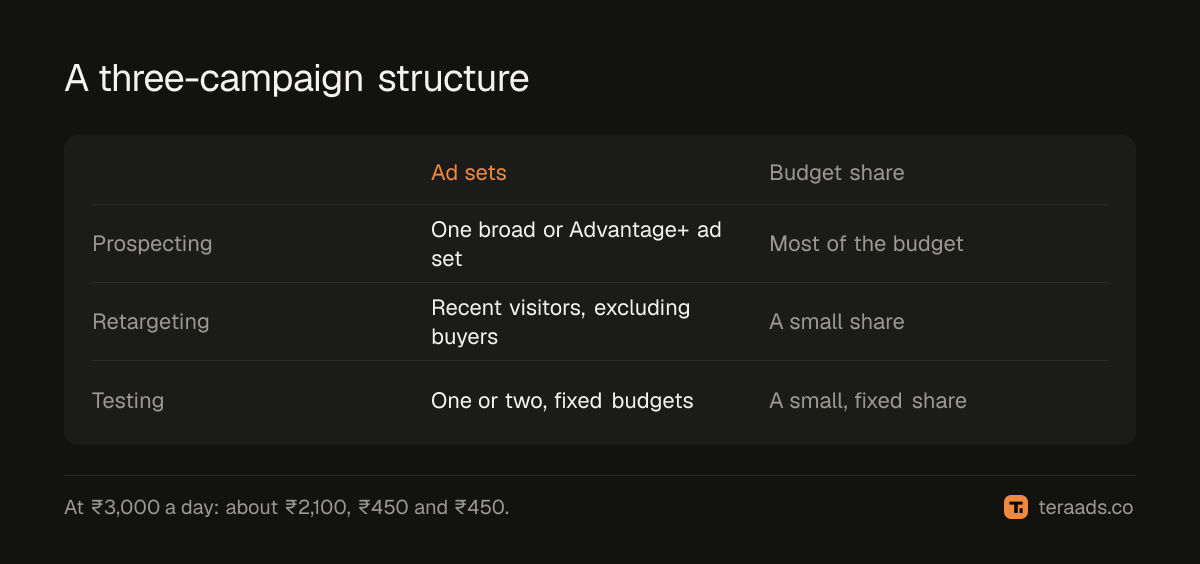
| Campaign | Job | Ad sets | Budget share |
|---|---|---|---|
| Prospecting | Find new buyers | One broad or Advantage+ ad set, plus one interest or lookalike ad set if needed | Most of the budget |
| Retargeting | Bring back visitors and cart abandoners | One ad set for recent visitors and engagers, excluding buyers | A small share |
| Testing | Try new creative and offers | One or two ad sets with a fixed budget | A small, fixed share |
As budgets grow, add campaigns only for genuinely different jobs: a separate campaign for a product line with very different margins, a country, or a seasonal push with its own budget.
Setting it up, step by step
- Audit what you have. List live campaigns and ad sets with spend, purchases and profit after RTO for the last 30 days.
- Pick the winners. Keep the best-performing ads; you'll move them into the new structure.
- Build prospecting. One campaign with a broad or Advantage+ audience and your best ads; consider Advantage+ shopping campaigns if your catalogue suits it.
- Build retargeting. Recent site visitors and engagers, excluding recent purchasers, with ads that answer objections such as reviews, delivery and returns. Meta ads retargeting covers windows and exclusions.
- Build testing. A fixed daily budget where new creatives compete; winners graduate to prospecting.
- Pause the old structure gradually, moving budget over a week so delivery doesn't collapse.
Campaign or ad set budgets
Campaign budget (Advantage campaign budget) lets Meta move money to the ad sets getting results; ad set budgets give you control over each. For prospecting, campaign budget usually works well. For testing, ad set budgets stop one creative from taking all the spend before others get a fair chance. CBO vs ABO explains the trade-off.
Naming conventions
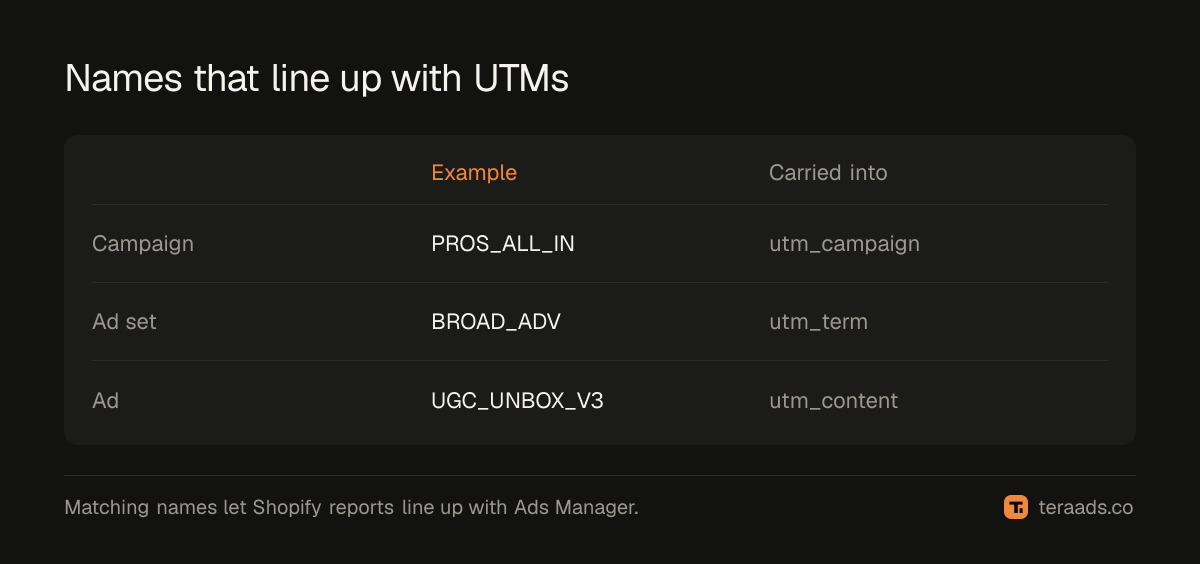
Use names that tell you what something is without opening it, and match them to your UTM campaign values so Shopify reports line up:
- Campaign: job, product line, country, for example PROS_ALL_IN or RET_ALL_IN.
- Ad set: audience and placement, for example BROAD_ADV or LAL2_PURCH.
- Ad: creative concept, format and version, for example UGC_UNBOX_V3 or STATIC_PRICE_V1.
Set Meta's URL parameters so utm_campaign, utm_content and utm_term carry these names automatically; the UTM guide shows how.
How to tell if your structure works
- Most spend sits in ad sets that have exited learning.
- Retargeting is a small share of spend and isn't simply re-buying customers who would return anyway.
- Testing produces a winner every few weeks.
- Profit after RTO per campaign is clear and comparable month to month.
If most ad sets are "Learning limited", consolidate further.
A worked example: ₹3,000 a day
Take a brand spending ₹3,000 a day on Meta with a cost per purchase of about ₹500. A sensible split is roughly 70% prospecting (₹2,100), 15% retargeting (₹450) and 15% testing (₹450). That looks small, and it is, which is the point.
Meta's guidance on the learning phase is that an ad set needs around 50 optimisation events in a week to stabilise. At ₹500 per purchase, 50 purchases a week costs about ₹25,000, or ₹3,570 a day, for a single ad set. This account can't feed even one ad set that fast, let alone eight. Splitting ₹3,000 across many ad sets leaves every one of them stuck in learning, with costs that swing from day to day and results you can't trust. Meta ads learning phase explains the mechanics.
So the structure stays tight:
- Prospecting: one campaign, one broad ad set, 4 to 6 ads. Most purchases come from here.
- Retargeting: one ad set for site visitors and add-to-carts from the last 30 days, excluding recent buyers.
- Testing: one ad set where new concepts earn their way into prospecting.
As spend grows past ₹10,000 a day, you can add a second prospecting ad set, for example a lookalike of your best customers, and compare it with broad on cost per kept order. Add structure only when each new piece can get enough purchases to learn.
Common mistakes
An ad set per interest. Budgets spread too thin to learn.
Retargeting without excluding buyers. You pay to reach people who just bought.
Testing inside prospecting. New ads rarely get spend next to proven winners.
Unclear names. Reports become guesswork, and Shopify UTMs don't match.
Restructuring every week. Every big change restarts learning.
Tera Ads shows every Meta Ads and Google Ads campaign in one table with profit after returns from your Shopify orders and RTO from Shiprocket, so a simpler structure is easy to judge. It is free for one business.
Frequently asked questions
How many campaigns should a small brand run on Meta?
Usually three: prospecting, retargeting and testing. Add more only for different budgets, goals or markets.
Why should I consolidate ad sets?
Each ad set needs enough conversions to exit learning. Fewer, larger ad sets learn faster and deliver more steadily.
Should I use campaign budget or ad set budget?
Campaign budget usually suits prospecting; ad set budgets suit testing, where each creative needs a fair share.
How should I name Meta campaigns?
By job, audience and creative, using the same names as your UTM values, so Ads Manager and Shopify reports match.
How much budget should go to retargeting?
A small share, because retargeting audiences are small and many would return anyway. Check it on profit after RTO.