Prepaid Discount Strategy: How Much to Offer Without Losing Money
A prepaid discount cuts RTO and speeds up cash, but every existing prepaid buyer gets it too. How to calculate a discount that pays for itself, and the alternatives.
On this page
A prepaid discount is worth offering when the profit you gain from COD buyers who switch is larger than the discount you give to buyers who would have paid online anyway. Switching a buyer from COD to prepaid usually adds profit, because prepaid orders are refused far less often. But the discount goes to every prepaid order. Work out the gain per switched order and the cost per existing prepaid order, then set the discount so enough buyers switch to cover it.
Key takeaways
- Prepaid orders avoid most RTO, arrive as cash sooner and skip COD charges.
- The discount's real cost includes every buyer who already paid online.
- The test is simple: switched orders × gain per order must exceed existing prepaid orders × discount.
- Small, visible discounts at the payment step often switch enough buyers; large ones mostly reward existing prepaid buyers.
- A COD fee, partial COD or cashback can achieve the same shift at lower cost.
Why prepaid orders are worth more
A COD order and a prepaid order for the same product have different economics. The COD order might be refused at the door, costing freight both ways and earning nothing. It carries a COD handling charge from many couriers, and its cash arrives a week or two after delivery; the COD remittance cycle explains the wait. A prepaid order is paid before dispatch, is refused much less often and has only a payment gateway fee.
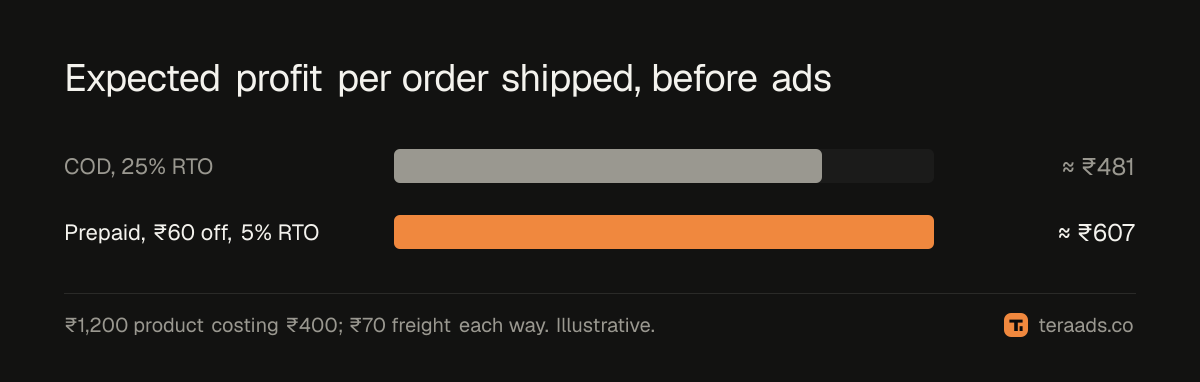
Here's an illustrative comparison for a ₹1,200 product costing ₹400, with ₹70 freight each way, ₹20 handling on a return, a ₹35 COD charge and a 2% gateway fee:
| COD order | Prepaid order, ₹60 off | |
|---|---|---|
| Price paid | ₹1,200 | ₹1,140 |
| Fees | ₹35 COD charge | About ₹23 gateway fee |
| Profit if delivered, before ads | ₹695 | About ₹647 |
| RTO rate (illustrative) | 25% | 5% |
| Loss per RTO | ₹160 | ₹160 |
| Expected profit per order shipped | About ₹481 | About ₹607 |
Each buyer who switches from COD to prepaid adds about ₹126 of expected profit in this example, even after the ₹60 discount.
The cost most brands miss
The discount isn't only paid by buyers who switch. Everyone who would have paid online anyway gets it too. In the example, an existing prepaid buyer now pays ₹60 less, which costs about ₹56 of expected profit once the slightly lower gateway fee and the small chance of RTO are counted.
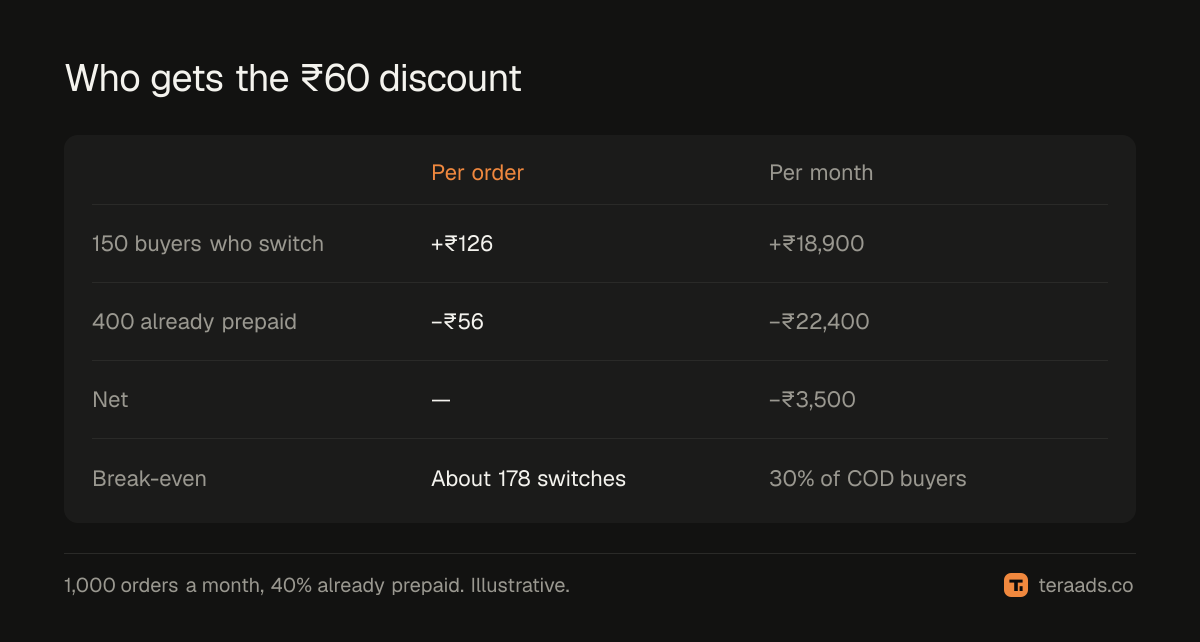
Take 1,000 orders a month: 400 already prepaid and 600 COD. Offer ₹60 off prepaid, and suppose 150 COD buyers switch.
- Gain from switched buyers: 150 × ₹126 = ₹18,900.
- Cost on existing prepaid buyers: 400 × ₹56 = ₹22,400.
- Net: a loss of about ₹3,500 a month.
The discount loses money unless more buyers switch. Here it breaks even at about 178 switches, roughly 30% of COD buyers. If your prepaid share is already high, the bar is higher still.
Setting the discount
Use your own numbers in four steps:
- Gain per switched order: expected profit as prepaid (after the discount) minus expected profit as COD.
- Cost per existing prepaid order: roughly the discount, less the small change in gateway fee.
- Break-even switch ratio: cost per existing prepaid order ÷ gain per switched order. In the example, ₹56 ÷ ₹126 ≈ 0.44, so you need about 44 switches for every 100 existing prepaid orders.
- Test it. Run the discount for two to four weeks and measure the change in prepaid share against the weeks before, on similar traffic.
Smaller discounts often work almost as well as large ones, because buyers react to seeing a saving at the payment step more than to its exact size. Test ₹30 or 3% before ₹100 or 10%.
Alternatives that cost less
A COD fee instead of a prepaid discount. Charging COD buyers a small fee creates the same price gap without giving anything to existing prepaid buyers. It can reduce COD conversions, so test it, and show the fee clearly before checkout.
Partial COD. Asking for a small advance online on COD orders filters out many low-intent buyers and brings part of the cash forward; see partial COD.
Targeted prepaid offers. Offer the discount only where RTO is highest, such as risky pin codes or high-value orders, if your checkout or apps allow it.
Cashback on the next order. A credit for paying online costs nothing unless the buyer comes back, and then it buys a repeat order.
Free shipping for prepaid. If you charge shipping below a threshold, waiving it for prepaid orders gives a clear incentive; free shipping thresholds covers the maths.
Where prepaid incentives fit best
They help most when COD refusal is high, average order values are large and your buyers are comfortable with UPI. They help least when prepaid share is already high, when margins are thin, or when buyers in your categories strongly prefer to inspect before paying. In those cases, order confirmation and address checks often cut RTO more cheaply; the COD vs prepaid guide compares the two in detail.
Measuring the result
Track three numbers before and after the change, on settled orders:
- Prepaid share of orders.
- RTO rate overall, not just on COD.
- Profit per order after returns, including the discount.
Conversion rate matters too. If the offer, or a COD fee, lowers checkout completion, the lost orders count against it. Read results over at least two full weeks, and allow three more for RTO to settle before judging profit.
Common mistakes
Counting only switched buyers. The discount also goes to everyone already paying online.
Starting with a large discount. Test small first; you can always raise it.
Judging on order counts. Profit per order after RTO decides whether it worked.
Hiding the saving. Buyers need to see it at the payment step.
Ignoring conversion. A COD fee that saves RTO but loses many orders isn't a win.
Tera Ads shows profit after returns for every Meta Ads and Google Ads campaign, with RTO from Shiprocket, so you can see whether a prepaid offer improved what each campaign really earns. It is free for one business.
Frequently asked questions
How much prepaid discount should I give?
Enough to switch buyers whose extra profit covers the discount given to existing prepaid buyers. Test small amounts, such as ₹30 or 3%, first.
Does a prepaid discount reduce RTO?
Yes, for the buyers who switch, because prepaid orders are refused far less often than COD orders.
Is a COD fee better than a prepaid discount?
It creates the same price gap without discounting existing prepaid orders, but it can lower conversions. Test both.
How do I measure if a prepaid offer worked?
Compare prepaid share, overall RTO rate and profit per order after returns before and after the change, on settled orders.
What is the break-even point for a prepaid discount?
When gains from switched buyers equal the discount paid to existing prepaid buyers. Divide cost per existing order by gain per switched order to get the switch ratio needed.