COD Remittance Cycle: How Long Your Cash Waits, and What It Costs
Cash-on-delivery money reaches you days after delivery. How the remittance cycle works, how much cash it ties up, and when paying for early COD makes sense.
On this page
The COD remittance cycle is the gap between a courier collecting cash from your buyer and that money reaching your bank. The courier passes the cash to your shipping platform, which then pays you on a schedule, often a week or two after delivery. Meanwhile you've already paid for stock, packaging, shipping and the ads that won the order. Work out how much cash the cycle ties up, then decide whether faster remittance is worth its fee.
Key takeaways
- COD money arrives days after delivery, so every COD order is a short loan you give the courier chain.
- The cash tied up equals your daily delivered COD value multiplied by the days you wait.
- Shiprocket's Early COD pays as early as two days after delivery for a fee; standard remittance can take up to 10–12 working days.
- Early COD is expensive money when you annualise the fee, so use it only when the cash earns more.
- Reconcile every remittance against delivered COD orders; RTO orders are never remitted.
How the cycle works
A COD order passes through several hands before the money is yours:
- Delivery. The courier's delivery agent collects cash or UPI from the buyer.
- Courier settlement. The courier hub deposits collections and settles them with the shipping platform.
- Platform remittance. The shipping platform pays you on its schedule, usually net of any amounts it's allowed to deduct.
- Bank credit. The transfer lands in your account.
Each step adds days. Shiprocket's support article on Early COD says the standard process "can take up to 10 - 12 working days", and that Early COD remits within two days of delivery (Shiprocket support, updated June 2024). Ten working days is about two calendar weeks.
How much cash it ties up
The cash you're waiting for at any moment is roughly:
Cash waiting = delivered COD value per day × days until remittance
Take an illustrative brand delivering ₹20,000 of COD orders a day, about ₹6,00,000 a month. On a cycle of about 14 calendar days, around ₹2,80,000 is always in transit. That money has already been spent once on stock, freight and ads, so the brand needs that much more working capital than its profit suggests.
| Remittance timing | Days waiting | Cash waiting at ₹20,000 a day |
|---|---|---|
| Standard cycle | About 14 calendar days | ₹2,80,000 |
| Early COD, four days | 4 | ₹80,000 |
| Early COD, two days | 2 | ₹40,000 |
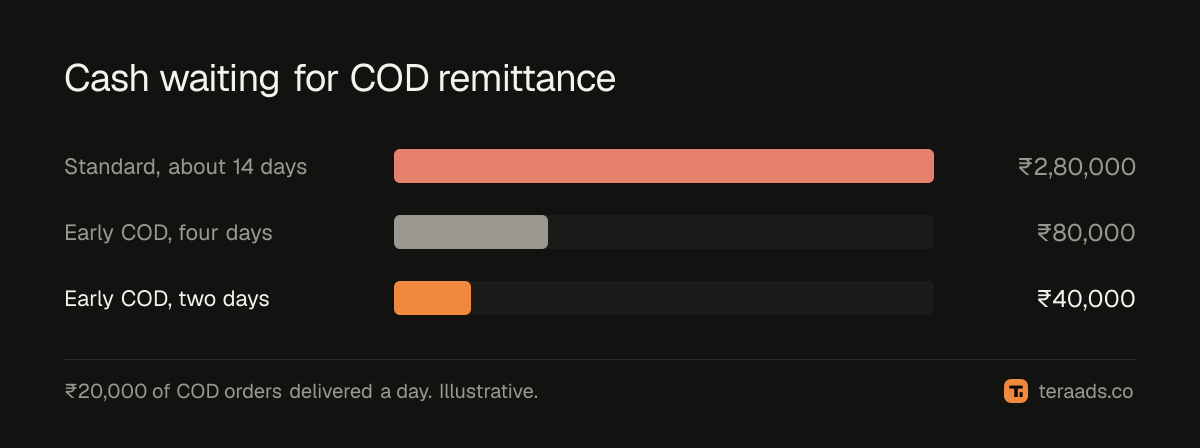
As COD volume grows, the number grows with it. A brand that doubles sales on COD doubles the cash stuck in the cycle, which is one reason fast-growing COD brands run short of money even when every order is profitable.
Early COD and Instant COD
Shiprocket offers two ways to get money sooner:
- Early COD. You choose from three plans and pay a fee, with remittance "as early as 2 days" after delivery, according to its Early COD page, checked on 8 October 2026. The page says you switch it on from Billing, then Remittance Logs.
- Instant COD. The same page describes a separate option that remits 70% of the COD amount within 24 hours of the order shipping.
Shiprocket's launch post in 2019 priced the three Early COD plans at 0.99% of the COD amount for two days after delivery, 0.69% for three days and 0.49% for four days, inclusive of GST (Shiprocket blog, August 2019). Fees may have changed since, so check the current plan in your panel before deciding. The current pages don't list fees in text.
What early remittance really costs
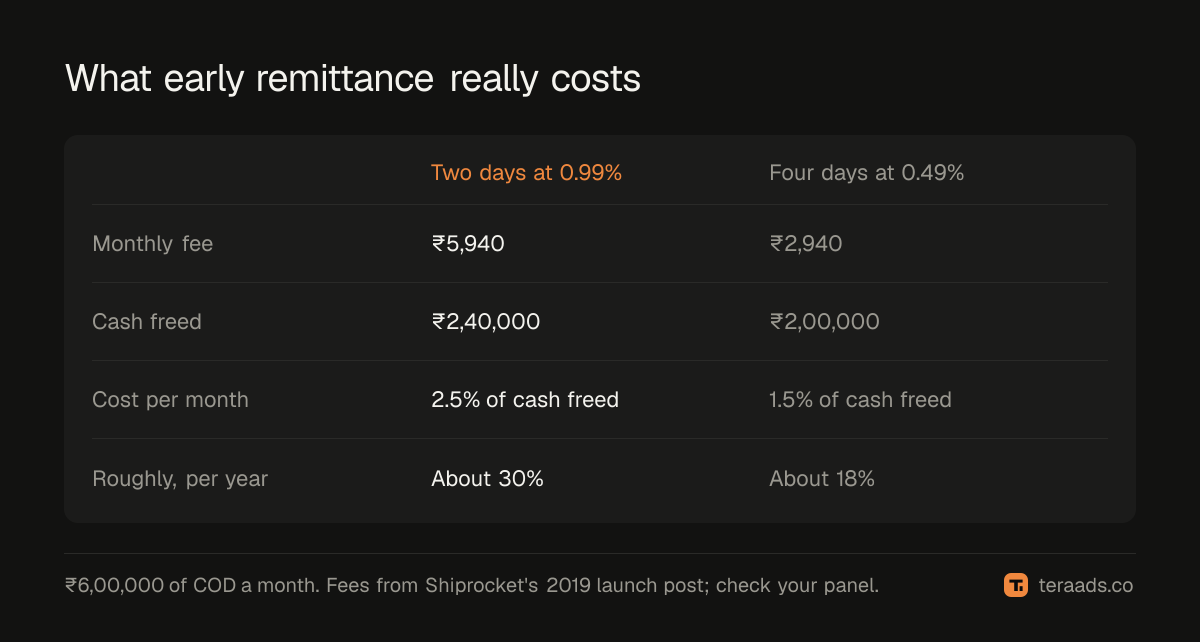
A fee of under 1% sounds small. It isn't, once you compare it with the cash it frees. Using the 2019 percentages on the brand above:
| Two days at 0.99% | Four days at 0.49% | |
|---|---|---|
| Monthly COD remitted | ₹6,00,000 | ₹6,00,000 |
| Monthly fee | ₹5,940 | ₹2,940 |
| Cash freed compared with 14 days | ₹2,40,000 | ₹2,00,000 |
| Fee as a share of cash freed, per month | 2.5% | 1.5% |
| Roughly, per year | About 30% | About 18% |
Paying ₹5,940 a month to free ₹2,40,000 is like borrowing that money at about 30% a year. The four-day plan costs about 18% a year. Your own fee and cycle will differ, so redo the sum with your numbers.
When early COD is worth it
Faster remittance pays for itself when the freed cash earns more than the fee:
- Ads that make money are capped by cash. If campaigns return a clear profit after RTO and you're holding back budget because the bank balance is low, the extra spend can earn more than the fee. True ROAS after RTO and COD shows how to check that campaigns really make money.
- Stock-outs on best sellers. Missing sales because you can't pay a supplier costs more than the fee.
- A short, seasonal crunch. Festive season needs stock and ad budget before the cash from earlier sales arrives.
It isn't worth it when the cash would sit in the bank, when cheaper credit is available, or when campaigns are only profitable before returns are counted.
Reducing the cash problem without paying for it
The cheapest way to wait less for COD money is to have less of it:
- Encourage prepaid payment. A small prepaid discount can pay for itself through lower RTO and faster cash; the prepaid discount strategy guide does the maths.
- Use partial COD on high-risk orders. A small advance paid online cuts refusals and brings part of the cash forward; see partial COD.
- Cut RTO. Every refused parcel costs freight both ways and never produces a remittance; reducing RTO in India covers the levers.
- Negotiate with suppliers. Longer payment terms on stock offset the wait on COD money.
Reconciling remittances
Remittances arrive as lump sums, so mistakes hide easily. Once a week:
- Export delivered COD orders for the period from your shipping platform.
- Match them to remittance records by order or AWB number.
- List delivered orders not yet remitted and how many days old they are.
- Check deductions shown on each remittance against what you expect.
- Escalate anything older than your normal cycle with the shipping platform.
RTO orders never produce a remittance, because no cash was collected. If you count COD revenue when orders are placed rather than when cash arrives, refused orders will make revenue look higher than the money you actually receive. The RTO cost calculator shows the full cost of each refusal.
Building a simple forecast
You can see a cash crunch coming with a few rows in a sheet. For each of the next four weeks, estimate COD orders you expect to deliver, multiply by your average order value, and place that cash in the week it should arrive based on your cycle. Put stock payments, ad spend and salaries in the weeks they leave. The weeks where money out exceeds money in are the weeks to plan for, with early remittance, a supplier conversation or a slower ramp in ad spend.
Update the forecast every Monday with actual remittances received. After a month you'll know your real cycle, which is the number that matters, rather than the one in a help article.
Common mistakes
Treating COD sales as cash. Revenue counted on order day can be two weeks and an RTO away from your bank.
Comparing the fee with revenue instead of cash freed. The fee looks tiny against sales and expensive against the money it releases.
Leaving early COD on by default. Turn it on when the cash has a profitable use, and check the plan's terms before changing it.
Not reconciling. Missing remittances are found only by matching orders to payments.
Ignoring RTO in the forecast. Refused orders never pay out; forecast on expected deliveries, not orders placed.
Tera Ads shows profit after returns for every campaign, with RTO from Shiprocket counted in the month each order was placed, so you can see which campaigns deserve the cash before you pay to get it faster. It is free for one business.
Frequently asked questions
What is a COD remittance cycle?
The time between a courier collecting cash from your buyer and the money reaching your bank, through the courier and your shipping platform.
How long does Shiprocket take to remit COD?
Shiprocket's support article says the standard process can take up to 10–12 working days, and Early COD remits within two days of delivery for a fee. Check your panel for your current cycle.
Is early COD worth the fee?
Only when the freed cash earns more than the fee, for example by funding profitable ads or stock. Annualised, fees under 1% a month can cost 18–30% a year.
Why haven't I received COD money for some orders?
RTO orders are never remitted, and delivered orders can be delayed in settlement. Match remittances to delivered orders weekly and escalate old ones.
How do I reduce the cash tied up in COD?
Move buyers to prepaid with a small incentive, use partial COD for high-risk orders, cut RTO and negotiate longer supplier terms.