Profit-First Ad Budget: Set Spend From the Profit You Want to Keep
Instead of setting ad spend as a share of revenue, start from the profit you need and work back to the most you can spend. A simple method, with RTO included.
On this page
A profit-first ad budget starts with the profit you want to keep, subtracts it and your fixed costs from expected contribution, and treats what's left as the most you can spend on ads. It replaces rules of thumb like "spend 20% of revenue", which ignore your margins and RTO. Estimate next month's net revenue after RTO, its contribution before marketing, your fixed costs and your profit target; the gap is your ad budget ceiling, and campaigns earn their share of it by making money after returns.
Key takeaways
- Ad budget ceiling = contribution before marketing − fixed costs − target profit.
- Contribution before marketing must use revenue after RTO and returns, not gross sales.
- The ceiling is a limit, not a target; spend up to it only while extra spend stays profitable.
- Turn the ceiling into a blended ROAS or MER target that every campaign must help meet.
- Recalculate monthly, because margins, RTO and fixed costs change.
Why "a percentage of revenue" fails
Rules of thumb such as "spend 15% to 25% of revenue on ads" don't know your product margin, shipping cost, COD share or RTO rate. A brand with a 70% margin and 10% RTO can afford far more than one with a 45% margin and 30% RTO at the same revenue. The percentage rule either leaves profitable growth on the table or quietly spends the profit.
The method, step by step
- Forecast net revenue. Start from expected gross sales for the month and remove discounts, expected RTO and returns. Use the last three settled months' rates.
- Calculate contribution before marketing. Subtract product cost, shipping, payment fees and packaging; contribution margin lists what to include.
- Subtract fixed costs. Salaries, rent, software and agency fees.
- Subtract your profit target. The amount you want to keep, or need to keep for cash.
- The remainder is your ad ceiling. It's the most you can spend and still hit the target, if ads deliver the revenue you forecast.
- Convert it into a target. Divide forecast net revenue by the ceiling to get the minimum blended return, or MER, on kept revenue.
A worked example
| Line | Monthly amount |
|---|---|
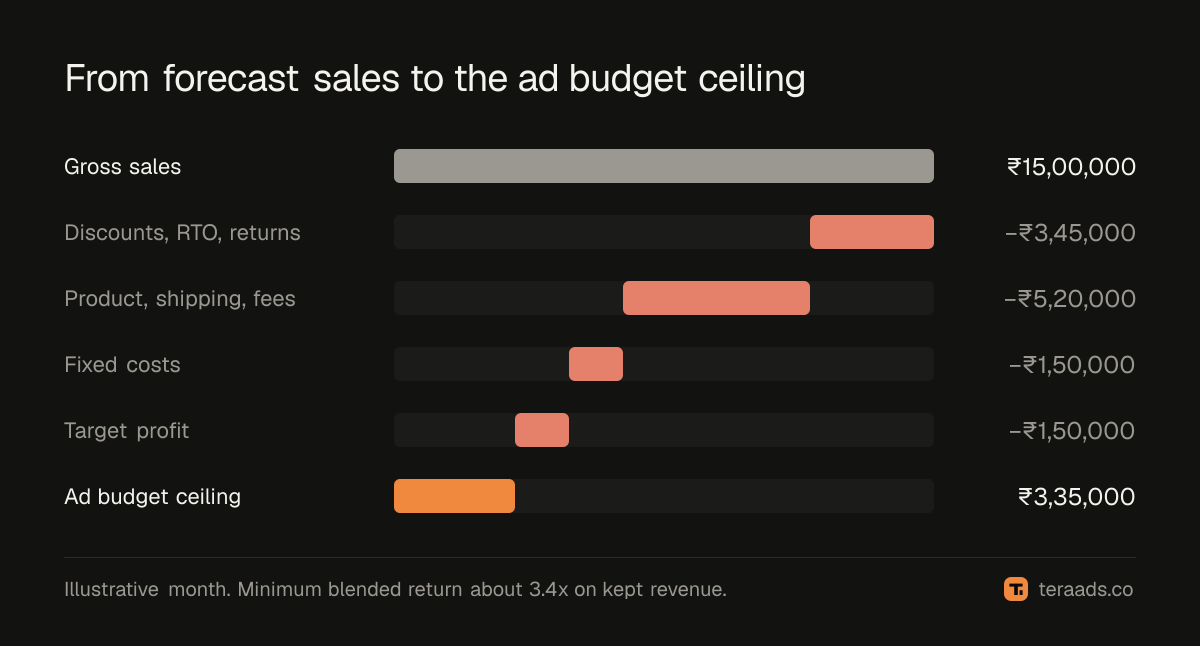
| Forecast gross sales, excluding GST | ₹15,00,000 |
| − Discounts, RTO and returns (about 23%) | ₹3,45,000 |
| Net revenue | ₹11,55,000 |
| − Product, shipping, fees, packaging | ₹5,20,000 |
| Contribution before marketing | ₹6,35,000 |
| − Fixed costs | ₹1,50,000 |
| − Target profit | ₹1,50,000 |
| Ad budget ceiling | ₹3,35,000 |
The minimum blended return on kept revenue is ₹11,55,000 ÷ ₹3,35,000 ≈ 3.4x. If total ad spend can't produce at least 3.4 rupees of kept revenue per rupee, either spend less or accept a lower profit.
Revenue depends on spend
The catch is that revenue isn't fixed: some of it comes from ads. So check the plan against reality:
- Repeat and organic revenue arrives without much ad spend. Estimate it from last month's returning-customer sales.
- Ad-driven revenue depends on how much you spend and your marginal returns. Scaling ad spend profitably shows how to measure them.
If the ceiling is far above what you can spend profitably, don't spend it; bank the extra profit. If it's below what you're spending now, the business is buying revenue at a loss somewhere.
Turning the ceiling into campaign budgets
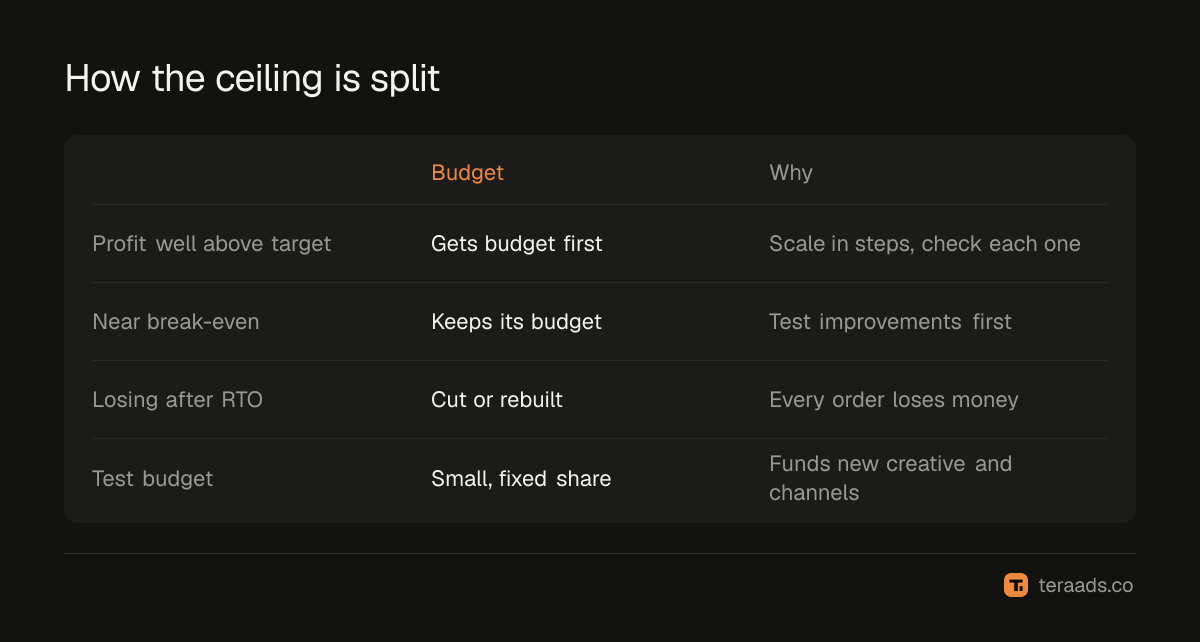
Split the ceiling by evidence, not habit:
- Campaigns with profit after RTO well above target get budget first, scaled in steps.
- Campaigns near break-even keep their budget while you test improvements.
- Campaigns losing money after RTO are cut or rebuilt; find wasted ad spend shows where to look.
- A test budget, often a small share of the ceiling, funds new creative, audiences and channels.
Reviewing during the month
Check weekly against two numbers: spend so far against the ceiling, and blended return on kept revenue against the target. If the return is below target by mid-month, cut the weakest campaigns rather than waiting for month end. At month end, compare the plan with the monthly P&L and adjust next month's rates.
When to break the rule
Some months justify spending past the ceiling deliberately: building a customer base before a big season, launching a product, or acquiring customers whose repeat purchases you've measured. Do it as a decision with a number attached, such as "we'll accept ₹1,00,000 less profit this month to acquire 400 more customers", and check afterwards whether those customers came back.
Pacing the ceiling through the month
A monthly ceiling of ₹3,35,000 works out to about ₹11,000 a day, but even spend isn't always right. Sales often cluster around paydays at the start of the month, festivals and sale events, so many brands spend a little more in strong weeks and less in quiet ones.
A simple pacing check: compare the share of the ceiling spent with the share of the month gone. On day 15 of a 30-day month, you'd expect about half the ceiling spent, about ₹1,67,500. If you've spent ₹2,20,000, you're ahead of pace; that's fine only if the blended return on kept revenue is at or above the 3.4x minimum. If it isn't, slow down now, not on day 28.
The reverse matters too. If you're well behind pace and campaigns are profitable, the ceiling is giving you room you aren't using. Check whether budgets are capped too tightly on your best campaigns before assuming demand has run out.
Common mistakes
Using gross sales. RTO and returns can remove a large share of revenue.
Treating the ceiling as a target. Spend only while extra spend is profitable.
Ignoring fixed costs. Contribution after marketing must still pay for the team and tools.
Budgeting by platform ROAS. Platforms over-report; use Shopify revenue after RTO.
Setting it once a year. Margins, RTO and costs move every month.
Tera Ads shows Shopify sales, Meta Ads and Google Ads spend and profit after RTO from Shiprocket for every campaign on one screen, so you can see which campaigns deserve their share of the budget. It is free for one business.
Frequently asked questions
How much should I spend on ads?
No more than contribution before marketing minus fixed costs and your profit target, and only while extra spend stays profitable after returns.
Is 20% of revenue a good ad budget?
It ignores your margins and RTO. Calculate a ceiling from your own contribution and costs instead.
What is a profit-first ad budget?
A budget set by starting from the profit you want to keep and working back to the most you can spend on ads.
How do I turn an ad budget into a ROAS target?
Divide forecast net revenue after RTO by the ad budget ceiling. That's the minimum blended return you need.
How often should I recalculate my ad budget?
Monthly, using the last settled months' RTO, return rates and costs.