Scaling Ad Spend Profitably: Watch the Next Rupee, Not the Average
Average ROAS can look healthy while the last rupee you added loses money. How to measure marginal returns, scale in steps, and know when to stop raising budgets.
On this page
To scale ad spend profitably, judge each budget increase by the extra kept revenue it brings, its marginal return, rather than by your average ROAS. As spend rises, ads reach colder audiences and returns per rupee fall. Average ROAS falls slowly and can stay above break-even long after the latest increase started losing money. Raise budgets in steps, measure the change in total Shopify revenue after RTO for each step, and stop when the next step's return drops below break-even.
Key takeaways
- Marginal ROAS = extra kept revenue ÷ extra ad spend, for one budget step.
- Average ROAS hides diminishing returns, because early, cheap results keep the average up.
- Measure steps with total store numbers, Shopify revenue after RTO, not platform-reported ROAS.
- Scale in steps, hold each long enough to read, and compare with your break-even ROAS.
- New customers, frequency and creative supply often limit scale before budget does.
Why average ROAS misleads
Every account has buyers who are cheap to reach: past visitors, warm audiences, people searching for your brand. The first rupees reach them. As budgets grow, ads reach people who are less interested, and each extra rupee brings back less.
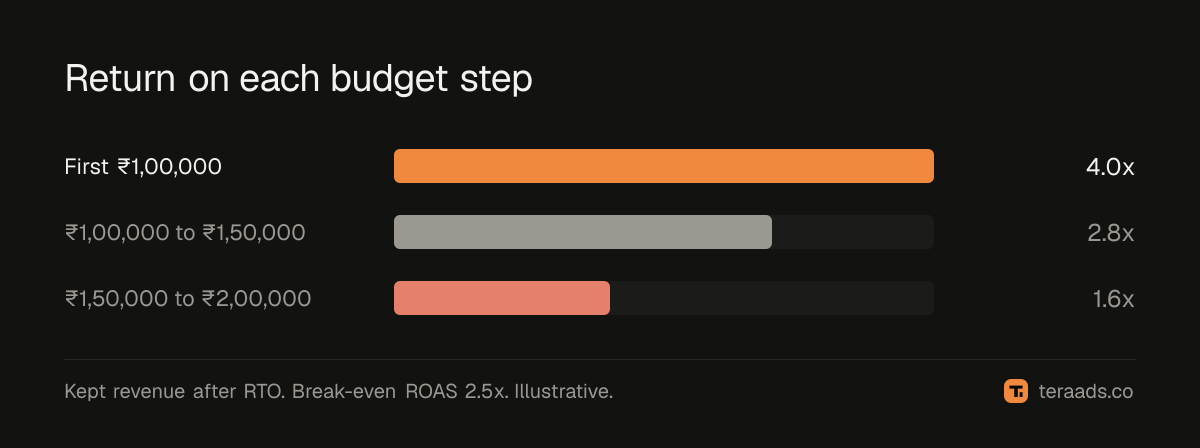
Here's an illustrative brand with a break-even ROAS of 2.5x on kept revenue, after RTO:
| Monthly spend | Kept revenue | Average ROAS | Extra spend | Extra revenue | Marginal ROAS |
|---|---|---|---|---|---|
| ₹1,00,000 | ₹4,00,000 | 4.0x | — | — | — |
| ₹1,50,000 | ₹5,40,000 | 3.6x | ₹50,000 | ₹1,40,000 | 2.8x |
| ₹2,00,000 | ₹6,20,000 | 3.1x | ₹50,000 | ₹80,000 | 1.6x |
At ₹2,00,000 a month, average ROAS of 3.1x looks comfortably above break-even. But the last ₹50,000 brought only ₹80,000 of kept revenue, a 1.6x return, well below the 2.5x needed. That step loses money; the first ₹1,50,000 is paying for it.
Measuring marginal returns
Platform ROAS isn't reliable for this, because platforms take credit for sales that would have happened anyway, and the share they over-claim changes as you scale. Use store totals instead:
- Record a baseline week: total ad spend, Shopify revenue and orders, and RTO rate once settled.
- Raise spend by one step, such as 20% to 30%, on the campaigns you want to scale.
- Hold for at least a week, longer if the platform is re-learning; Meta's learning phase explains why.
- Compare total revenue and orders with the baseline, adjusting for seasonality and promotions.
- Divide the change in kept revenue by the change in spend. That's the step's marginal ROAS.
MER, total revenue divided by total ad spend, is the simplest daily view of the same thing; MER vs ROAS shows how to track it.
How to scale
In steps, not jumps. Moderate increases let the platform adjust and give you a clean read on each step. Scaling Meta ad budgets covers pacing on Meta.
Where returns are highest first. Scale the campaigns with the best profit after RTO, not the best platform ROAS. A campaign with lower ROAS but fewer refusals may earn more per rupee.
Across channels. When one channel shows diminishing returns, the next rupee may earn more on another, such as Google Search for high-intent buyers or a new Meta audience.
With new creative. Fresh creative reaches new people at a lower cost. Without it, more budget mostly means higher frequency; see creative fatigue on Meta.
Signals to keep going or stop
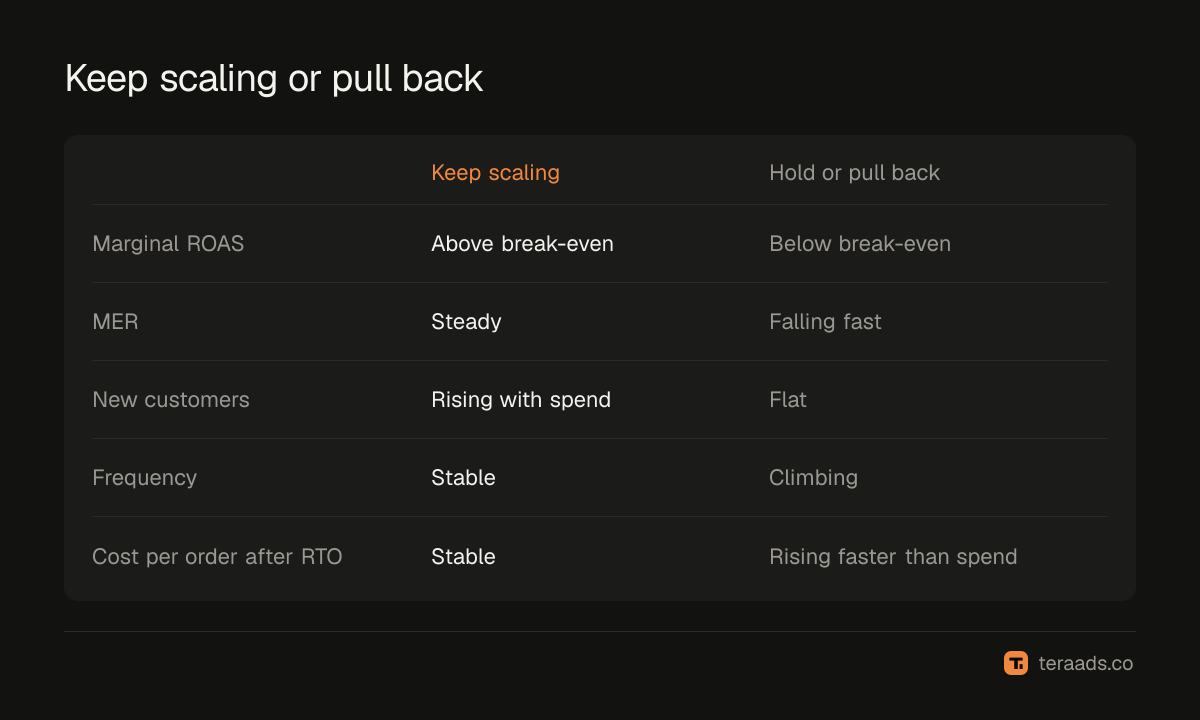
| Signal | Keep scaling | Hold or pull back |
|---|---|---|
| Marginal ROAS on kept revenue | Above break-even | Below break-even |
| MER as spend rises | Steady or falling slowly | Falling fast |
| New customers | Rising with spend | Flat while spend rises |
| Frequency | Stable | Climbing week on week |
| Cost per order after RTO | Stable | Rising faster than spend |
Setting a budget ceiling
Once you've found a step where marginal ROAS falls below break-even, the spend just before it is your current ceiling. It isn't permanent: new creative, a new product, a higher order value or a lower RTO rate all raise it. Recalculate your break-even ROAS after any of these changes, then test another step.
Cash and scaling
Scaling costs cash before it returns any, especially for COD-heavy brands where revenue arrives a week or two after delivery. Make sure the business can fund a month of higher spend before the money from those orders lands; the COD remittance cycle shows how much cash is tied up.
A scaling plan for one month
For a brand spending ₹1,00,000 a month with a healthy profit after RTO, a cautious plan might look like this:
- Week 1: raise spend on the two most profitable campaigns by about 20%, and launch two new creatives.
- Week 2: hold. Compare total Shopify revenue and orders with the baseline week.
- Week 3: if the step's marginal return was above break-even, raise again by a similar amount; if not, move that budget to the next-best campaign or channel.
- Week 4: hold, and check RTO on the first step's orders as they settle.
By the end of the month you'll know your marginal return at two spend levels, which is enough to set a ceiling for now. Repeat the cycle when you have new creative or a new product to test. It's slower than doubling the budget overnight, but you'll know exactly which step paid and which didn't, and you won't need to undo a month of losses.
Common mistakes
Scaling on average ROAS. The average stays high long after the last step stopped paying.
Judging steps on platform ROAS. Platforms over-claim more as you scale; use Shopify totals.
Ignoring RTO. Colder audiences often refuse more COD orders, so kept revenue falls faster than orders.
Raising budgets daily. Steps need time to settle before you can read them.
More budget, same creative. Without new creative, extra spend mostly raises frequency.
Tera Ads shows Shopify sales, Meta Ads and Google Ads spend and profit after RTO from Shiprocket on one screen, with every campaign in one table, so you can see what each budget step really earned. It is free for one business.
Frequently asked questions
What is marginal ROAS?
The extra kept revenue from an increase in ad spend, divided by that increase. It shows whether the latest rupees are paying.
Why does ROAS fall when I increase budget?
Bigger budgets reach less interested people, so each extra rupee brings back less. This is diminishing returns.
How much should I increase my ad budget at a time?
Moderate steps, held for at least a week, so you can measure each step's effect on total store revenue.
How do I know when to stop scaling?
When the marginal ROAS of the latest step, on kept revenue after RTO, falls below your break-even ROAS.
Should I use platform ROAS to judge scaling?
No. Use total Shopify revenue after RTO against total spend, because platform ROAS over-credits ads as you scale.