Repeat Purchase Rate: How to Measure It on Shopify and Raise It
Repeat purchase rate is the share of customers who order again. How to calculate it properly from Shopify orders, what's typical by category, and how to raise it.
On this page
Repeat purchase rate is the percentage of customers who place a second order within a set period. Measure it on customers acquired in the same month (a cohort), over a fixed window such as 90 or 180 days, counting only orders that weren't cancelled or returned. It shows whether your product earns loyalty, and it drives lifetime value: a small rise in repeat rate can do more for profit than a big cut in acquisition cost.
Key takeaways
- Define it precisely: customers acquired in a period who ordered again within a fixed window.
- Count only kept orders; cancelled, refunded and RTO orders aren't real repeat purchases.
- Compare cohorts at the same age, such as 90-day repeat rate by acquisition month.
- Typical rates vary hugely by category; consumables repeat far more than jewellery or furniture.
- Raise it with reorder timing, a good first experience and second-order offers, not blanket discounts.
Calculating it properly
Shopify reports a returning customer rate, which is the share of customers in a period who had ordered before. That's useful, but it mixes customers acquired years ago with recent ones. For decisions, use a cohort repeat rate:
90-day repeat rate = customers acquired in a month who placed a second kept order within 90 days ÷ customers acquired in that month
Steps:
- Pick a cohort: customers whose first kept order was in a given month.
- Choose a window: 60, 90 or 180 days, depending on how often your product is used up.
- Count repeaters: customers in the cohort with a second kept order inside the window.
- Divide by the cohort size.
Customers acquired in the last 90 days can't have a 90-day figure yet. Leave them out until they've had the full window.
| Metric | What it answers | Good for |
|---|---|---|
| Returning customer rate (Shopify) | What share of this period's buyers had ordered before? | A quick health check |
| Cohort repeat rate | What share of a month's new customers came back within N days? | Comparing months, channels and offers |
| Orders per customer | How many orders does a customer place over a period? | Estimating lifetime value |
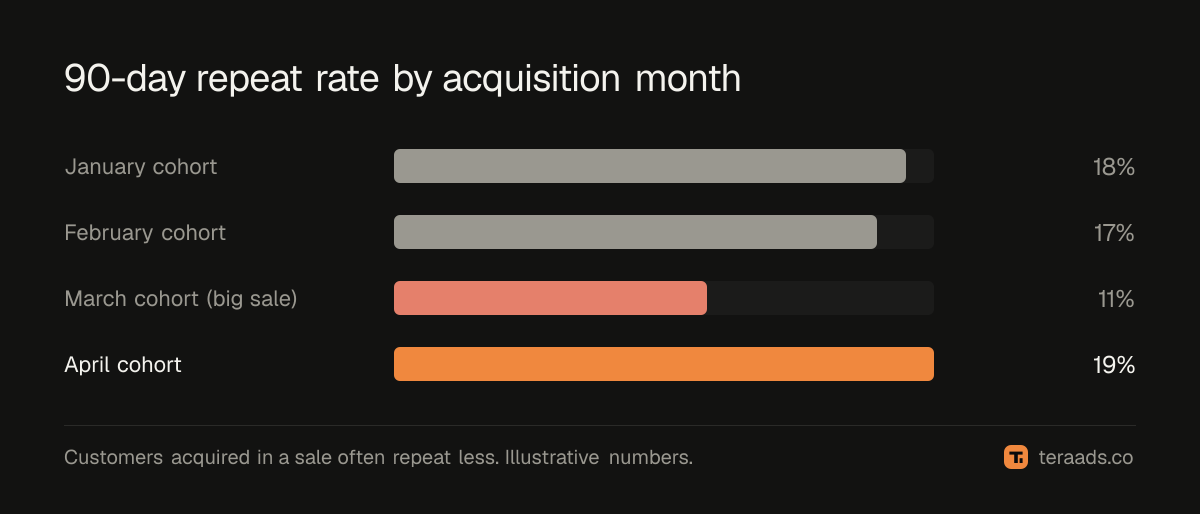
Why kept orders matter
For cash-on-delivery brands, a customer whose first order was refused isn't really a customer yet. If you count them, the repeat rate drops and lifetime value calculations go wrong. If you count a second order that was later returned as a repeat, the rate looks better than it is. Filter out cancelled, refunded and RTO orders before calculating. The COD vs prepaid guide covers why prepaid customers often behave differently.
What's typical?
Rates vary widely by category, price and how often the product is used up. Use your own trend as the main benchmark, and treat category differences as context:
| Category | Repeat behaviour |
|---|---|
| Consumables (coffee, supplements, skincare refills) | High; people run out and reorder |
| Fashion and beauty | Moderate; driven by new ranges and seasons |
| Jewellery and gifts | Lower; occasion-driven, with spikes around festivals |
| Furniture and electronics | Low; long gaps between purchases |
A jewellery brand shouldn't compare itself with a coffee brand. It should compare this year's cohorts with last year's, and its repeat rate around festivals with other months.
Why it matters so much
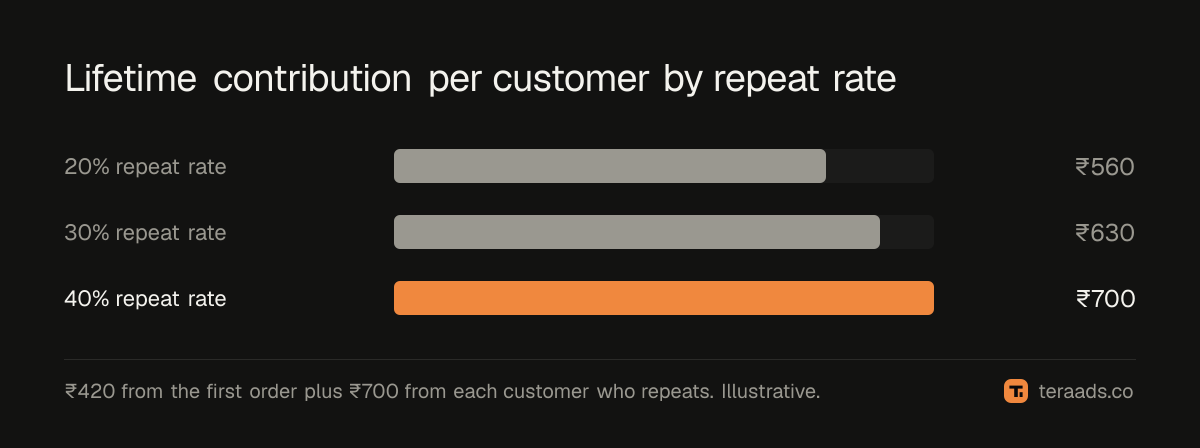
Repeat customers cost little or nothing to reacquire, so their orders are mostly contribution. Raising repeat rate raises lifetime value, which shortens CAC payback and improves the LTV to CAC ratio. It also lets you afford a higher acquisition cost, which means you can outbid competitors for the same customers.
How to raise it
- Get the first order right. Delivery speed, packaging and product quality decide whether customers return. A refused or late COD delivery rarely leads to a second order.
- Time reminders to usage. If a product lasts 30 days, remind buyers around day 25, not day 90.
- Offer a reason for the second order: a complementary product, a refill or a new range, rather than a generic discount.
- Make reordering easy: saved addresses, quick reorder links and subscriptions where they suit the product.
- Watch which channels bring repeaters. Some campaigns bring one-time discount hunters; others bring loyal customers. Compare repeat rates by first-order source.
Repeat rate by channel and first product
Two cuts of the data are especially useful. The first is repeat rate by the channel that brought the customer: compare customers whose first order came from Meta prospecting, Google search, organic search and referrals. Channels that bring more repeaters can justify a higher acquisition cost, which a simple ROAS comparison misses. You need UTM-tagged first orders for this; the UTM guide covers the setup.
The second is repeat rate by first product. Customers whose first purchase was a particular product or category often come back far more than others. Those products make good first-order offers and good subjects for prospecting ads, even if their own margin is lower, because the customers they bring are worth more over time.
Both cuts need enough customers in each group to mean anything; a group of 30 customers can swing widely by chance.
Common mistakes
Mixing old and new customers. A blended returning rate can rise just because old customers keep buying while new ones don't.
Counting refused and returned orders. They inflate or deflate the rate depending on where they fall.
Comparing immature cohorts. Recent customers haven't had time to repeat.
Discounting every repeat order. It trains customers to wait for offers and cuts the contribution that makes repeats valuable.
Benchmarking against the wrong category. Compare with your own history first.
Tera Ads works out sales and profit after returns from your Shopify orders, so the order data you build repeat rates from is the same data behind your ad decisions. It is free for one business.
Frequently asked questions
How do you calculate repeat purchase rate?
Take customers acquired in a period, count those who placed a second kept order within a fixed window such as 90 days, and divide by the total acquired.
What is a good repeat purchase rate?
It depends heavily on category. Consumables repeat far more than jewellery or furniture. Compare your cohorts over time rather than chasing a universal number.
Is returning customer rate the same as repeat purchase rate?
Not quite. Shopify's returning customer rate is the share of a period's buyers who had ordered before. A cohort repeat rate tracks whether a specific group of new customers came back.
Should RTO orders count in repeat purchase rate?
No. Exclude cancelled, refunded and RTO orders, so only kept orders count as first and repeat purchases.
How can I increase repeat purchases?
Deliver a good first experience, remind customers when they're likely to run out, offer a relevant second product and make reordering easy.