Returns vs RTO: Two Different Losses and How to Count Each
An RTO comes back before delivery; a return comes back after the buyer has it. How the costs, refunds and accounting differ, and why mixing them hides problems.
On this page
An RTO (return to origin) is a parcel that comes back before delivery, because the buyer refused it or couldn't be reached; a return is a parcel the buyer received and sent back. They cost different amounts, hit different lines of your P&L and have different causes. RTO is mostly about intent, address and payment mode; returns are mostly about the product matching expectations. Track them separately, with separate rates, so you fix the right problem.
Key takeaways
- RTO happens before delivery and produces no sale; a return happens after delivery and reverses a sale.
- RTO costs freight both ways and handling; a return adds a reverse pickup, inspection, a refund and sometimes damaged stock.
- RTO causes: COD refusals, wrong addresses, unavailable buyers. Return causes: size, quality, wrong item, changed mind.
- Mixing the two into one "returns" number hides which problem is growing.
- Both belong in profit per campaign, counted in the month the order was placed.
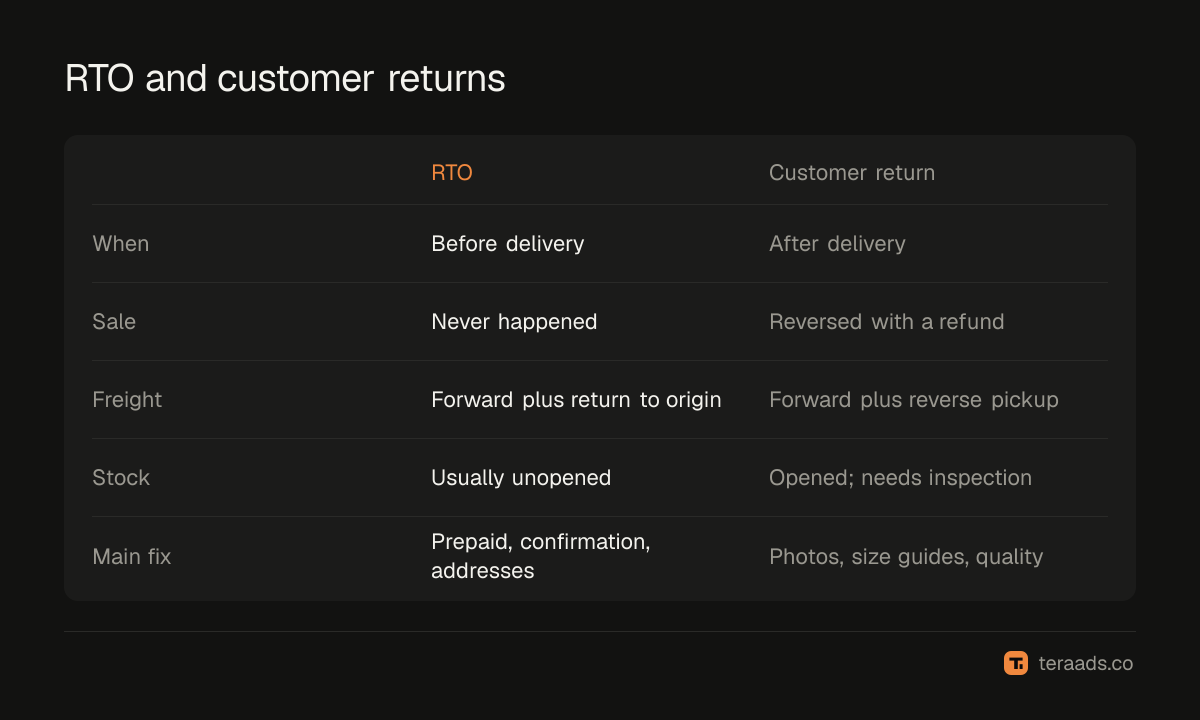
The difference in one table
| RTO | Customer return | |
|---|---|---|
| When it happens | Before delivery | After delivery |
| Did a sale happen? | No; no money collected on COD | Yes, then reversed with a refund or exchange |
| Who starts it | Courier, after a refusal or failed attempts | Buyer, through your return policy |
| Freight | Forward plus return to origin | Forward plus a reverse pickup |
| Stock condition | Usually unopened | Opened; needs inspection |
| Main causes | COD refusal, address, unavailability | Size, quality, wrong item, expectations |
| Main fixes | Prepaid incentives, confirmation, address checks | Better photos, size guides, quality control |
What each one costs
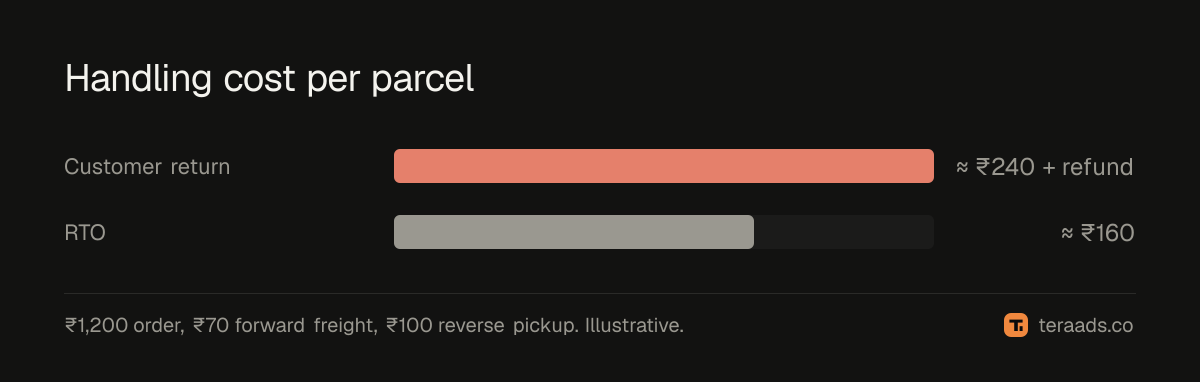
Take an illustrative ₹1,200 order with ₹70 forward freight:
- RTO: ₹70 forward, about ₹70 return freight and around ₹20 to receive and restock. Total about ₹160, and the product is usually resellable. On a COD order, no money was collected, so there's nothing to refund.
- Return: ₹70 forward, a reverse pickup that often costs more than forward freight, say ₹100, inspection and repacking of around ₹30, and the refund of ₹1,200 that was already counted as revenue. If one in ten returned items can't be resold, add ₹40 of written-off stock on average for a ₹400 product.
The return costs more to handle, around ₹240 against ₹160 here, and it also reverses revenue that your reports had already counted. Your own costs will differ; the RTO cost calculator works through each line.
Why the causes differ
RTO is decided before the buyer sees the product. A COD buyer who ordered on impulse, gave a wrong address or wasn't home, refuses or misses the parcel. That's why RTO is far higher on COD than prepaid and varies so much by pin code and campaign; reducing RTO in India covers the fixes.
Returns are decided after the buyer has the product in hand. The usual reasons are that it doesn't fit, looks different from the photos, arrived damaged or isn't what they expected. Returns are high in categories like apparel and footwear where sizing matters, and they respond to product-page fixes and quality control rather than payment-mode changes.
Why mixing them hides problems
Many brands track one "returns" number. If RTO falls because you added order confirmation, while returns rise because a new product runs small, the combined number can stay flat and both stories disappear. Separate rates make each change visible:
- RTO rate = RTO shipments ÷ (delivered + RTO), on settled shipments.
- Return rate = returned orders ÷ delivered orders, after your return window has closed.
Track both by product and by campaign. A campaign can look great on RTO and terrible on returns if its ads oversell the product.
Counting them in profit
Both reduce what a campaign really earned, and both should be counted in the month the order was placed, so each month's profit reflects the orders it generated:
- RTO: remove the order's revenue entirely, and subtract freight both ways and handling.
- Return: subtract the refund, reverse pickup, inspection and any stock you can't resell. Exchanges cost freight and handling but keep the revenue.
True ROAS after RTO and COD shows how RTO changes a campaign's real return. Apply the same approach to returns once your return window has passed.
Timing: when each one is final
RTO usually settles within two to three weeks of dispatch. Returns settle only after your return window closes, which might be 7, 15 or 30 days after delivery depending on your policy. So a month's profit is truly known only after both have settled: around three weeks for RTO, longer for returns. Until then, use your recent average rates as an estimate and replace them with actuals as they arrive.
Reducing each one
For RTO: prepaid incentives, partial COD for risky orders, order confirmation, address checks and courier routing. The prepaid discount strategy shows how to price the incentive.
For returns: accurate photos from several angles, size charts with measurements, honest descriptions of material and colour, careful packing, and quality checks before dispatch. Read return reasons monthly by product; one bad size chart can drive most of a product's returns.
Return policies and RTO
A generous return policy can reduce RTO a little, because buyers who know they can return are less likely to refuse at the door. It also raises returns. Neither is free, so choose the policy by comparing the cost of each: if a refusal costs ₹160 and a return ₹240, a policy that turns refusals into returns costs more unless many of those buyers keep the product.
Common mistakes
One combined rate. Improvements in one hide problems in the other.
Treating RTO as revenue until it comes back. COD orders that are refused never produced money.
Forgetting reverse pickup costs. They're often higher than forward freight.
Assuming returned stock is resellable. Opened items need inspection, and some are written off.
Judging a month too early. Wait for RTO and returns to settle before calling it.
Tera Ads shows profit after RTO for every Meta Ads and Google Ads campaign, with shipment outcomes from Shiprocket counted in the month each order was placed. It is free for one business.
Frequently asked questions
What is the difference between RTO and a return?
RTO comes back before delivery, after a refusal or failed attempts. A return comes back after the buyer received the product.
Which costs more, RTO or a return?
Per parcel, a return usually costs more to handle because of reverse pickup, inspection and possible write-offs, and it reverses a counted sale.
How do I calculate RTO rate and return rate?
RTO rate is RTO shipments divided by delivered plus RTO. Return rate is returned orders divided by delivered orders, after the return window closes.
Why is RTO higher on COD orders?
COD buyers haven't paid yet, so refusing the parcel costs them nothing. Prepaid buyers have money at stake.
Should RTO and returns be in campaign profit?
Yes. Both reduce what a campaign earned, and both should be counted in the month the order was placed.