How to Increase Average Order Value Without Hurting Conversions
A higher order value spreads shipping, fees and ad cost over more revenue. The tactics that raise AOV for D2C brands, the maths behind them, and how to test each.
On this page
Raising average order value (AOV) is one of the fastest ways to make ads profitable, because shipping, payment fees and the ad cost of winning the order stay roughly the same while revenue per order grows. The tactics that work best for D2C brands are bundles, free-shipping thresholds just above your current AOV, quantity breaks, relevant add-ons at checkout and gift sets. Test one at a time, and judge each on profit per order after ads and returns, not AOV alone.
Key takeaways
- Per-order costs (shipping, fees, packaging, ad cost per order) don't grow with order value, so higher AOV lifts profit faster than revenue.
- Bundles and quantity breaks raise AOV while keeping margin, if the discount is modest.
- Free-shipping thresholds work best set slightly above your current AOV.
- Add-ons should be cheap, relevant and one click.
- Measure profit per order and conversion rate, because a tactic that lifts AOV but cuts conversion can lose money.
Why AOV matters so much
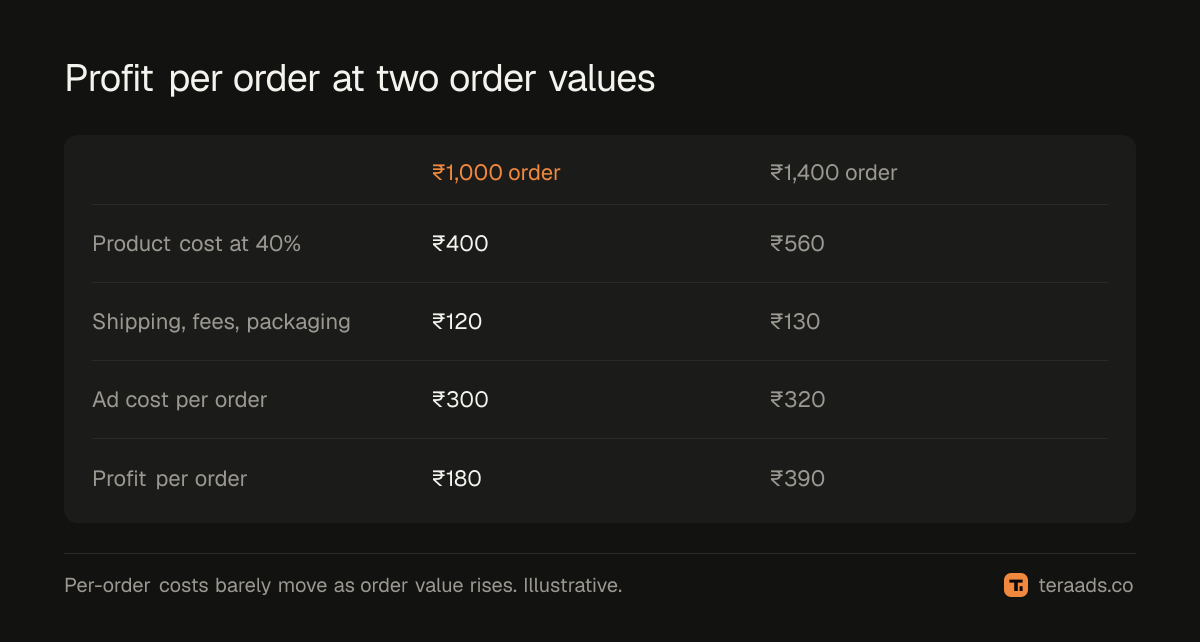
Many costs come per order, not per rupee of sales. Here's an illustrative comparison:
| ₹1,000 order | ₹1,400 order | |
|---|---|---|
| Product cost at 40% | ₹400 | ₹560 |
| Shipping, fees and packaging | ₹120 | ₹130 |
| Ad cost per order | ₹300 | ₹320 |
| Profit per order | ₹180 | ₹390 |
A 40% higher order value more than doubles profit per order here, even allowing for slightly higher shipping and a small drop in conversion that raises ad cost per order. That's why AOV is often a better lever than chasing a lower cost per click.
The tactics
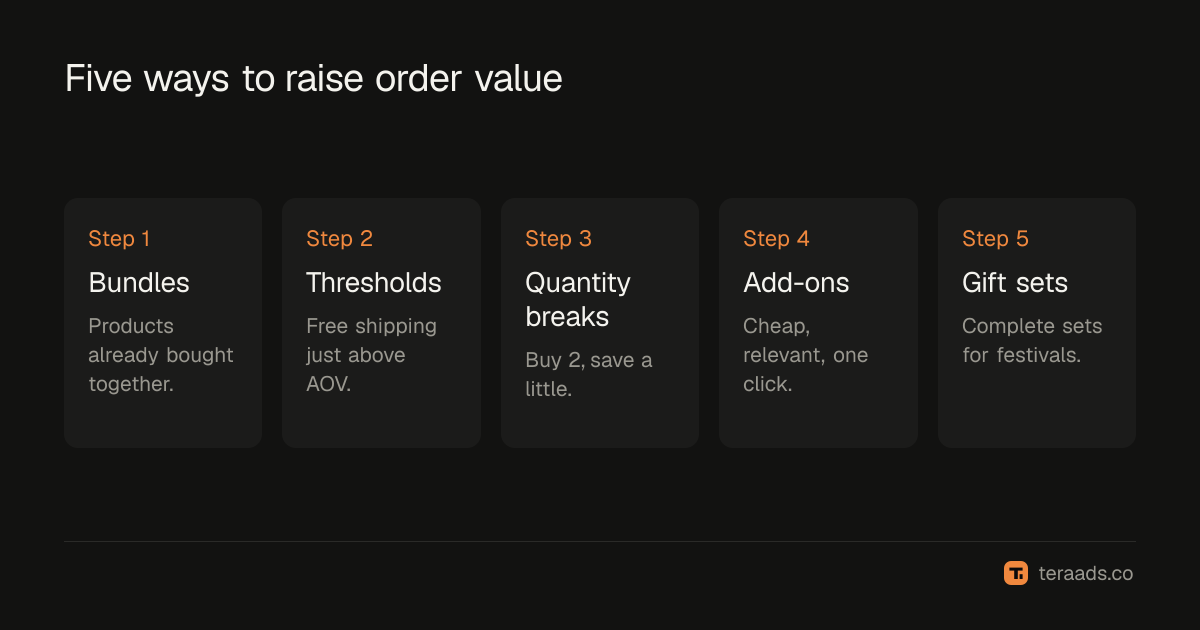
Bundles. Pair products that are bought together, such as a set of three, a matching pair or a starter kit, at a modest discount. A bundle at 10% off that doubles the order value usually earns far more margin than a single item at full price. Price it so the saving is clear but the margin per order rises.
Free-shipping thresholds. Set the threshold slightly above your current AOV, so many buyers add one more item to reach it. Too high and few reach it; too low and you give free shipping to orders that would have come anyway. Free shipping thresholds shows how to pick the number.
Quantity breaks. "Buy 2, save 10%" works well for consumables and gifting. It raises units per order and can bring forward a repeat purchase.
Add-ons at checkout. A small, relevant item, such as a care kit, gift wrap or a matching accessory, offered once with one click. Keep the price low relative to the order, so it doesn't make buyers reconsider.
Gift sets for festivals. Ready-made sets at a higher price point suit festive gifting, when buyers want something complete.
Product page suggestions. "Complete the look" or "frequently bought together" suggestions based on real order data, not random products.
Choosing what to try first
Start with your order data. Export the last few months of orders and look at:
- Your AOV distribution. If many orders sit just below a round number, a threshold slightly above it can move them.
- Products bought together. Pairs that already appear often are the best bundle candidates.
- Single-item orders. If most orders contain one item, bundles and add-ons have the most room.
- Repeat purchases. Products bought again within weeks suit quantity breaks.
Testing a tactic
- Measure a baseline for two weeks: AOV, conversion rate, orders and profit per order after ads.
- Change one thing, such as adding a bundle or moving the threshold.
- Run it for at least two weeks on similar traffic and ad spend.
- Compare profit per order and total profit, not just AOV.
- Wait for RTO to settle before calling the result for COD-heavy stores.
Running several changes at once makes it impossible to tell which helped.
What to watch out for
Conversion rate. A higher threshold or a pushy upsell can lose buyers. If conversion drops more than AOV rises, total profit falls.
Margin on bundles. A bundle at a deep discount raises AOV but can lower margin per order; use the discount cost calculator to check.
RTO on larger COD orders. Higher-value COD orders tie up more stock and freight when refused. Prepaid incentives on large orders can help; see the prepaid discount strategy.
Returns. Buyers who add items to reach a threshold sometimes return them. Track return rates on threshold orders.
AOV and ad targets
Higher AOV changes what you can afford to pay for an order. If profit per order rises from ₹180 to ₹390, your break-even cost per order rises too, which lets you bid for more buyers or accept a lower ROAS on campaigns that bring larger orders. Recalculate your break-even ROAS after AOV changes, so ad targets reflect your new economics.
A worked threshold example
Suppose your AOV is ₹950 and you charge ₹79 shipping on orders below ₹999. Looking at last month's orders, a large group sits between ₹700 and ₹999, many of them a single ₹799 product. A threshold of ₹1,199 with free shipping, plus a ₹399 add-on shown in the cart, gives those buyers a clear reason to add one item.
If a quarter of the buyers in that group add the add-on, AOV for the store might rise by ₹60 to ₹100 with little change in conversion. The shipping you waive on qualifying orders is a cost, so subtract it, along with the add-on's product cost, before calling the result. Free shipping thresholds shows how to check whether the trade-off pays.
Common mistakes
Judging on AOV alone. Profit per order and total profit decide whether a tactic worked.
Thresholds far above current AOV. Few buyers reach them, and those who do would have anyway.
Irrelevant add-ons. Random suggestions lower trust and rarely convert.
Deep bundle discounts. Higher AOV with lower margin can leave you worse off.
Testing everything at once. You won't know what worked.
Tera Ads shows Shopify sales, Meta Ads and Google Ads spend and profit after RTO from Shiprocket on one screen, so you can see whether a higher order value turned into more profit for every campaign. It is free for one business.
Frequently asked questions
What is average order value?
Total revenue divided by number of orders over a period. It tells you how much a typical order is worth.
What is the fastest way to increase AOV?
Bundles of products already bought together and a free-shipping threshold slightly above current AOV usually work fastest.
Does a higher AOV always mean more profit?
No. If it comes from deep discounts or lowers conversion, profit can fall. Measure profit per order after ads and returns.
How do I set a free shipping threshold?
Look at your AOV distribution and set it slightly above where many orders cluster, so a small addition reaches it.
Should I change ad targets when AOV rises?
Yes. Higher profit per order raises your break-even cost per order and lowers your break-even ROAS.