Discount Cost Calculator: How Many Extra Orders a Sale Needs
A discount comes straight out of margin. Calculate how many extra orders a sale needs to break even, including ad costs, RTO and buyers who'd pay full price anyway.
On this page
A discount pays off only if it brings enough extra orders to replace the margin you give away. With a 60% margin before ads, 20% off needs 50% more orders just to earn the same profit, and 30% off needs twice as many. Work out your margin per order before ads, apply the discount, divide the old margin by the new one, and compare the result with the extra orders the sale is likely to bring.
Key takeaways
- The discount comes entirely out of margin, so its effect on profit is far bigger than its percentage suggests.
- Orders needed to break even = old margin per order ÷ new margin per order.
- At a 60% margin: 10% off needs 1.2× the orders, 20% off needs 1.5×, 30% off needs 2×.
- Include ad cost per order, RTO and buyers who would have paid full price.
- Use discounts for clear goals, such as clearing stock or acquiring customers who repeat, not as a default.
Why discounts cost more than they look
Take an illustrative product priced at ₹1,000 with ₹400 of variable costs per order: product, packaging, shipping and payment fees. The margin before ads is ₹600, or 60%.
A 20% discount takes ₹200 off the price, but costs stay at ₹400. The margin falls from ₹600 to ₹400, a third of your margin for a fifth off the price. To earn the same total margin, you need 600 ÷ 400 = 1.5 times as many orders.
| Discount | Price | Margin before ads | Orders needed for the same margin |
|---|---|---|---|
| None | ₹1,000 | ₹600 | 1.0× |
| 10% | ₹900 | ₹500 | 1.2× |
| 20% | ₹800 | ₹400 | 1.5× |
| 30% | ₹700 | ₹300 | 2.0× |
| 40% | ₹600 | ₹200 | 3.0× |
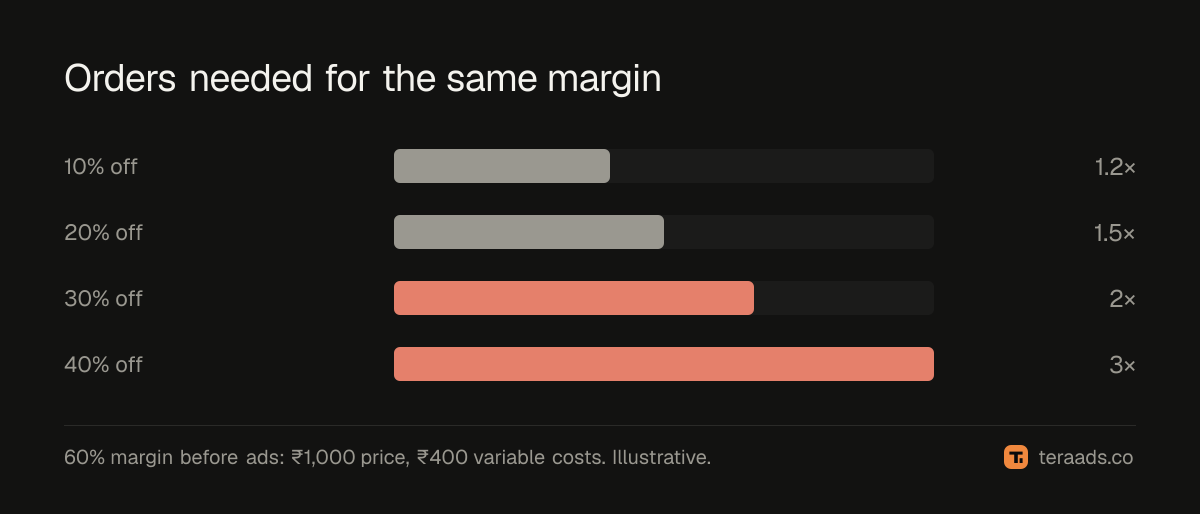
The lower your margin, the steeper this gets. At a 40% margin, 20% off needs twice the orders.
The calculator, step by step
- Find your margin per order before ads. Price minus product cost, packaging, shipping, payment or COD fees. Contribution margin lists what to include.
- Apply the discount. New price = price × (1 − discount). New margin = new price − the same variable costs.
- Divide. Orders needed = old margin ÷ new margin.
- Add ad costs. Subtract your cost per order from both margins and divide again; this is the number that decides profit.
- Adjust for RTO. Multiply both margins by your delivery rate and subtract the expected RTO cost per order shipped.
- Compare with a realistic uplift. Look at past sales of similar size, not hopes.
Including ad costs
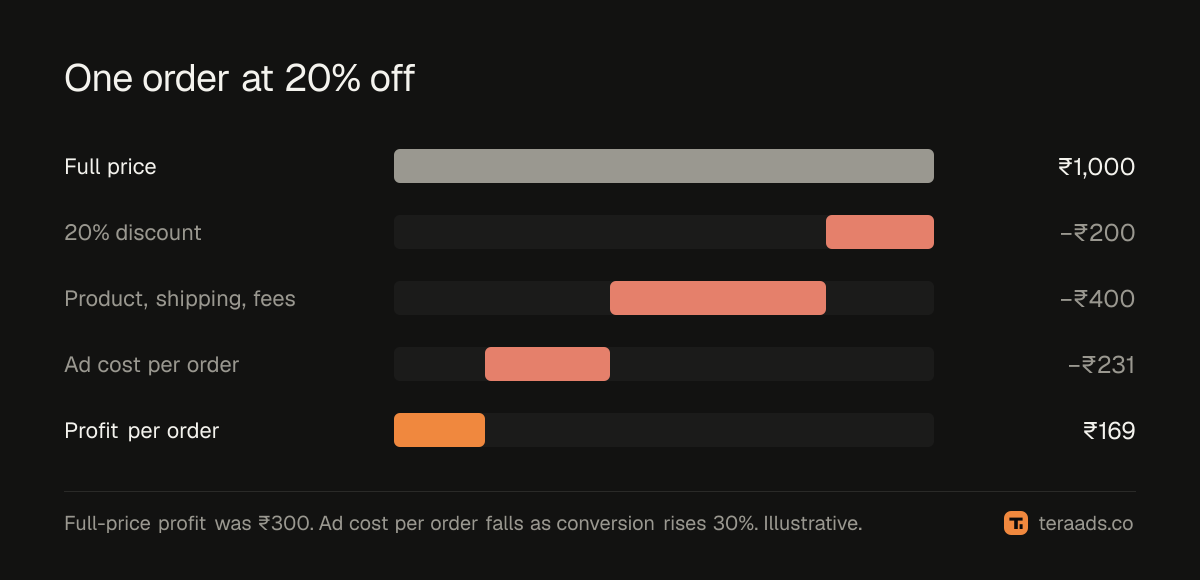
Ad spend changes the answer. Suppose ads cost ₹300 per order at full price, so profit per order is ₹1,000 − ₹400 − ₹300 = ₹300. A 20% sale lifts conversion rate by 30%, so the same ad spend brings 30% more orders and cost per order falls to about ₹231.
Profit per order on sale: ₹800 − ₹400 − ₹231 = ₹169. To match ₹300 of profit per full-price order, you need about 1.8 times as many orders. The sale brought 1.3 times as many from the same budget, so total profit falls unless you spend more and the extra spend converts as well.
The hidden costs
Buyers who would have paid full price. Regular customers and people who were about to buy get the discount too. If half of a sale's orders would have happened anyway, the real uplift is much smaller than the order count suggests.
Pulled-forward demand. Buyers wait for the next sale or buy now instead of next month. Sales after a promotion often dip.
RTO on impulse orders. Discount-driven COD orders are often refused more, which adds freight costs on orders that never pay; the RTO cost calculator shows what each costs.
Brand and price expectations. Frequent sales teach buyers to wait, which lowers full-price conversion over time.
When discounts make sense
- Clearing slow stock. Cash tied up in stock that isn't selling is worth freeing even at a low margin.
- Acquiring customers who repeat. If cohorts from a sale come back at a good rate, the first order can earn less; check with cohort analysis.
- Festive peaks. When buyers expect offers and competitors run them, a sale may protect share, but set the depth with this calculator.
- Bundles instead of price cuts. A bundle at a modest discount often raises order value enough to keep margin; increasing average order value covers bundles and thresholds.
Alternatives to a straight discount
- Free shipping above a threshold, which lifts order value instead of cutting price; see free shipping thresholds.
- Gift with purchase, which costs you the product cost, not its price.
- Prepaid-only offers, which cut RTO at the same time; the prepaid discount strategy covers the maths.
- Offers for returning customers only, so new full-price buyers aren't subsidised.
Measuring a sale afterwards
After the sale and once RTO has settled, compare with a similar period before:
- Orders, average order value and margin per order.
- Ad spend, cost per order and profit after ads and returns.
- Share of orders from returning customers.
- Orders in the two weeks after the sale, to see any dip.
If total profit after ads and RTO didn't rise, the sale moved revenue around without adding profit.
Common mistakes
Thinking in percentages of price. A 20% discount can remove a third or more of your margin.
Forgetting ad costs. Margin before ads isn't profit.
Counting every sale order as extra. Many would have happened anyway.
Ignoring the dip after. Pulled-forward demand counts against the sale.
Running sales by habit. Each one should have a goal and a break-even number.
Tera Ads shows profit after returns for every Meta Ads and Google Ads campaign beside your Shopify sales, so you can see whether a sale made money once ad spend and RTO are counted. It is free for one business.
Frequently asked questions
How do I calculate the cost of a discount?
Subtract the discount from the price, keep variable costs the same, and compare the new margin with the old. Old margin ÷ new margin gives the orders needed to break even.
How many more sales do I need for a 20% discount?
At a 60% margin before ads, 1.5 times the orders. At a 40% margin, twice the orders.
Do discounts increase profit?
Only when they bring enough genuinely extra orders to replace the lost margin, after ad costs and returns.
Should I include ad spend when evaluating a sale?
Yes. Ad cost per order often falls during a sale, but profit per order falls faster, so compare profit after ads.
What are alternatives to discounting?
Free shipping thresholds, bundles, gifts with purchase, prepaid-only offers and offers limited to returning customers.