First-Click vs Last-Click Attribution: Which Should a D2C Brand Use?
First-click credits the ad that found the customer; last-click credits the one that closed the sale. How each changes your budget decisions, and what to use instead.
On this page
First-click attribution gives all the credit for a sale to the first ad or channel that brought the customer; last-click gives it all to the last one before purchase. Last-click favours brand search, retargeting and email, which close sales; first-click favours prospecting ads that start them. Neither is right on its own. Look at both, judge total results with MER, and use incrementality tests for big budget decisions.
Key takeaways
- Attribution models split credit for a sale; they don't measure whether an ad caused it.
- Last-click flatters channels near the purchase: brand search, retargeting, email.
- First-click flatters channels that introduce customers: prospecting on Meta, YouTube, non-brand search.
- GA4 uses data-driven attribution by default and still offers last-click; Shopify reports first and last touch.
- Compare both views, watch blended MER and test incrementality before big budget shifts.
How the two models work
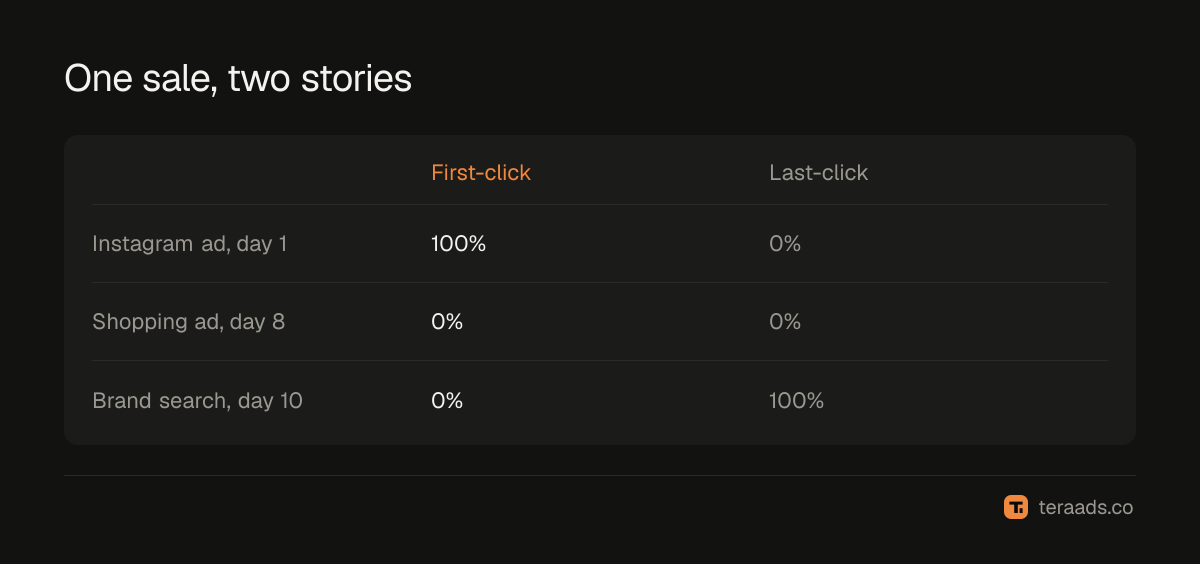
Take a customer who sees an Instagram ad, visits a week later from a Google Shopping ad, then searches your brand name and buys through a brand search ad.
| Touchpoint | First-click credit | Last-click credit |
|---|---|---|
| Instagram ad (day 1) | 100% | 0% |
| Google Shopping ad (day 8) | 0% | 0% |
| Brand search ad (day 10) | 0% | 100% |
Under last-click, Instagram looks useless and brand search looks brilliant. Under first-click, the reverse. The sale is the same; only the story changes.
What each model rewards
Last-click rewards the channels that catch people who have already decided: brand search, retargeting, email, WhatsApp reminders. They often show very high ROAS. Cutting prospecting because last-click says it doesn't convert usually shrinks those "great" channels a few weeks later, because fewer new people enter the funnel.
First-click rewards the channels that create demand: prospecting ads, influencer posts, non-brand search. It can make a broad campaign look like a hero even when the customer needed several reminders to buy.
| First-click | Last-click | |
|---|---|---|
| Favours | Prospecting, discovery, new audiences | Brand search, retargeting, email |
| Undervalues | Channels that close sales | Channels that introduce customers |
| Good for | Understanding where new customers come from | Understanding what closes sales |
| Risk | Overspending on discovery that rarely converts | Starving prospecting, then shrinking |
What your tools use
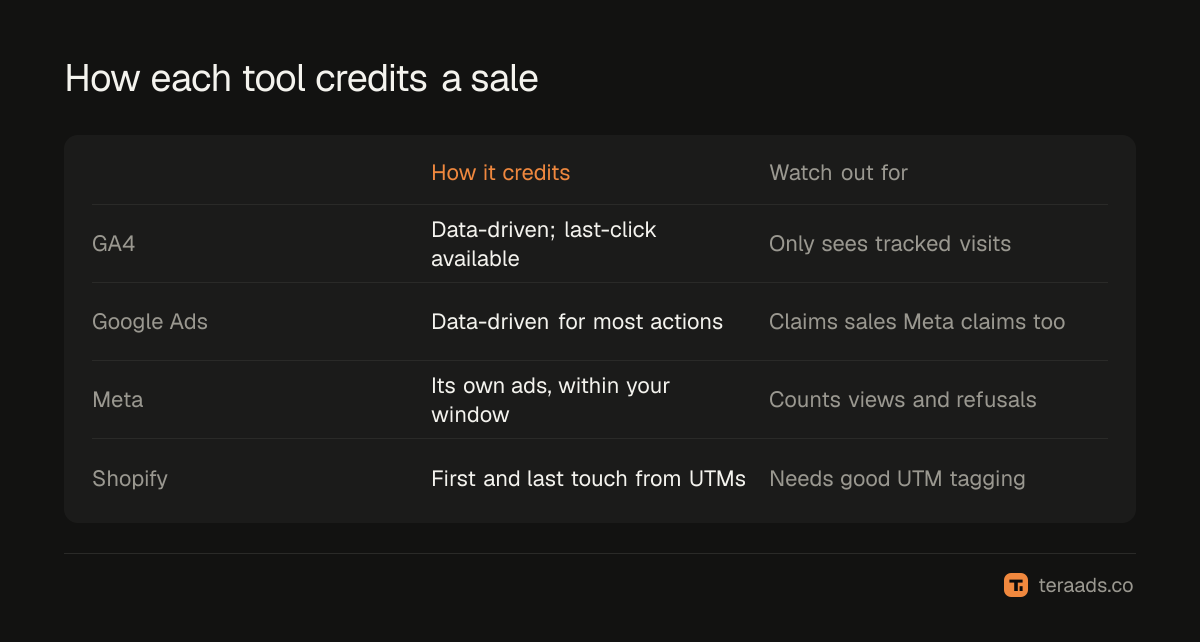
GA4 uses data-driven attribution by default, which spreads credit across touchpoints based on patterns in your data, and still offers last-click as an alternative model. Google removed first-click, linear, time-decay and position-based models from GA4 and Google Ads in 2023.
Google Ads uses data-driven attribution by default for most conversion actions, with last-click available.
Meta credits its own ads within your attribution window, regardless of other channels, so it often claims sales Google also claims. Attribution windows after January 2026 covers its settings.
Shopify shows first and last touch information for orders in its marketing reports, based on UTMs and referrers. That's useful because it's independent of the ad platforms. Good UTM tagging makes it far more accurate.
The reasons these tools disagree are in GA4 vs Shopify.
What to use for decisions
- Look at both first and last touch in Shopify or GA4. A channel that leads on first touch and trails on last touch is a starter, not a waste.
- Watch blended numbers. MER, total revenue divided by total ad spend, and new customer counts show whether the whole system is working.
- Test the big questions. Before cutting a channel, pause or reduce it in a planned way and watch total sales. Incrementality testing explains how.
- Keep platform numbers for in-platform comparisons. Meta ROAS is fine for comparing two Meta ad sets, not for comparing Meta with Google.
An example of the trap
An illustrative brand looks at last-click in GA4 and sees brand search at 12x ROAS and Meta prospecting at 1.1x. It moves half the Meta budget to brand search. Brand search can't spend more, because only so many people search the brand name, and over the next month brand searches fall as fewer new people hear of the brand. Total revenue drops 18%. First-touch data would have shown that most brand searchers first arrived from Meta.
Other models worth knowing
Between first-click and last-click sit several other ways to split credit. Linear attribution gives every touchpoint an equal share. Time-decay gives more credit to touchpoints closer to the purchase. Position-based models give most credit to the first and last touches and share the rest across the middle. These rule-based models were removed from GA4 and Google Ads in 2023, but you'll still see them in some analytics tools and spreadsheets.
Data-driven attribution, the default in GA4 and Google Ads, uses your own conversion data to estimate how much each touchpoint contributes, by comparing journeys that converted with journeys that didn't. It's more flexible than fixed rules, but it only sees the touchpoints Google can track, and it isn't a test of cause. Views of Meta ads, word of mouth and creator posts often show up as direct or referral visits, if at all.
The lesson is the same for every model: attribution divides credit among what was tracked. It can't tell you what would have happened without an ad, and it can't see channels it doesn't track. A post-purchase survey helps with the second problem; tests help with the first. For a small brand, a simple monthly routine works well: first touch from Shopify, last-click from GA4 and survey answers, compared side by side.
Common mistakes
Picking one model and trusting it. Each tells half the story.
Comparing platform ROAS across platforms. Meta and Google both claim the same sales.
Cutting prospecting on last-click data. The closing channels shrink a few weeks later.
No UTMs. Without them, first and last touch in Shopify are mostly guesses.
Never testing. Attribution describes; only tests show cause.
Tera Ads shows Meta Ads and Google Ads spend beside your Shopify orders, with total results and profit after returns on one screen, so you can watch blended numbers as well as campaigns. It is free for one business.
Frequently asked questions
What is the difference between first-click and last-click attribution?
First-click gives all credit to the first touchpoint in a customer's journey; last-click gives all credit to the final one before purchase.
Which attribution model is best for ecommerce?
None on its own. Compare first and last touch, watch MER and run incrementality tests for big decisions.
Does GA4 still have first-click attribution?
No. Google removed first-click and other rule-based models in 2023. GA4 offers data-driven and last-click attribution.
Why does last-click make brand search look so good?
People search your brand after deciding to buy, often because of earlier ads. Last-click gives the brand ad all the credit.
Where can I see first and last touch for Shopify orders?
Shopify's marketing reports show first and last touch information, based on UTMs and referrers.