Prompts for Ads Analysis: 25 Questions to Ask Claude or ChatGPT
Ready-to-use prompts for analysing Meta Ads, Google Ads and Shopify data with AI, plus the context to give first and the format that makes answers easy to check.
On this page
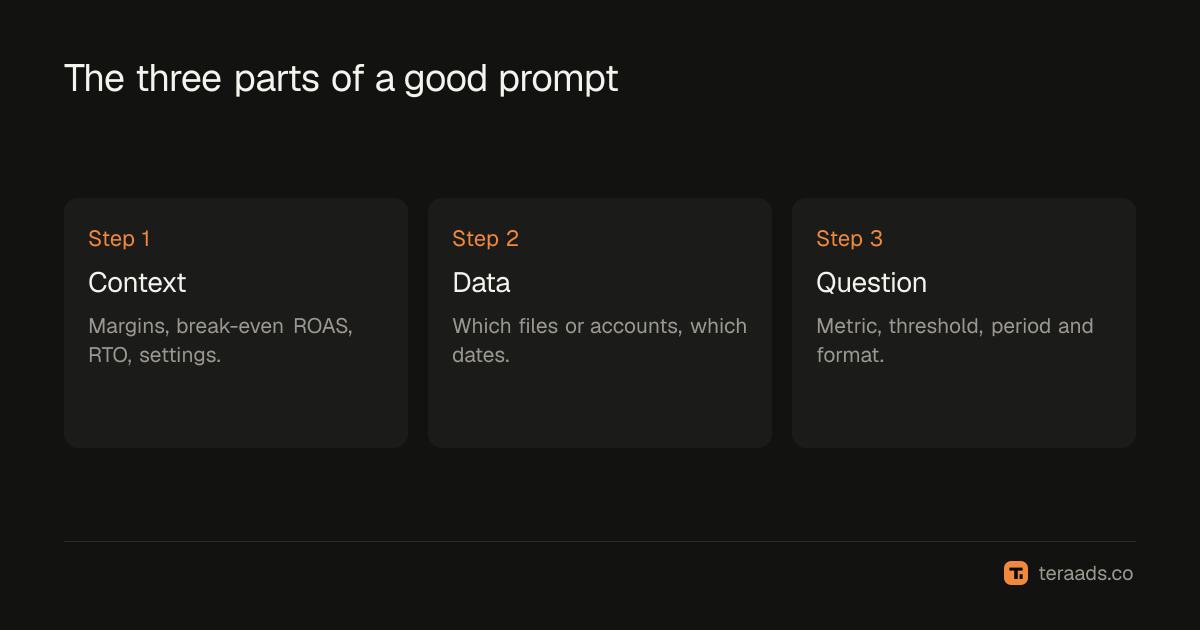
Good prompts for ads analysis share three parts: context about your business, the data and period to use, and a specific question with the format you want back. Tell the assistant your break-even ROAS, RTO rate and attribution setting first, ask one question at a time, and request a table plus the rows behind each conclusion. The prompts below work in Claude or ChatGPT, with uploaded exports or a live connector.
Key takeaways
- Start every analysis with a context block: margins, break-even ROAS, RTO rate, currency and attribution setting.
- Name the metric, threshold and period in every question.
- Ask for tables and the evidence behind each conclusion, so answers can be checked.
- Separate "what happened" questions from "what should I do" questions.
- Reuse the same prompts weekly so results are comparable.
The context block
Paste this at the start of a conversation and fill in your numbers. It stops the assistant judging your campaigns against generic benchmarks.
We're a D2C brand selling [product] in India through Shopify. Average order value is ₹[x]. Contribution margin after product, shipping and fees is [y]%, so break-even ROAS on kept orders is [z]x. About [a]% of orders are cash on delivery, and our RTO rate on COD orders is around [b]%. Meta attribution setting is 7-day click, 1-day view. All money is in INR. When you answer, state the date range and the setting you used.
If you don't know your break-even ROAS, the break-even ROAS guide shows the one-line formula.
Prompts for spend and efficiency
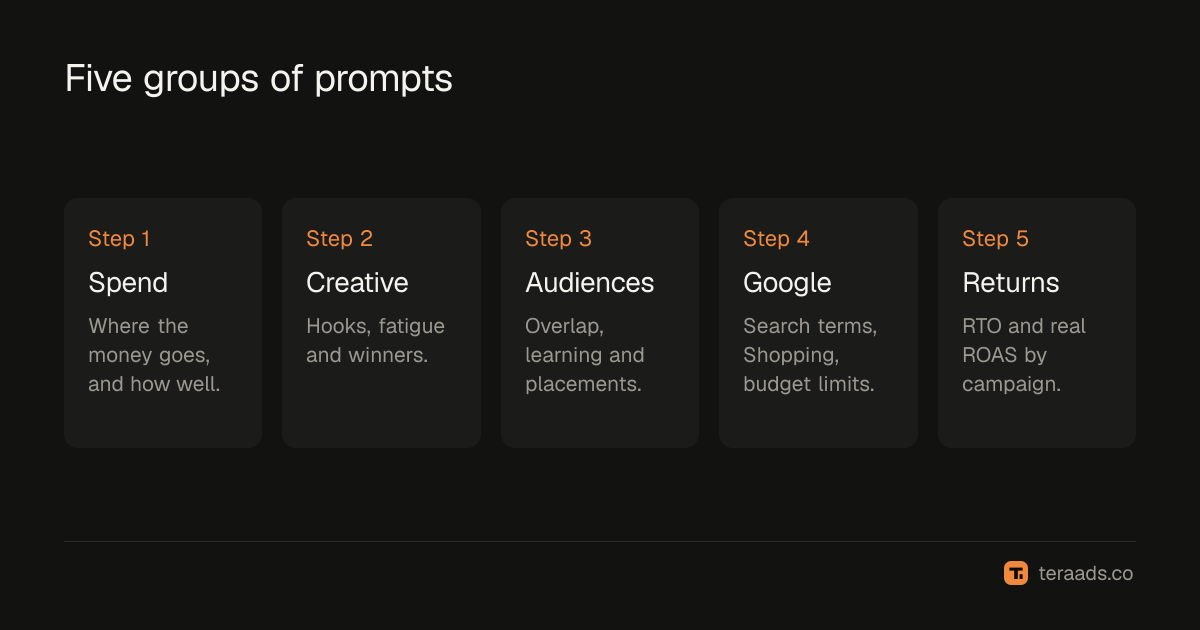
- "Which campaigns spent the most in the last 30 days? Show spend, purchases, cost per purchase and ROAS in a table, sorted by spend."
- "Which ad sets have a cost per purchase more than 50% above our average over 14 days, with at least ₹5,000 spent?"
- "Show weekly spend and ROAS for the last eight weeks. Did efficiency fall as spend rose?"
- "Which campaigns are below break-even ROAS on platform numbers? Which are close enough that returns would push them below?"
- "Compare blended results: total spend across Meta and Google against total Shopify revenue (MER), by week." See MER vs ROAS.
Prompts for creative
- "For each active ad, show spend, CTR, frequency and cost per purchase over 14 days. Which ads show falling CTR with rising frequency?"
- "Group our ads by their opening hook. Which hook type has the best cost per purchase with at least ₹10,000 spend?"
- "Which ads get high CTR but low conversion rate? List them with landing page."
- "What do our three best ads by cost per purchase have in common: format, length, offer, opening line?"
- "Which ads have run for more than 45 days? Show their weekly CTR trend."
Prompts for audiences and structure
- "Which ad sets target overlapping audiences? Show their CPMs side by side."
- "How much spend goes to retargeting versus prospecting, and how does cost per new customer compare?"
- "Which ad sets haven't exited the learning phase, and how many conversions did each get last week?"
- "Compare results by age and gender breakdown. Where does cost per purchase differ by more than 40%?"
- "Which placements spend the most with the worst cost per purchase?"
Prompts for Google Ads
- "List search terms with more than ₹1,000 spent and no conversions in 30 days, grouped by theme, as negative keyword candidates."
- "Split search spend into brand and non-brand. Show ROAS for each."
- "Which Shopping products got clicks but no sales in 60 days?"
- "Which campaigns are limited by budget, and which by target ROAS?"
- "Compare conversion value with Shopify revenue from Google-tagged orders for the same month."
Prompts that bring in returns
These need Shopify orders with UTM campaign and delivery outcomes from your shipping platform. They matter most for cash-on-delivery brands, because platform ROAS counts refused orders as sales. True ROAS after RTO and COD explains the calculation.
- "Join orders to shipment outcomes by order number. Calculate RTO rate by UTM campaign for orders older than 21 days."
- "Calculate real ROAS on kept orders for each campaign. Which campaigns change rank compared with platform ROAS?"
- "Which products have the highest RTO rate on COD orders?"
- "Which pin codes or states have RTO above 35% with at least 30 orders?"
- "Estimate how much monthly profit we lose to RTO, using ₹[x] shipping each way."
Getting answers you can check
| Ask for | Why |
|---|---|
| A table, not paragraphs | Easy to scan and compare with the platform |
| Date range and settings used | Catches the most common mismatch |
| The rows behind each conclusion | Lets you verify in a minute |
| Totals that reconcile | Revenue by campaign should add up to the total |
| "Say if the data can't answer this" | Reduces confident guesses |
From analysis to action
Keep diagnosis and recommendations apart. First ask what happened and check it. Then ask: "Based only on the tables above, suggest up to three changes, the evidence for each, and how we'd know in two weeks whether it worked." Asking for the success measure up front turns a suggestion into a small test, and it stops the assistant recommending changes it can't justify from the data. Using ChatGPT for ad analysis covers preparing the data these prompts need.
Common mistakes
Skipping the context block. Without margins and RTO, the assistant judges by generic benchmarks.
Asking several questions at once. Answers get shallow; ask one, then follow up.
Mixing periods. Compare the same dates across Meta, Google and Shopify.
Asking for recommendations first. Diagnose, check, then decide.
Changing prompts every week. Reusing the same prompts makes week-on-week comparisons fair.
Tera Ads shows real ROAS after returns for every Meta Ads and Google Ads campaign beside your Shopify sales, which gives you checked numbers to paste into any prompt. It is free for one business.
Frequently asked questions
What is the best prompt for analysing Facebook ads?
There's no single one. Start with a context block covering margins, break-even ROAS and RTO, then ask a specific question with a metric, threshold and period.
Do these prompts work with Claude and ChatGPT?
Yes. They work with uploaded spreadsheet exports in either assistant, or with a live connector to your ad account where your plan supports one.
How do I stop AI giving generic marketing advice?
Give it your own numbers and targets, and ask it to base every conclusion only on the data provided, saying when the data can't answer.
Should I share customer data in prompts?
No. Ad analysis rarely needs personal data. Remove names, phones and addresses from order exports before uploading.
How often should I run these prompts?
Weekly for spend, creative and search terms; monthly for returns, audiences and blended results.