Meta Ads for Jewellery Brands: Creative, Trust and COD That Works
Jewellery sells on detail, trust and occasion. How D2C jewellery brands in India can plan Meta ads creative, handle COD risk and judge campaigns on kept orders.
On this page
Jewellery is bought on detail, trust and occasion, so the Meta ads that work for jewellery brands show the piece up close and on a person, prove quality and returns, and time spend around gifting moments. It's also a category where COD refusals can be costly, because orders are often impulse or gift purchases. Build creative around close-ups, try-ons and real reviews, plan budgets around festivals and wedding season, and judge every campaign on kept orders after RTO.
Key takeaways
- Close-up detail and on-person shots answer the two biggest questions: what it looks like and how big it is.
- Trust signals, such as material details, certification where relevant, reviews and a clear return policy, matter more than in most categories.
- Gifting and festive occasions drive large swings in demand; plan creative and budget for them.
- COD jewellery orders can be refused at high rates; confirm high-value orders and offer prepaid incentives.
- Catalogue ads suit large ranges; UGC and try-on videos suit prospecting.
Creative that sells jewellery
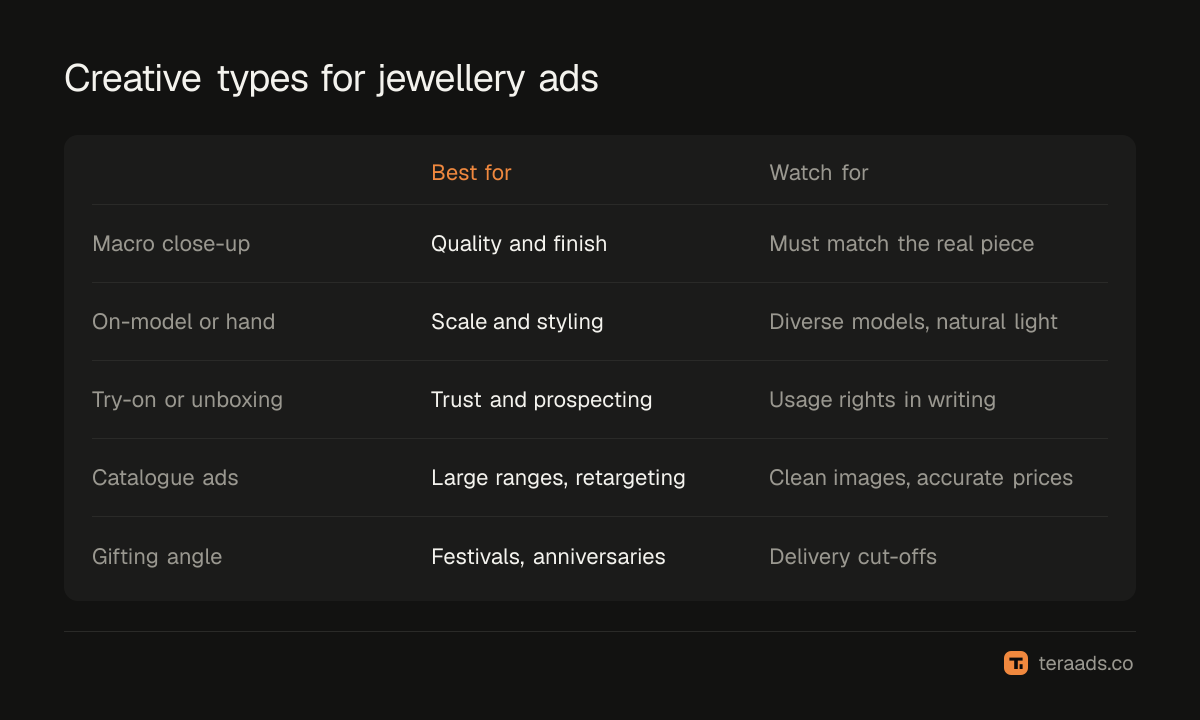
Macro detail. Sharp close-ups of stones, finish and clasp show quality that a small product photo can't.
On a person. Worn on the ear, neck or hand, so buyers see scale and how it sits. Include different skin tones and outfits that match your audience.
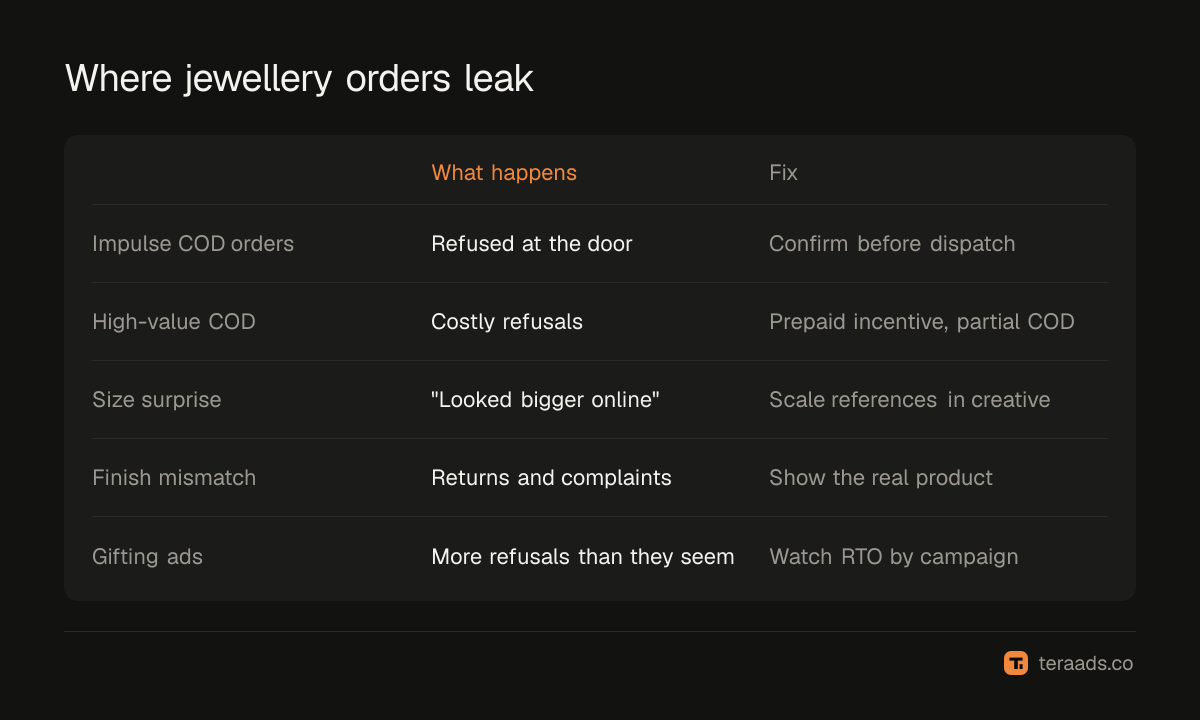
Scale references. A coin, a hand or a ruler in one frame removes the "it looked bigger online" surprise that leads to refusals and returns.
Try-on and unboxing videos. Creator or customer videos showing the box, the piece and how it looks in daylight build trust quickly; UGC ads covers briefing and rights.
Styling and occasions. One piece shown three ways, or a look for a wedding, office or festival, gives buyers a reason to buy now.
| Creative type | Best for | Watch for |
|---|---|---|
| Macro close-up | Showing quality and finish | Must match the real product; avoid heavy retouching |
| On-model or hand shot | Scale and styling | Diverse models; natural light |
| Try-on or unboxing video | Trust and prospecting | Usage rights in writing |
| Catalogue or collection ads | Large ranges, retargeting | Clean feed images, accurate prices |
| Gifting angle | Festivals, birthdays, anniversaries | Delivery cut-offs |
Trust signals
Jewellery buyers worry about quality, size and whether they can return something. Put answers in the ad and on the product page:
- Material and finish, stated plainly: base metal, plating, stone type.
- Certification or hallmark details where they apply to what you sell.
- Real reviews with photos.
- A clear return or exchange policy and delivery time.
- Care instructions, which also reduce complaints later.
Never show a finish, size or stone that the delivered product doesn't match; it drives refusals, returns and ad account problems.
Occasions and seasons
Demand rises around festivals, wedding season, Raksha Bandhan, Valentine's Day and other gifting days, and some buyers time gold purchases to auspicious dates. Plan creative and budgets ahead of each moment, and stop promising delivery once couriers can't make it. Festive season ads planning has a calendar for Diwali 2026.
COD and RTO in jewellery
Jewellery orders are often impulse or gift buys, and higher-value COD orders cost more when refused. Keep the basics in place:
- Confirm COD orders above a value before dispatch; see COD order confirmation.
- Offer a prepaid incentive on higher-value pieces; the prepaid discount strategy shows how to price it.
- Use partial COD for risky pin codes or very high-value orders.
- Watch RTO by campaign, because gifting and discount-led ads can bring more refusals than they appear to sell.
Reducing RTO in India covers the wider playbook.
Structure and targeting
Keep the account simple: one broad prospecting campaign with your best creative, a catalogue retargeting campaign for viewers and cart abandoners, and a testing campaign; Meta ads account structure explains why. Broad targeting usually works well because creative does the targeting: a bridal set ad finds bridal buyers. Separate a product line only if its price and margin are very different.
Catalogue ads and price points
Jewellery brands often have hundreds of products, which suits Meta's catalogue ads (Advantage+ catalogue ads, formerly dynamic product ads). They pull products from your Shopify catalogue and show each person pieces related to what they viewed or what Meta predicts they'll like.
To make them work for jewellery:
- Use clean main images on a plain background, because catalogue ads crop and resize them. Make sure the piece fills the frame.
- Build product sets by category or price band, so earrings retargeting shows earrings, and premium pieces aren't mixed with entry-level ones.
- Show price and offers with catalogue overlays, because price is one of the first questions in this category.
- Exclude out-of-stock items, which waste clicks.
Price points shape everything else. Entry pieces, often under ₹1,000, convert impulse buyers and gift shoppers but can carry higher COD refusal rates and thinner margins after shipping. Premium pieces convert less often but each kept order earns more. Test both, and compare them on profit after RTO per order, not conversion rate. Many brands find entry pieces work as a first purchase and premium pieces sell better to returning customers, so the two belong in different campaigns.
COD order confirmation and prepaid discounts help protect the margin on higher-value orders.
Common mistakes
Product photos only. Without scale and on-person shots, buyers guess and refuse.
Over-retouched images. The parcel that arrives doesn't match the ad.
Ignoring occasions. Generic ads in gifting weeks waste the best demand of the year.
Judging on purchases. High-value COD refusals can turn a strong campaign into a loss.
No return policy in sight. It's one of the first things jewellery buyers look for.
Tera Ads shows every Meta Ads and Google Ads campaign with profit after returns from your Shopify orders and RTO from Shiprocket, so jewellery campaigns are judged on kept orders, not purchases. It is free for one business.
Frequently asked questions
What ads work best for jewellery on Meta?
Close-up detail, on-person shots with scale, try-on or unboxing videos and occasion-led gifting ads.
How do I reduce RTO on jewellery orders?
Confirm high-value COD orders, offer prepaid incentives, use partial COD for risky areas and show accurate size and finish in ads.
Should jewellery brands use catalogue ads?
Yes, for large ranges and retargeting, as long as feed images are clean and prices accurate.
When should jewellery brands spend most on ads?
Ahead of festivals, wedding season and gifting days, while couriers can still deliver in time.
How should I target jewellery ads?
Broad targeting with strong, specific creative usually works; separate campaigns only for very different price points.