ROAS vs ROI: The Difference, With Examples for Online Stores
ROAS divides revenue by ad spend; ROI divides profit by what you invested. The formulas, when to use each, and a worked example for a Shopify store.
On this page
ROAS (return on ad spend) divides the revenue your ads brought in by what you spent on them; ROI (return on investment) divides the profit they made by everything you put in. ROAS tells you how much you sold per dollar of ads. ROI tells you whether those sales made money. A campaign with a 4x ROAS can have a strong ROI on a 50% margin and a negative one on a 20% margin.
Key takeaways
- ROAS = revenue ÷ ad spend. ROI = (profit − cost) ÷ cost, written as a percentage.
- ROAS ignores product cost, shipping, fees and returns. ROI includes them, so it answers "did this make money".
- For ads alone, ROI = ROAS × contribution margin − 1. A 4x ROAS at a 35% margin is a 40% ROI.
- ROAS breaks even at 1 ÷ margin; ROI breaks even at 0%.
- Use ROAS to compare ads inside a platform, and ROI (or POAS) to decide budgets.
Two formulas, two questions
The two numbers sound alike but measure different things.
ROAS = revenue from ads ÷ ad spend
ROI = (profit from ads − cost) ÷ cost
ROAS stops at revenue. It is quick to calculate and every ad platform reports it, which is why it is the number most people talk about. How to calculate ROAS covers which revenue to count.
ROI goes all the way to profit. To work it out for ads, you need what the sales leave after product cost, shipping, payment fees and returns, which is your contribution margin, and then you take the cost of the ads out of that.
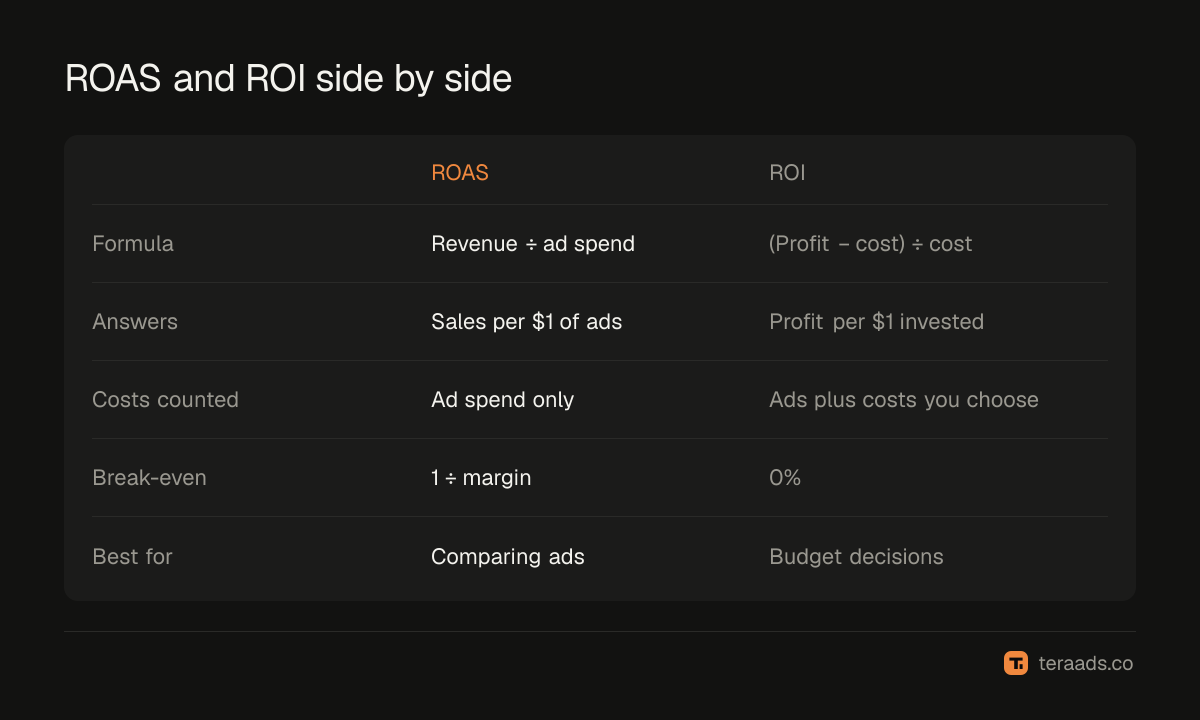
| ROAS | ROI | |
|---|---|---|
| Measures | Revenue per dollar of ad spend | Profit per dollar invested |
| Formula | Revenue ÷ ad spend | (Profit − cost) ÷ cost |
| Costs included | Ad spend only | Ad spend plus any costs you choose: creative, agency, tools |
| Written as | 4x, or 400% | 40% |
| Break-even | 1 ÷ contribution margin | 0% |
| Best for | Comparing ads, audiences and campaigns | Budget decisions and reporting profit |
A worked example
Here is an illustrative month for a Shopify store running Meta ads:
- Ad spend: $10,000.
- Revenue from those ads, from Shopify orders after returns and without sales tax: $40,000.
- Contribution margin after product cost, shipping, payment fees and returns: 35%.
- Creative production and an agency retainer for the same campaigns: $1,500.
ROAS is $40,000 ÷ $10,000 = 4x, or 400%.
ROI on ad spend starts from margin. The $40,000 of sales leaves $14,000 after costs. Take out $10,000 of ads and $4,000 is left. ROI = $4,000 ÷ $10,000 = 40%.
ROI on everything adds the $1,500 of creative and agency costs: profit is $2,500 on $11,500 invested, so ROI is about 22%.
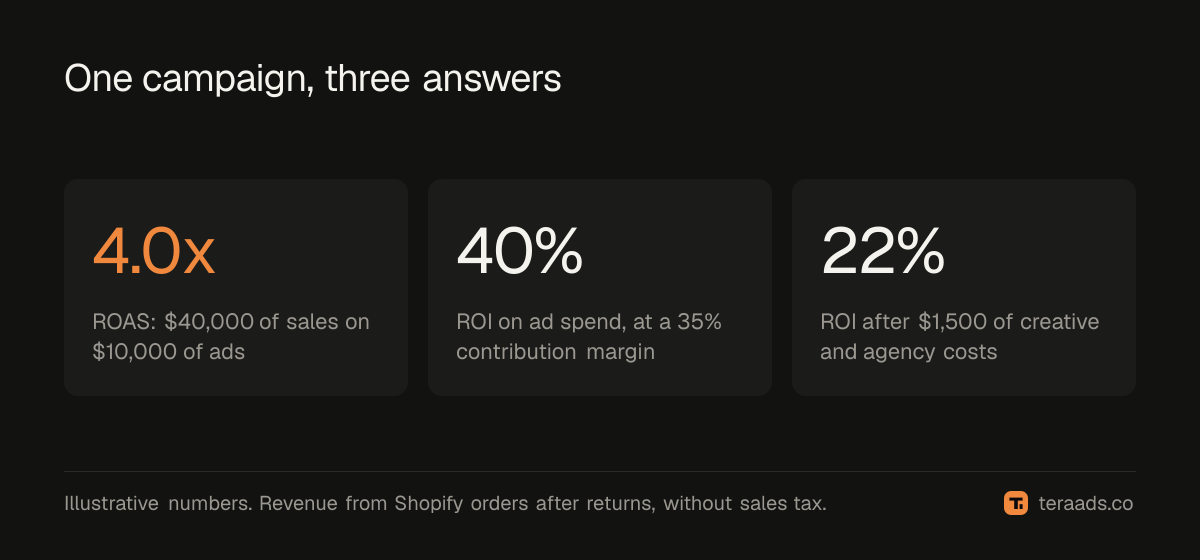
All three numbers are correct. They answer different questions: how much did the ads sell, did the ad spend pay off, and did the whole campaign pay off.
Converting ROAS to ROI
If ad spend is the only cost you count, there is a shortcut:
ROI = ROAS × contribution margin − 1
At a 35% margin, a 4x ROAS gives 4 × 0.35 − 1 = 0.40, a 40% ROI. A 2.5x ROAS gives 2.5 × 0.35 − 1 = −0.125, a loss of 12.5%. The ROAS where ROI hits zero is 1 ÷ 0.35 = 2.9x, which is the store's break-even ROAS. Break-even ROAS shows how to work out the margin honestly.
This is why ROAS on its own can't tell you whether ads are working. The same 4x is a 100% ROI at a 50% margin and a 20% loss at a 20% margin. Contribution margin for D2C brands explains what belongs in the margin.
When to use each
Use ROAS to compare things inside one ad platform: one ad against another, one audience against another, this week against last week. The platform optimizes on its own conversion data, so ROAS from the platform is the fairest way to compare its parts, as long as you remember it counts revenue, not profit.
Use ROI when the question is about money: whether to raise or cut a budget, whether a channel is worth keeping, what to report to a partner or investor. ROI needs margin, so work it out from Shopify orders after returns rather than from platform revenue.
Use both with a known link between them. Once you know your break-even ROAS, any ROAS number tells you roughly where ROI sits, and you can manage day to day on ROAS without losing sight of profit.
Where POAS and MER fit
Two other numbers sit between ROAS and ROI.
POAS, profit on ad spend, divides the profit from ads (before ad spend) by ad spend. A POAS of 1 is break-even, so it reads like ROAS but carries the margin inside it. In the example, POAS is $14,000 ÷ $10,000 = 1.4. POAS covers it in full.
MER, the marketing efficiency ratio, divides total store revenue by total ad spend across every platform. It is a store-wide ROAS that no single platform can inflate. MER vs ROAS shows how to use it alongside campaign numbers.
Common mistakes
- Treating ROAS as ROI. A 3x ROAS is not a 200% return. Depending on margin it can be a loss.
- Using platform revenue for ROI. Ad platforms count sales inside their attribution windows and don't take out refunds. ROI should use revenue you keep.
- Leaving returns out of margin. Returns cost shipping both ways and earn nothing, so they belong in contribution margin.
- Mixing time frames. Ad spend is immediate; returns and repeat purchases arrive later. Compare a month only once most returns have come in.
Tera Ads connects Shopify, Google Ads and Meta Ads, and shows every campaign from both platforms in one table with the ROAS each platform reports, beside your store's profit after product costs, ad spend, shipping, payment fees, returns and refunds. It is free for one business.
Frequently asked questions
Is ROAS the same as ROI?
No. ROAS divides revenue by ad spend; ROI divides profit by cost. ROAS ignores what it costs to deliver the sales, so a campaign can have a good ROAS and a negative ROI.
How do I convert ROAS to ROI?
If ad spend is the only cost, ROI = ROAS × contribution margin − 1. A 5x ROAS at a 30% margin is a 50% ROI. Add other campaign costs to the cost side if you want ROI on the whole campaign.
Can ROAS be good while ROI is negative?
Yes. If your contribution margin is 25%, you need a 4x ROAS just to break even. A 3.5x ROAS looks healthy but loses money on every dollar spent.
What is a good ROI for ads?
Any ROI above 0% means the ads paid for themselves after costs. How much above depends on the profit you need and on whether the customers buy again later. What is a good ROAS shows how to turn a profit goal into a target.
Is ROI or ROAS better for ecommerce?
Neither on its own. ROAS is better for comparing ads inside a platform; ROI is better for deciding budgets. Knowing your break-even ROAS links the two.
Is POAS the same as ROI?
Close, but not the same. POAS is profit before ad spend divided by ad spend, so break-even is 1. ROI takes the ad spend out of the profit first, so break-even is 0%. A POAS of 1.4 is an ROI of 40%.