CPM vs CPC vs CPA: What Each Ad Cost Means and Which to Watch
CPM is the cost of 1,000 impressions, CPC the cost of a click and CPA the cost of a purchase. How they connect, how to calculate each, and which matters most.
On this page
CPM is what you pay for 1,000 ad impressions, CPC is what you pay for one click, and CPA is what you pay for one purchase or other result. They are links in one chain: CPM and click-through rate set your CPC, and CPC and conversion rate set your CPA. For a Shopify store, CPA measured on Shopify orders is the one that decides profit; CPM and CPC explain why it moved.
Key takeaways
- CPM = ad spend ÷ impressions × 1,000. CPC = ad spend ÷ clicks. CPA = ad spend ÷ purchases.
- CPC = CPM ÷ (1,000 × click-through rate). CPA = CPC ÷ conversion rate.
- A cheap CPM or CPC means nothing if the clicks don't buy. Judge ads on CPA and ROAS after returns.
- Your break-even CPA is what an order leaves after product cost, shipping, fees and returns.
- When CPA rises, the chain shows where: costlier impressions, fewer clicks, or fewer buyers.
Three costs, one chain
Every paid order travels the same path: people see an ad, some click, some of those buy. Each step has a cost.
| Metric | Formula | Measures | Mostly driven by |
|---|---|---|---|
| CPM, cost per 1,000 impressions | Spend ÷ impressions × 1,000 | What attention costs | Competition, season, audience, placement |
| CPC, cost per click | Spend ÷ clicks | What a visit costs | CPM and how many people click |
| CPA, cost per acquisition | Spend ÷ purchases (or other results) | What a sale costs | CPC and how many visitors buy |
The three connect through two rates:
- Click-through rate (CTR) = clicks ÷ impressions. It turns CPM into CPC: CPC = CPM ÷ (1,000 × CTR).
- Conversion rate = purchases ÷ clicks. It turns CPC into CPA: CPA = CPC ÷ conversion rate.
A worked example
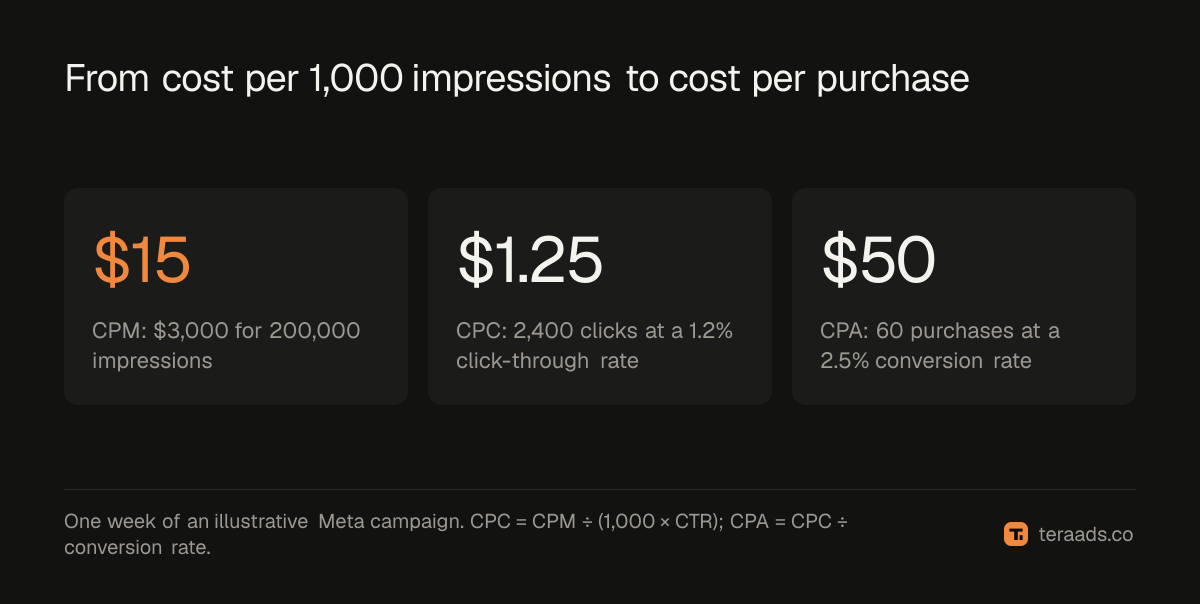
An illustrative Meta campaign for a Shopify store spends $3,000 in a week:
- 200,000 impressions, so CPM = $3,000 ÷ 200,000 × 1,000 = $15.
- 2,400 link clicks, a 1.2% CTR, so CPC = $3,000 ÷ 2,400 = $1.25.
- 60 purchases, a 2.5% conversion rate from click to order, so CPA = $3,000 ÷ 60 = $50.
Check it with the chain: $15 ÷ (1,000 × 1.2%) = $1.25, and $1.25 ÷ 2.5% = $50.
If each order is $90 and leaves $36 after product cost, shipping, payment fees and returns, a $50 CPA loses $14 an order on the first purchase. To break even, CPA has to fall to $36, which means a better CTR, a better conversion rate or cheaper impressions, or the customers have to come back and buy again.
Which one to watch
CPA, measured on Shopify orders, is the number that decides profit. Compare it with your break-even CPA: what an average order leaves after product cost, shipping, payment fees and returns. What is a good ROAS shows the same idea expressed as ROAS; break-even CPA and break-even ROAS are two views of one limit.
CPM and CPC are diagnostic. They explain why CPA moved, but chasing them on their own leads to bad decisions:
- Cheap CPMs often come from placements and audiences that rarely buy.
- Cheap clicks can come from curious people, accidental taps or bargain hunters who never order.
- Expensive CPMs can be worth it when they reach people far more likely to buy.
The ad platform's own CPA is useful for comparing ads inside the platform. For profit, use orders in Shopify, because platforms count purchases inside their attribution windows and two platforms can claim the same order. Meta Ads Manager metrics explained covers which columns to trust.
When CPA rises, find the broken link
Work along the chain to see which step changed:
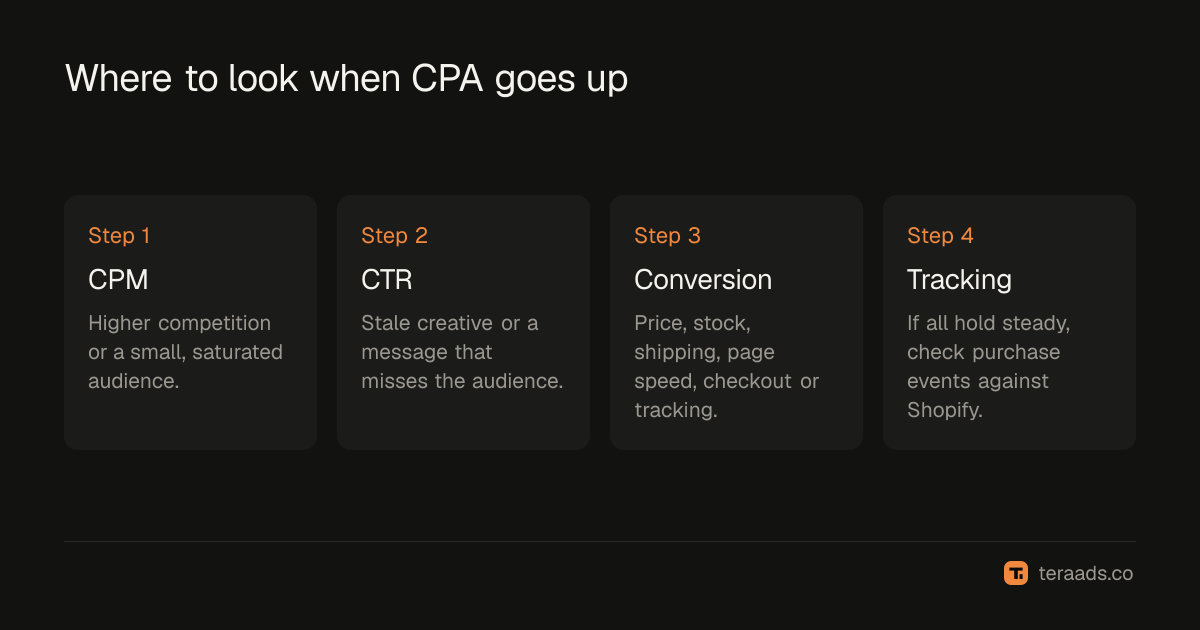
- CPM up? Competition is higher, often in Q4 and around holidays, or your audience is small and saturated. Broader targeting and new placements can help; seasonal rises often pass.
- CTR down? The creative has gone stale or doesn't speak to the audience. Fresh creative is the usual fix. Creative fatigue on Meta shows the signs.
- Conversion rate down? Something changed after the click: price, stock, shipping cost, page speed, a broken checkout or tracking. Check the store before the ads.
- All steady but CPA up? Look at tracking and attribution. A lost purchase event makes CPA look worse in the platform while Shopify orders hold.
CPA, CAC and cost per result
These names overlap, and platforms use them loosely.
- CPA usually means cost per purchase as the ad platform counts it, including repeat customers.
- CAC, customer acquisition cost, divides spend by new customers only. It is higher than CPA and closer to what growth costs. Blended CAC covers the variations.
- Cost per result in Meta Ads Manager is cost per whatever the campaign optimizes for: purchases, add-to-carts, leads or clicks. Check the result type before comparing campaigns.
How to lower each one
- CPM: widen audiences, let the platform choose placements, avoid many small overlapping ad sets, and plan around peak seasons. Google Ads vs Meta Ads compares how each platform charges.
- CPC: improve CTR with stronger hooks, clearer offers and fresh creative every few weeks.
- CPA: improve conversion rate on the store, raise order value, and send traffic to the products that convert best. Then set budgets from your break-even CPA, as the Facebook ads budget guide shows.
Tera Ads connects Shopify, Google Ads and Meta Ads, and shows every campaign from both platforms in one table with the ROAS each platform reports, beside your store's profit after product costs, ad spend, shipping, payment fees, returns and refunds. It is free for one business.
Frequently asked questions
What is the difference between CPM, CPC and CPA?
CPM is the cost of 1,000 ad impressions, CPC the cost of one click, and CPA the cost of one purchase or other result. CPM and click-through rate set CPC; CPC and conversion rate set CPA.
How do you calculate CPA?
Divide ad spend by the number of purchases (or other results) it brought. $3,000 of spend and 60 purchases is a $50 CPA. For profit decisions, count purchases from Shopify orders rather than the ad platform's report.
Is a high CPM bad?
Not on its own. A high CPM that reaches people likely to buy can give a lower CPA than a cheap CPM that reaches people who never order. Judge CPM by what happens further down the chain.
Should I optimize for CPC or CPA?
For a store, CPA, or better, purchases with a value. Optimizing for clicks gets you the cheapest clicks, which are often the least likely to buy.
What is a good CPA for a Shopify store?
Any CPA below your break-even CPA: what an average order leaves after product cost, shipping, payment fees and returns. If an order leaves $36, a CPA under $36 is profitable on the first purchase.
Why is my CPA in Meta different from Shopify?
Meta counts purchases inside its attribution window, including some after an ad view without a click, and may count orders another channel also claims. Shopify counts each order once. Divide spend by Shopify orders from Meta for the CPA you actually pay.