How Much Should You Spend on Facebook Ads? A Shopify Budget Guide
How much to spend on Facebook (Meta) ads: the most your margin allows, the least Meta needs to learn, and how to test and scale a budget for a Shopify store.
On this page
Spend on Facebook ads what your margin can pay for, and at least enough for Meta's delivery to learn. The ceiling is the most you can pay per order and still keep the profit you want. The floor is roughly 50 purchases a week for each ad set, so at a $25 cost per purchase one ad set needs about $1,250 a week. Start near the floor, prove your cost per order in Shopify, then scale in steps.
Key takeaways
- A Facebook (Meta) ads budget has a ceiling set by margin and a floor set by how much data Meta needs.
- Ceiling: the most you can pay per order is what an order leaves after costs and returns, minus the profit you want.
- Floor: an ad set generally needs about 50 optimization events in seven days to leave the learning phase.
- Percentage-of-revenue rules ignore margin. At a 20% margin, spending 20% of revenue leaves nothing.
- Scale only after Shopify-measured results beat your target for a couple of weeks, and raise budgets in steps.
Two limits: the most you can afford and the least that works
Most budget advice gives a single number, such as a daily amount or a share of revenue. A better way is to work out two limits from your own store and spend between them.
- The ceiling comes from your margin. Above it, every extra order costs more in ads than it leaves in profit.
- The floor comes from how Meta's delivery works. Below it, an ad set rarely gets enough results to settle, and costs stay high and unstable.
If the floor is above the ceiling, more budget won't fix it. The fix is a better margin, a better offer, or a cheaper way to get a purchase.
The ceiling: what your margin can pay for
Start with what an average order leaves after product cost, shipping, payment fees and returns. That is your contribution margin per order. Break-even ROAS shows how to work it out.
Take an illustrative store with $60 orders, 40% product cost, 3% payment fees, $6 shipping each way and 10% of orders returned. Each order placed leaves about $24.18 before ads. If the owner wants to keep $6 an order as profit after ads, the most Meta can cost per order is $24.18 − $6 = $18.18. That is the store's target cost per purchase, the same as a target ROAS of $60 ÷ $18.18 = 3.3x.
The monthly ceiling is that target cost per purchase times the orders Meta can bring at that cost. If the store can win 400 orders a month at $18 or less, it can spend up to about $7,300. Past that point, costs per order usually rise as Meta reaches people less likely to buy.
At the store level, the profit-first ad budget works the same way from the top down: contribution from all sales, minus fixed costs and the profit you want, is the most you can spend on all ads together.
The floor: enough for Meta to learn
After you launch or significantly change an ad set, Meta's delivery system goes through a learning phase. Meta's guidance is that an ad set generally needs about 50 optimization events, such as purchases, within seven days to exit it. The learning phase explains what resets it and what "Learning Limited" means.
That gives a simple minimum: weekly budget per ad set ≈ 50 × your expected cost per purchase.
| Expected cost per purchase | Weekly budget per ad set | Daily budget per ad set |
|---|---|---|
| $15 | $750 | about $107 |
| $25 | $1,250 | about $179 |
| $40 | $2,000 | about $286 |
| $60 | $3,000 | about $429 |
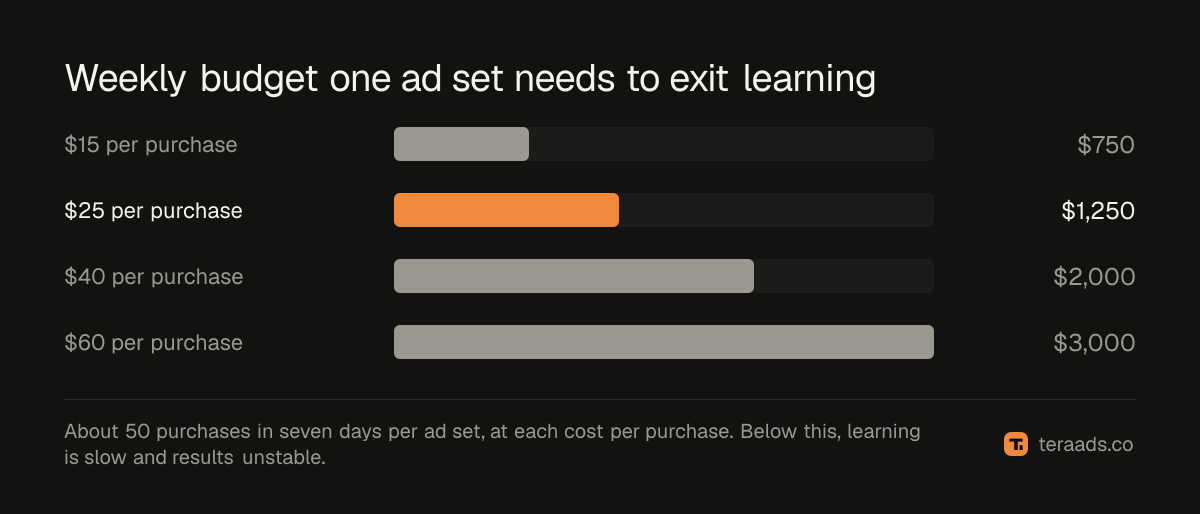
If that is more than you can spend, don't spread a small budget across many ad sets. Fewer, broader ad sets learn faster: two ad sets at $250 a day will usually do better than ten at $50. CBO vs ABO covers how to let Meta move budget between ad sets.
Is $10 or $20 a day enough?
You can get sales on $10 or $20 a day, but the ad set will rarely leave learning. At a $25 cost per purchase, $20 a day buys about five or six purchases a week, far from 50. Delivery stays less stable, and it is hard to tell a good ad from a lucky week.
A small budget still works for learning which products and creatives get attention, as long as you judge it on cost per purchase over several weeks rather than day to day. When you have a winner, move budget into it rather than adding more ad sets.
Why percentage-of-revenue rules mislead
A common rule is to spend a fixed share of revenue on ads, often 10% to 20%. It is easy to follow and ignores the thing that matters most: margin.
- At a 50% contribution margin, spending 20% of revenue leaves 30% for fixed costs and profit.
- At a 20% contribution margin, spending 20% of revenue leaves nothing.
Two stores can follow the same rule and get opposite results. Set the budget from your own margin and cost per purchase, then check what share of revenue it comes to, not the other way round.
How to test, then scale
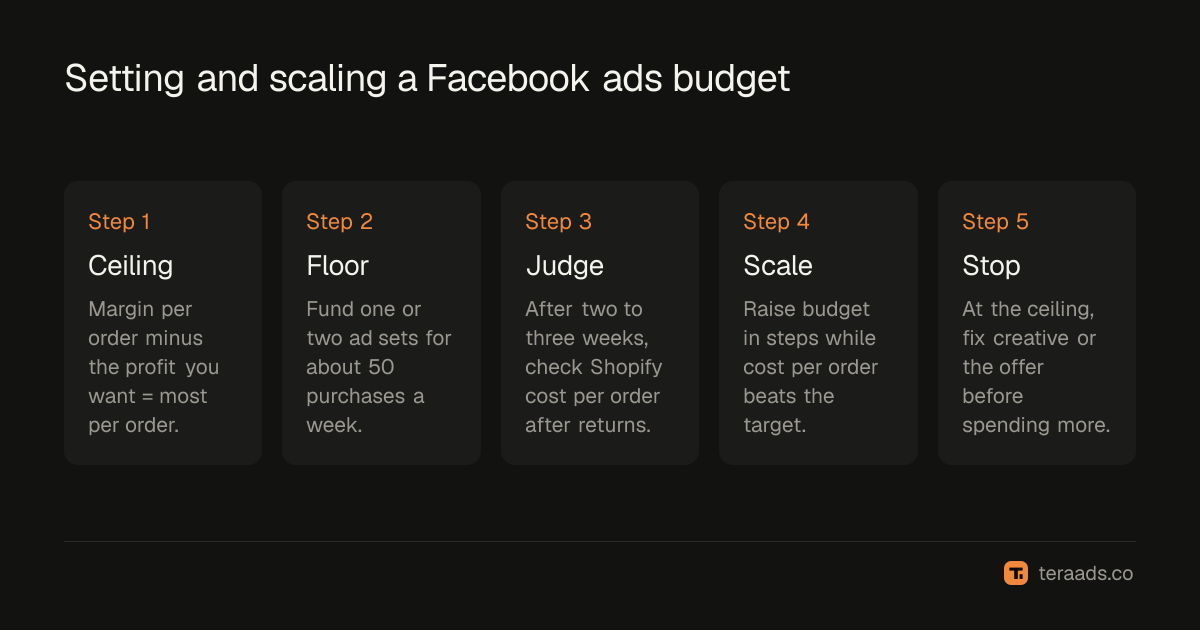
- Work out the ceiling. Target cost per purchase = margin per order minus the profit per order you want.
- Fund one campaign at the floor. One or two ad sets with enough budget for about 50 purchases a week at your expected cost.
- Judge on Shopify. After two to three weeks, compare Shopify orders from Meta, after returns, with your target cost per purchase.
- Scale in steps. If results beat the target, raise the budget gradually and check the cost per order again after each step.
- Stop at the ceiling. When the cost per order reaches your target, more budget buys orders that don't pay. Improve creative or the offer before pushing further.
Scaling Meta Ads budgets covers how fast to raise budgets without resetting learning, and what is a good ROAS shows how to turn your margin into a ROAS target.
Tera Ads connects Shopify, Google Ads and Meta Ads, and shows every campaign from both platforms in one table with the ROAS each platform reports, beside your store's profit after product costs, ad spend, shipping, payment fees, returns and refunds. It is free for one business.
Frequently asked questions
How much should a small Shopify store spend on Facebook ads?
Enough for one ad set to get about 50 purchases a week, which is roughly 50 times your expected cost per purchase, and no more than your margin can pay for. If that floor is above what you can afford, start smaller with one ad set, judge it over several weeks, and improve the offer or margin before scaling.
Is $10 a day enough for Facebook ads?
It can bring some sales, but at most costs per purchase it won't give Meta enough results to leave the learning phase. Treat it as a way to test products and creatives, and judge it on cost per purchase over several weeks.
Should my ad budget be a percentage of revenue?
Not as a starting point. Percentage rules ignore margin, so the same share can be profitable for one store and loss-making for another. Set the budget from your margin and cost per purchase, then see what share of revenue it comes to.
How much should I spend on Facebook ads per day?
Divide the weekly floor by seven: about 50 × your expected cost per purchase ÷ 7 per ad set. At a $25 cost per purchase that is about $179 a day. Below that, expect slower learning and less stable results.
When should I increase my Facebook ads budget?
When Shopify orders from Meta, after returns, have beaten your target cost per purchase for a couple of weeks. Raise the budget in steps and check the cost per order after each step.
Does a bigger budget lower my cost per purchase?
Not usually. A bigger budget helps an ad set leave learning, which can steady results, but beyond that each extra dollar tends to reach people less likely to buy, so the cost per purchase often rises as you scale.