How Much Do Facebook Ads Cost? What a Sale Costs a Shopify Store
Facebook ads cost what you choose to spend, but the cost of each sale depends on CPM, clicks and conversion rate. How to work out what your store can afford.
On this page
Facebook and Instagram ads cost whatever budget you set, because Meta sells ads in an auction and spends up to your daily or lifetime budget. The real question is what each sale costs, which depends on three things: what Meta charges for 1,000 impressions (CPM), how many people click, and how many of those buy. Two stores spending $1,000 each can pay $20 or $100 per sale. Your store can afford any cost per sale below what an average order leaves after product cost, shipping, fees and returns.
Key takeaways
- You choose the spend. Meta has a small minimum daily budget that depends on your currency, and no upper limit.
- For most campaigns Meta charges for impressions, so CPM is the price you actually pay.
- Cost per sale = CPM ÷ (1,000 × click-through rate × conversion rate). Creative and the store move it as much as the auction does.
- The most a sale may cost is what an order leaves after product cost, shipping, payment fees and returns.
- Start with enough budget for about 50 purchases a week per ad set, or results will be slow and unstable.
How Facebook ad pricing works
Every time someone scrolls Facebook or Instagram, Meta runs an auction for the ad slots in front of them. Ads compete on more than the bid. Meta ranks them by a combination of the bid, how likely the person is to take the action the advertiser wants, and the ad's quality. A relevant ad that people respond to can win the slot at a lower price than a weak one.
You don't bid by hand in most campaigns. You set a budget and an optimization goal, such as purchases, and Meta bids for you, trying to get the most purchases for the budget. You can add a cost-per-result goal or a ROAS goal if you want Meta to hold back when results get expensive, at the risk of spending less.
For most objectives you are charged for impressions, so the bill is CPM × impressions ÷ 1,000. Clicks and purchases are what the money buys, not what Meta charges for. That is why two campaigns paying the same CPM can have very different costs per sale.
What makes Facebook ads cost more
| Factor | Costs rise when | What you can do |
|---|---|---|
| Country | You target markets where many advertisers compete for attention | Price each market separately; judge each on its own break-even |
| Season | Q4, Black Friday and holidays bring more advertisers into the auction | Plan budgets and offers ahead; expect higher CPMs |
| Audience | The audience is small, narrow or heavily targeted by others | Go broader and let the creative find buyers |
| Creative | Ads are stale or people scroll past them | Refresh creative every few weeks; test new hooks |
| Optimization goal | You optimize for an event that rarely happens | Optimize for purchases once you have enough of them |
| Account structure | Many small ad sets compete with each other | Fewer ad sets with more budget each |
Most of these push CPM up. Creative and the store also change what happens after the impression, which matters more: a better ad lifts click-through rate, and a better product page lifts conversion rate, so the same CPM buys more sales.
Same budget, five times the cost per sale
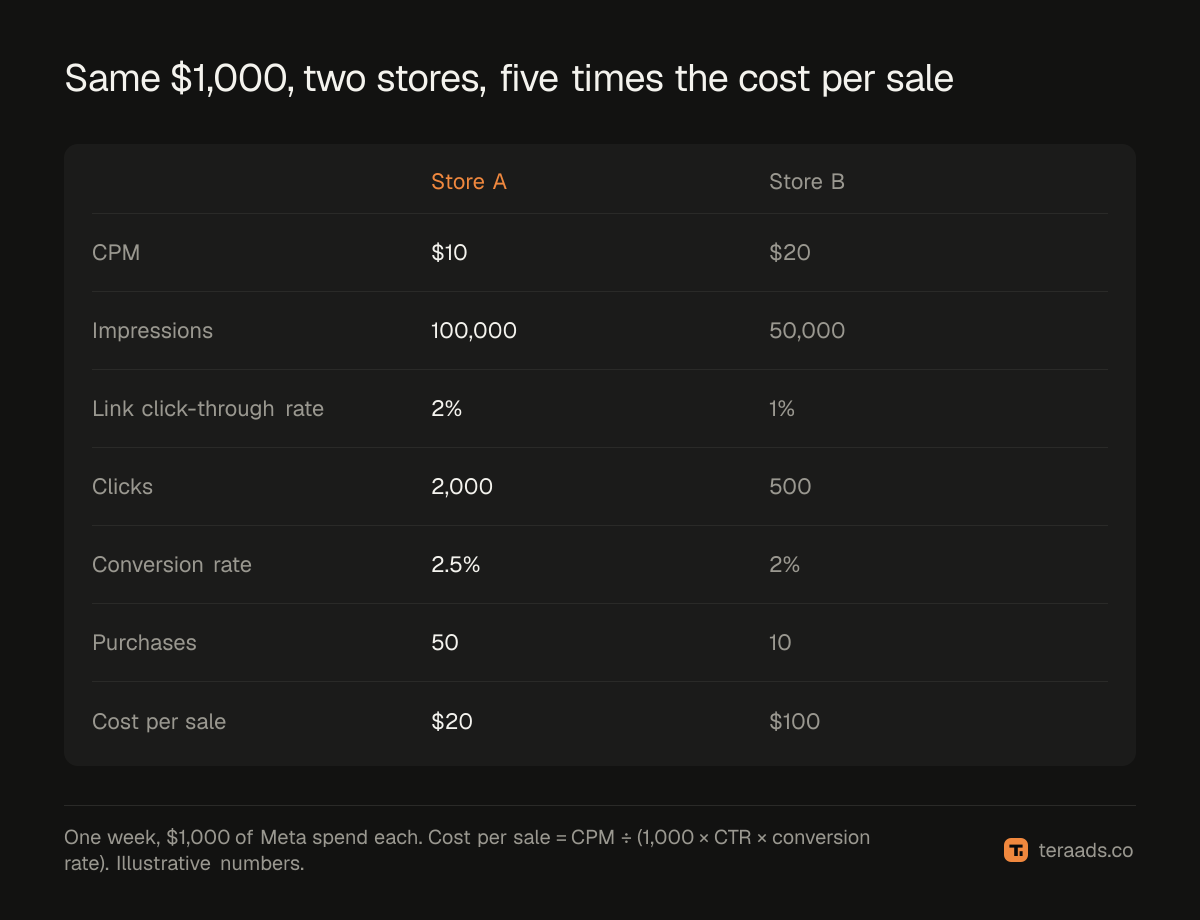
Here are two illustrative stores, each spending $1,000 on Meta in a week:
- Store A pays a $10 CPM, gets a 2% link click-through rate and converts 2.5% of visitors. That is 100,000 impressions, 2,000 clicks and 50 purchases: $20 per sale.
- Store B pays a $20 CPM, gets a 1% click-through rate and converts 2% of visitors. That is 50,000 impressions, 500 clicks and 10 purchases: $100 per sale.
Store B's CPM is only twice Store A's, but each weaker step multiplies the one before it. The formula shows why:
Cost per sale = CPM ÷ (1,000 × CTR × conversion rate)
For Store A: $10 ÷ (1,000 × 0.02 × 0.025) = $20. For Store B: $20 ÷ (1,000 × 0.01 × 0.02) = $100. CPM vs CPC vs CPA walks through each link in that chain.
What a sale can cost your store
"How much do Facebook ads cost" only has a useful answer next to what a sale is worth. The limit is your break-even cost per sale: what an average order leaves after every cost that comes with it.
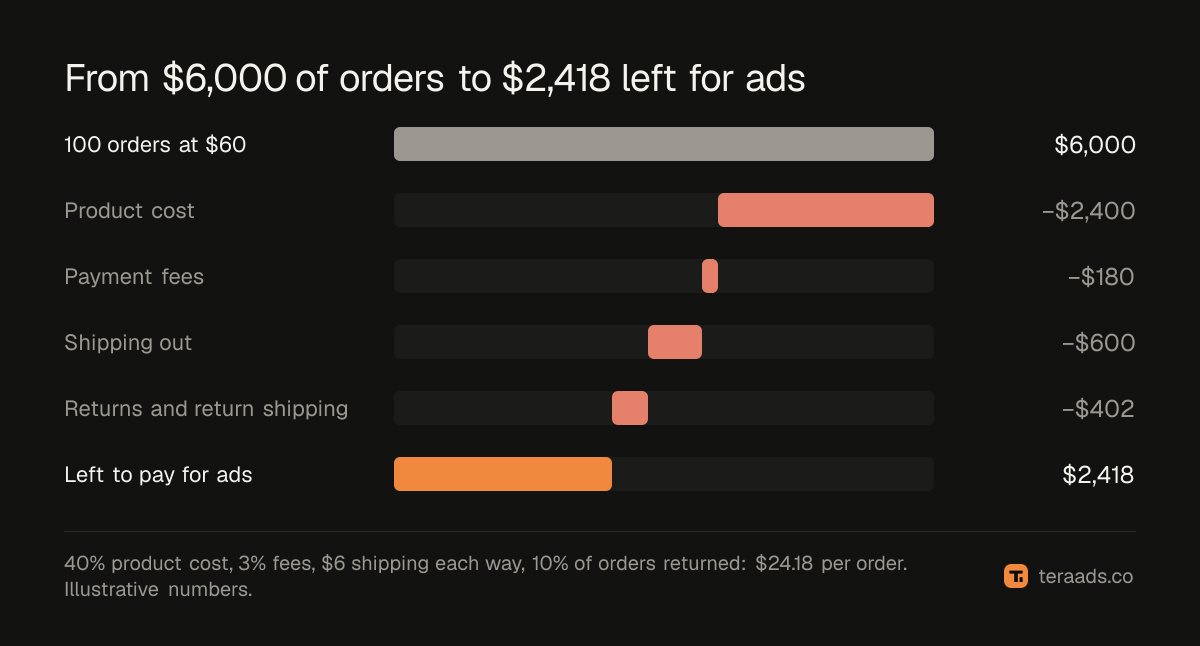
In this illustrative store, orders average $60, products cost 40% of the price, payment fees are 3%, shipping is $6 each way and 10% of orders come back. Each order placed leaves $24.18 to pay for ads. So:
- At Store A's $20 per sale, each order makes $4.18 after ads.
- At Store B's $100 per sale, each order loses about $76, unless those customers come back and buy several more times.
The same limit, written as ROAS, is $60 ÷ $24.18 = 2.48x. What is a good ROAS has a table of break-even ROAS by margin, and Shopify profit margin shows how to find the margin to put in.
Count sales from Shopify orders after returns, not from Ads Manager alone. Meta credits purchases inside its attribution window and doesn't take out refunds, so its cost per purchase usually looks better than what you pay.
How much to spend when you start
Meta's delivery system learns which people buy. It needs about 50 optimization events, such as purchases, in seven days for each ad set to leave the learning phase. At $20 per sale, that is roughly $1,000 a week for one ad set; at $40, about $2,000.
If that is more than you can spend, run one ad set rather than several, or optimize for an event that happens more often, such as add to cart, until purchases build up. How much to spend on Facebook ads works through the floor and the ceiling, and the learning phase explains why splitting a small budget slows everything down.
How to lower what each sale costs
Work on the step that is weakest, because each one multiplies the others:
- Cheaper impressions. Broader audiences, automatic placements and fewer overlapping ad sets usually bring CPM down. Accept higher CPMs in Q4 and plan for them.
- More clicks. Fresh creative with a clear hook, real product shots and a reason to click now. Rising frequency with falling click-through rate means the ads are tiring; creative fatigue on Meta shows the signs.
- More buyers per click. Fast pages, clear prices and shipping costs, reviews and an easy checkout. If clicks hold but sales fall, the problem is usually the store, not the ads.
- Bigger orders. Bundles and free-shipping thresholds raise what each sale is worth, which raises what you can afford to pay for it. Ways to raise average order value lists the common ones.
Then judge the result weekly against break-even, on Shopify orders after returns. Why your Facebook ads aren't profitable has the checks for when the numbers don't add up.
Tera Ads connects Shopify, Google Ads and Meta Ads, and shows every campaign from both platforms in one table with the ROAS each platform reports, beside your store's profit after product costs, ad spend, shipping, payment fees, returns and refunds. It is free for one business.
Frequently asked questions
How much do Facebook ads cost per day?
As much as you set. Meta spends up to your daily budget, and the minimum depends on your currency. What matters is whether the budget can buy enough purchases for Meta to learn, about 50 a week per ad set.
How much does a Facebook ad cost per sale?
It depends on CPM, click-through rate and conversion rate together: cost per sale = CPM ÷ (1,000 × CTR × conversion rate). A $10 CPM, 2% CTR and 2.5% conversion rate gives $20 per sale; weaker steps can make it several times higher.
Are Instagram ads cheaper than Facebook ads?
They are bought in the same auction through Ads Manager, and costs vary by placement, audience and creative rather than by app alone. Let Meta choose placements automatically, then check results by placement before excluding any.
What is a good cost per purchase on Facebook ads?
Any cost per purchase below what an average order leaves after product cost, shipping, payment fees and returns. If an order leaves $24, a cost per purchase under $24 is profitable on the first order.
Why are my Facebook ads so expensive?
Usually one weak link: high CPMs from a small audience or Q4 competition, a low click-through rate from tired creative, or a low conversion rate from the store. Find the step that changed before raising or cutting budget.
Do Facebook ads cost more in Q4?
Usually, yes. More advertisers enter the auction around Black Friday and the holidays, so CPMs tend to rise. Plan budgets and offers ahead, and recalculate break-even with sale prices.