Google Ads for Jewellery Brands: Shopping, Search and Feed That Sell
Jewellery shoppers search by metal, stone, style and occasion. How D2C jewellery brands can set up Shopping, Search and Performance Max, judged on kept orders.
On this page
Google Ads works for jewellery brands when the product feed describes each piece the way shoppers search for it, by metal, stone, style, size and occasion, and when campaigns separate brand searches, high-intent product searches and gifting moments. Shopping and Performance Max carry most of the sales, so the feed matters more than bids. Search covers specific, high-intent terms. Judge every campaign on Shopify orders kept after RTO, because jewellery COD orders can be refused at high rates.
Key takeaways
- Jewellery shoppers on Google already know what they want: "silver hoop earrings", "rose gold bracelet for women".
- Titles and attributes decide which searches your products appear for; fix the feed before raising budgets.
- Jewellery sits under Apparel & Accessories, so colour, gender and age group should be filled on every product.
- Split brand from non-brand, and split products by margin or category, so budget follows profit.
- Gifting peaks around festivals, Valentine's Day and wedding season; plan budgets and feed labels ahead.
How jewellery shoppers search
Search behaviour for jewellery is specific. People combine a product type with a material, stone, style or recipient: "925 silver anklet", "oxidised jhumka", "minimalist gold chain for men", "anniversary gift for wife". Some searches name an occasion or price, such as "earrings under 1000". The more of those words your titles and landing pages contain, the more relevant your ads are to these searches.
Campaign types and what each does
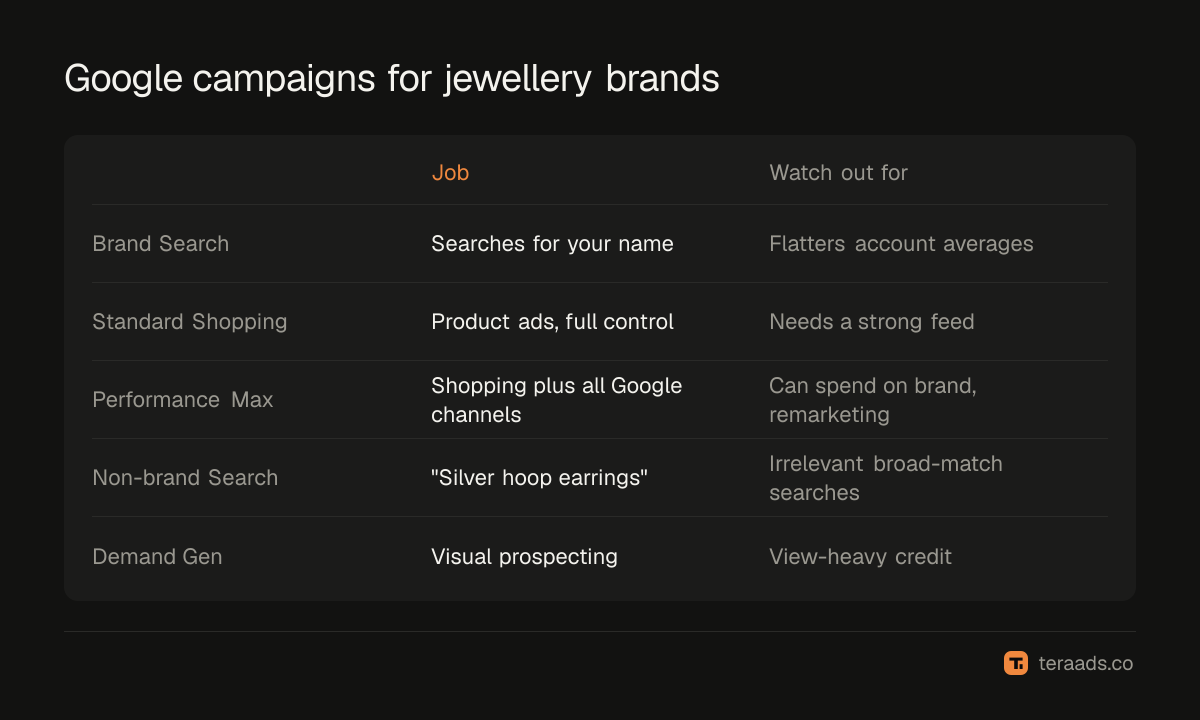
| Campaign | Job for a jewellery brand | Watch out for |
|---|---|---|
| Brand Search | Capture people searching your name | Flatters account averages; keep it separate |
| Standard Shopping | Product ads with full control over bids and search terms | Needs a strong feed and regular search-term review |
| Performance Max | Shopping plus YouTube, Display, Discover and Gmail | Can spend on brand and remarketing; judge on new orders |
| Non-brand Search | High-intent terms like "silver hoop earrings" | Broad match can bring irrelevant searches |
| Demand Gen | Visual prospecting before people search | View-heavy credit; test once Shopping is profitable |
Most jewellery brands start with brand Search plus Shopping or Performance Max, then add non-brand Search for their best categories. Brand vs non-brand search explains why the split matters.
Building the feed
The feed is the foundation for Shopping and Performance Max. For jewellery:
- Titles: product type + material + stone or style + recipient + size. "Sterling silver hoop earrings for women, 20 mm" matches more searches than "Luna Hoops". Google Shopping titles has more patterns.
- Category attributes: colour (usually metal or main stone colour), gender and age group on every product. Merchant Center feed attributes explains why missing values can hide products.
- Material: "925 sterling silver", "brass, gold plated", "18k gold". Use only claims you can support.
- Images: a clean product shot as the main image, with on-person and close-up shots as additional images.
- Custom labels: margin band, best-seller status or occasion, so you can split campaigns and asset groups.
Setting it up, step by step
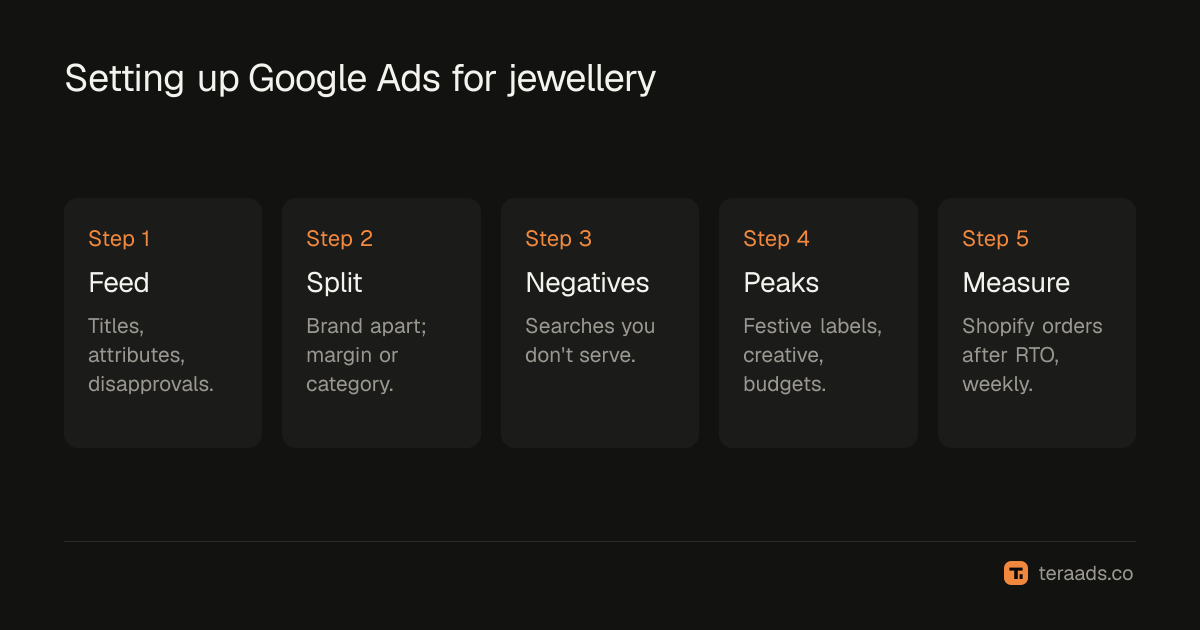
- Fix the feed first. Clear disapprovals, fill colour, gender and age group, and rewrite titles for your top products.
- Separate brand. Run brand Search on its own, or exclude brand terms where your campaign type allows it.
- Split by margin or category. Use custom labels so high-margin products get their own campaign or asset group.
- Add negatives. Exclude searches you don't serve, such as "real diamond" if you sell imitation, or "repair" and "wholesale"; see negative keywords.
- Plan gifting peaks. Prepare occasion labels, creative and budgets a few weeks before festivals and Valentine's Day; festive season ads planning covers the calendar.
- Track Shopify orders and RTO. Set up conversion tracking, tag links with UTMs and check refusals by campaign.
- Review weekly. Search terms, product-level spend and kept orders, not just Google's conversion value.
Trust and policy
Jewellery claims attract scrutiny from shoppers and from Google. Describe materials accurately: "gold plated" is not "gold", and "lab-grown" or "American diamond" should be named as such. Show purity or hallmark details where your products carry them, a clear returns policy and real contact details. Unsupported claims and unclear policies can lead to disapprovals or a Merchant Center misrepresentation suspension.
COD, RTO and measuring profit
Jewellery is often an impulse or gift purchase, which makes COD refusals more likely, and each refusal costs two-way shipping on top of the lost sale. Google counts the order the moment it's placed, so a campaign can look strong on Google's numbers and weak after refusals. Check RTO by campaign and by product, confirm high-value COD orders before shipping, and offer a prepaid incentive. Reduce RTO in India covers the levers.
Where Google fits beside Meta
Google captures demand that already exists: people searching for a piece. Meta creates demand with creative: people who weren't looking until they saw it. Many jewellery brands find Google brings fewer orders at a better cost per kept order, while Meta brings more volume. Look at both on the same profit basis; Meta ads for jewellery covers the Meta side.
Remarketing for considered purchases
Higher-priced pieces are often considered over days: shoppers compare designs, check reviews and come back. Remarketing keeps you in front of them. Performance Max and Demand Gen can use your customer lists and site visitors as signals, and Shopping ads naturally reach people who search again. Exclude recent buyers so you don't pay to reach people who already ordered, and judge remarketing on new kept orders, because it easily takes credit for buyers who were coming back anyway.
Common mistakes
Brand-name titles. Shoppers don't search for your collection names.
Empty category attributes. Missing colour, gender or age group can hide products.
One campaign for everything. Budget flows to cheap, low-margin pieces.
Overstated materials. "Gold" on plated pieces invites refusals, returns and policy trouble.
Judging on Google's conversions. Use Shopify orders after RTO.
Tera Ads shows Google Ads and Meta Ads spend beside Shopify orders, with profit after RTO from Shiprocket for every campaign, plus deep dives into disapproved Shopping products and wasted search terms. It is free for one business.
Frequently asked questions
Do Google Ads work for jewellery brands?
Yes, especially Shopping and Performance Max, because shoppers search for specific pieces. Results depend heavily on feed quality.
Which Google campaign is best for jewellery?
Most brands start with Shopping or Performance Max plus brand Search, then add non-brand Search for their best categories.
What should jewellery product titles include?
Product type, material, stone or style, recipient and size, with the most searched words first.
Does Google treat jewellery as apparel?
Jewellery sits under Apparel & Accessories in Google's product taxonomy, so fill colour, gender and age group on every product.
How do I reduce RTO on jewellery orders from Google?
Confirm high-value COD orders, offer prepaid incentives, describe materials accurately and check refusals by campaign.