Why Your Facebook Ads Aren't Profitable: 7 Checks for Shopify Stores
Facebook (Meta) ads can show a good ROAS and still lose money. Seven checks, from break-even and returns to retargeting and discounts, to find the leak.
On this page
Facebook ads usually stop being profitable for a handful of reasons: the store doesn't know its break-even ROAS, judges ads on Ads Manager instead of Shopify, ignores returns, or pays for sales it would have made anyway. Check those first, then creative fatigue, discounts and low-margin products. A 3x ROAS in Ads Manager can leave almost nothing once product costs, shipping and returns settle.
Key takeaways
- A ROAS that looks good in Ads Manager can still lose money. Profit depends on margin, returns and which sales the ads really added.
- Work out break-even ROAS from your contribution margin first. Everything else is measured against it.
- Judge Meta on Shopify orders after returns, not on the purchase value Ads Manager reports.
- Retargeting and existing customers often claim sales you would have made anyway.
- Discounts, tired creative and low-margin products quietly raise the ROAS you need.
How a good-looking ROAS turns into almost no profit
Here is an illustrative month for a store selling $60 orders. Meta spent $10,000 and Ads Manager reports 500 purchases worth $30,000, a 3x ROAS. That sounds healthy. Now follow the money:
- Shopify shows 450 orders from Meta, worth $27,000. The other 50 were counted after views or claimed by another channel too.
- 10% of orders come back: 45 orders and $2,700 refunded, leaving $24,300.
- Product cost is 40% of the price on the orders kept: $9,720. Returned items go back to stock.
- Shipping is $6 an order out on 450 orders and $6 back on 45 returns, $2,970. Payment fees on the kept orders are about $730.
- Ad spend is $10,000.
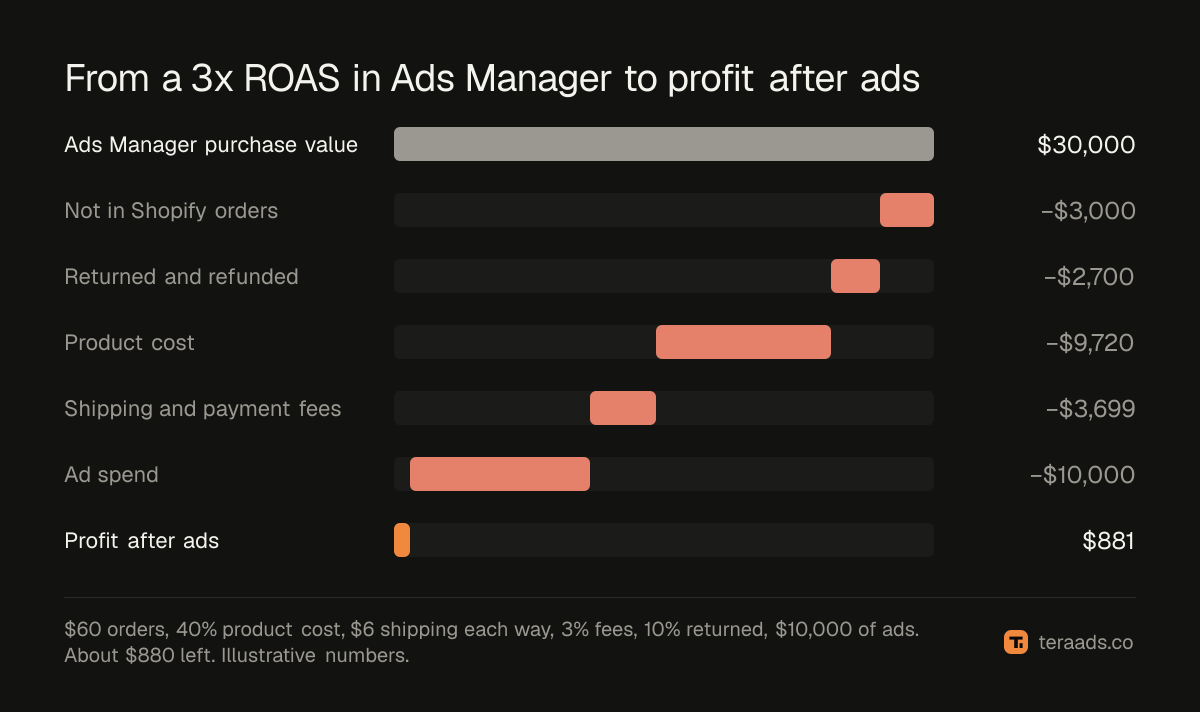
What's left is about $880 of profit on $10,000 of ads. The store's break-even ROAS, measured on Shopify orders, is 2.48x, and it is running at 2.7x. One bad week, a sale or a rise in returns tips it into a loss, even though Ads Manager says 3x.
Seven checks
| Symptom | Check | Fix |
|---|---|---|
| ROAS looks fine, bank balance doesn't | Break-even ROAS from contribution margin | Set targets from margin, not from a rule of thumb |
| Ads Manager sales far above Shopify | Meta purchases vs Shopify orders | Judge on Shopify orders; fix tracking gaps |
| Profit drops weeks after a good month | Refunds and returns by order month | Use ROAS after returns |
| Retargeting has the best ROAS | New vs returning customers | Cap retargeting; judge prospecting on new customers |
| Sales up, profit flat | Discount share of revenue | Raise thresholds, shorten sales |
| Costs per purchase creeping up | Frequency and creative age | Refresh creative, retire tired ads |
| Best sellers are cheap items | Margin by product | Push higher-margin products |
1. You don't know your break-even ROAS
Without a break-even number, any ROAS can look good. Break-even ROAS is 1 divided by your contribution margin: what an order leaves after product cost, shipping, payment fees and returns. A 40% margin breaks even at 2.5x; a 25% margin needs 4x. Break-even ROAS has the formula, and what is a good ROAS shows how to add a profit target on top.
2. You judge ads on Ads Manager, not Shopify
Ads Manager counts purchases inside Meta's attribution window, including some after someone saw an ad without clicking, and it can count orders that Google or email also claim. Shopify counts each order once. If Ads Manager says 3x and Shopify says 2.4x, the 2.4x is closer to what you keep. Why Meta Ads and Shopify never agree explains the gap and what is normal.
A very large gap, or purchases in Meta that never appear in Shopify, can also mean a tracking problem. Shopify customer events and pixels covers how to check that the pixel and Conversions API are sending purchases properly.
3. Returns and refunds aren't taken out
Meta counts the purchase when the order is placed. A refund two weeks later doesn't come out of the ROAS it reported. For stores in fashion and other high-return categories, this alone can be the difference between profit and loss. True ROAS after refunds shows how to work it out, and the cost of returns shows what each return really costs.
4. Retargeting and existing customers take the credit
Retargeting campaigns and broad campaigns that reach your existing customers report the highest ROAS, because many of those people were already likely to buy. Meta gets the credit; you would have had much of the sale anyway. Look at how much of Meta's reported revenue comes from returning customers, and keep retargeting budgets small. Meta Ads retargeting covers how to size it.
5. Discounts are eating the margin
Take a product with a 40% contribution margin. A 20% discount cuts the margin per order in half, from 40% of the full price to 20%, and raises break-even ROAS from 2.5x to 4x. Constant sales also train customers to wait. The real cost of a discount shows how many extra orders a discount needs to pay for itself.
6. Creative fatigue is pushing costs up
When the same people see the same ads too often, click rates fall and costs per purchase rise. Rising frequency with falling click-through rate is the usual sign. Creative fatigue on Meta and Meta Ads frequency cover when to refresh and what to look at.
7. Budget goes to low-margin products
Meta optimizes for purchases or purchase value, not profit, so it can push your cheapest or lowest-margin products because they sell most easily. Check margin by product, and build campaigns or catalog sets around the products that make money. Contribution margin by product shows how.
A weekly profit check
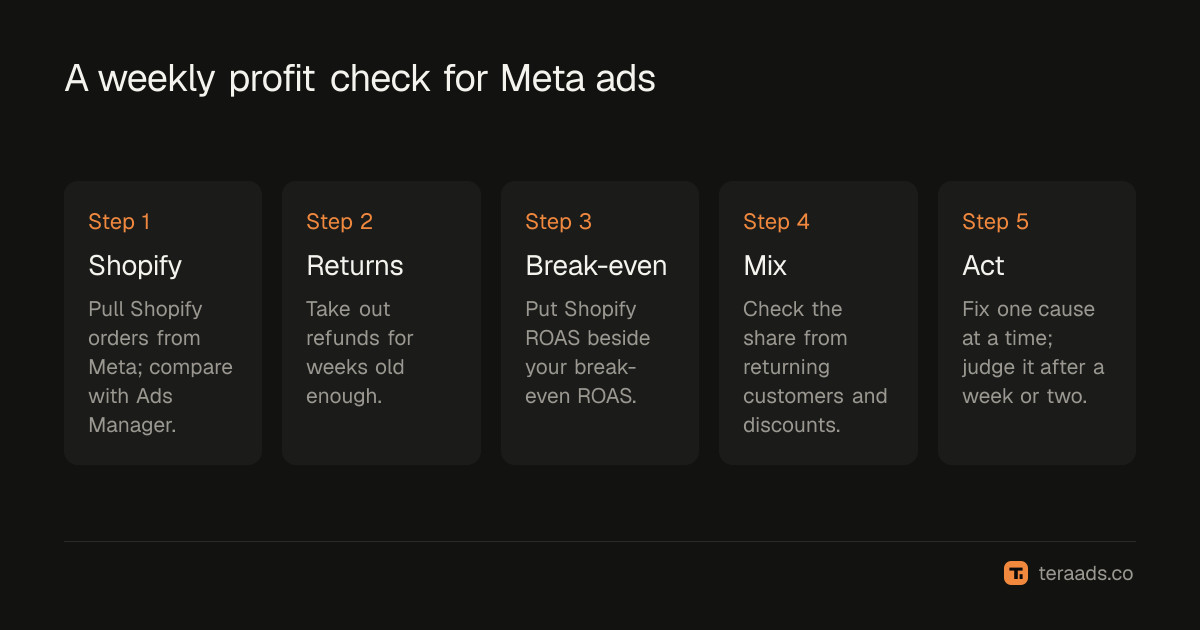
- Pull Shopify orders from Meta. Compare them with the purchases Ads Manager reports for the same week.
- Take out refunds. For weeks old enough, use revenue after returns.
- Compare with break-even. Put this week's Shopify ROAS beside your break-even ROAS.
- Look at the mix. Check how much came from returning customers and from discounted orders.
- Act on the cause. Cut or cap what loses money, refresh tired creative, and move budget toward high-margin products.
Fix one cause at a time and give each change a week or two before judging it. Meta's delivery needs time to settle after big changes, as the learning phase explains.
Tera Ads connects Shopify, Google Ads and Meta Ads, and shows every campaign from both platforms in one table with the ROAS each platform reports, beside your store's profit after product costs, ad spend, shipping, payment fees, returns and refunds. It is free for one business.
Frequently asked questions
Why is my Facebook ads ROAS good but I'm not making money?
Usually because ROAS counts revenue, not profit. Product cost, shipping, payment fees and returns can take most of the revenue, and Ads Manager may count sales Shopify doesn't. Compare Shopify ROAS after returns with your break-even ROAS.
What ROAS do I need for Facebook ads to be profitable?
Above your break-even ROAS: 1 divided by your contribution margin. With a 40% margin that is 2.5x on Shopify orders after returns, and more if you want to keep a profit after ads.
Should I turn off Facebook ads if they lose money?
Not straight away. First check whether the loss is real (Shopify after returns), whether retargeting or discounts are the cause, and whether new customers buy again later. If prospecting loses money even counting repeat purchases, cut it back and fix the cause before scaling again.
How long does it take for Facebook ads to become profitable?
There is no fixed time. New campaigns need data before delivery settles, and returns take weeks to show up. Judge a campaign on at least two to four weeks of results, measured on Shopify orders after returns.
Why are my Facebook ad costs going up?
Common causes are creative fatigue, a small audience seeing the same ads too often, more competition in busy seasons, and frequent changes that restart learning. Check frequency, click-through rate and creative age first.
Is retargeting on Facebook profitable?
It usually reports a high ROAS, but much of it is sales you would have made anyway. Keep it small, exclude recent buyers, and judge it on the extra sales it adds rather than the sales it touches.