25 Questions to Ask Claude or ChatGPT About Your Ads and Profit
The questions that get useful answers once Claude or ChatGPT can read your Meta ads and Shopify store: profit, returns, spend, creatives and audiences.
On this page
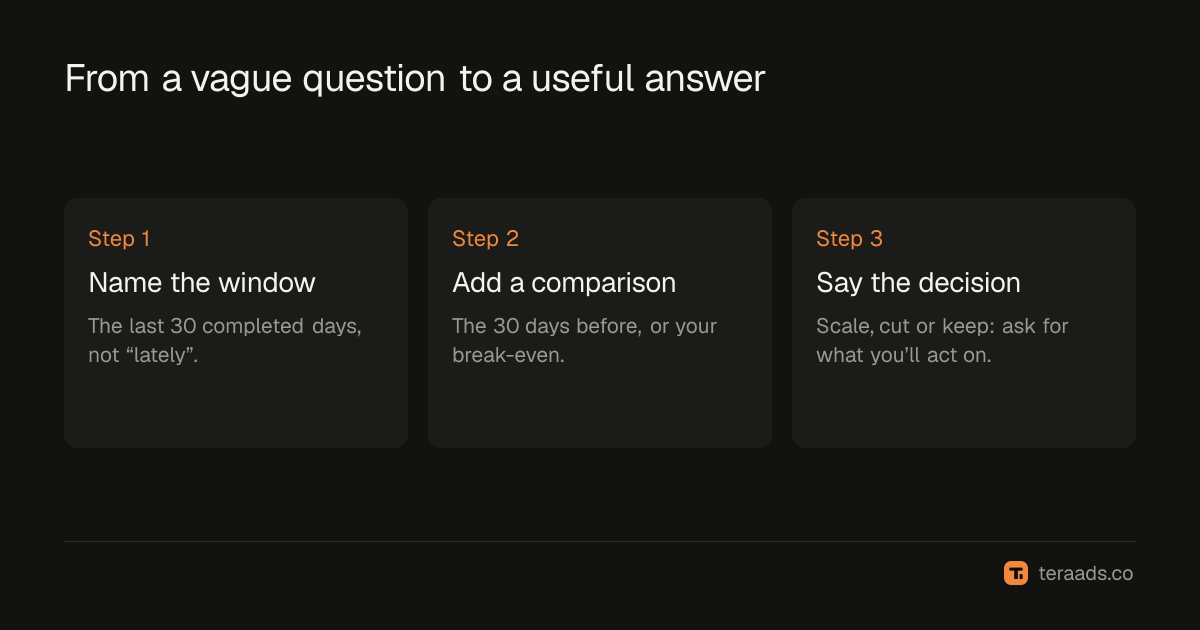
Once Claude or ChatGPT can read your ad accounts and your Shopify store, the best questions are specific: a time window, a number to compare against and the decision you're trying to make. Ask "what was my profit after returns in the last 30 days, and how does it compare with the 30 before?" rather than "how are my ads doing?". The 25 questions below are grouped by the decision they help with, and each says what the assistant needs to answer it.
Key takeaways
- Give every question a time window and a comparison, or the answer drifts into generalities.
- Ask about profit after returns before you ask about ROAS; Meta's numbers don't see returned orders.
- Check the first few answers against Ads Manager and Shopify before you rely on them.
- Keep change requests separate from analysis, and start with read-only or "ask me first" access.
- One question can take several lookups, so long chats use more of a weekly call allowance.
Why the question matters more than the prompt
An assistant connected to your accounts doesn't guess: it calls a tool, reads the numbers and writes an answer. What it can say depends on which tools it has. An assistant connected only to Meta can repeat what Meta reports, the same view as Ads Manager. An assistant connected through Tera Ads Connect can also read your Shopify orders, returns and costs, so it can answer in money you kept, not only in sales Meta claims.
That makes vague questions expensive. "How are my ads?" makes the assistant pick a window, pick metrics and pick a comparison, and every one of those choices can be wrong for your decision. A good question fixes them for it. If you're new to connectors, using Claude with Meta Ads covers setup, and the Meta Ads MCP options compares what each connector can see.
Questions about profit and returns
Start here. These answer "are the ads making money?" in the store's terms.
- What was my estimated profit after returns in the last 30 days, and how does it compare with the 30 days before?
- How much did returns and refunds take off my profit last month?
- What is my return on ad spend after returns over the last 90 days, and how far is it from what Meta reports?
- Which month this year had the most returns, and what did that month's profit look like once they were counted?
- How did store sales over the last 7 completed days compare with the 7 days before?
- How much of last month's revenue went on ad spend, product cost, shipping and fees?
Two habits make these more useful. First, ask for completed days: today is never finished, and a half-day makes any comparison look bad. Second, ask for the breakdown, not just the total, so you can see whether a drop came from sales, returns or spend. The gap between platform ROAS and the store's view is explained in true ROAS after refunds.
Questions about spend and campaigns
These help you decide where the next dollar goes. They use Meta's own campaign results, so treat purchases in them as Meta's count.
- Which campaigns spent the most in the last 14 days, and what results did Meta report for each?
- Which ad sets spent money in the last 7 days with no purchases reported?
- Which campaign's cost per purchase rose the most this week compared with last week?
- How much did I spend on Meta and on Google Ads last month, and what share of store sales was that?
- Which campaigns are active right now, and what is each one's daily budget?
- Is any campaign spending more per purchase than I make on an order? My margin before ads is 45%.
The last one is worth copying. Giving the assistant your margin lets it compare Meta's cost per purchase with what an order can afford, the idea behind break-even ROAS. It still can't tell you which campaign's orders came back, because returns are counted for the whole store.
Questions about ads, creatives and audiences
These read live Meta data: each ad's words and picture, and results split by who saw it.
- Show me the words and picture of my three highest-spending ads this month.
- Break down last week's results for my top campaign by age and gender.
- Which placements spent the most in the last 14 days, and what did each return in Meta's count?
- Which countries did my ads reach last month, and where was cost per purchase lowest?
- Which ads in my top campaign spent the most this month with the fewest purchases?
- What interests and behaviours could I target for a new product aimed at runners?
- Roughly how many people would an audience of women aged 25 to 44 in the United States who like yoga reach?
Questions 18 and 19 use Meta's targeting search and audience estimates. The numbers are Meta's estimates, so use them to compare options, not as a promise of reach.
Questions that check the setup
Ask these first in a new chat, and any time an answer looks wrong.
- Which accounts are connected, and when was each last checked?
- Is my Shopify store connected, and how many completed days of orders can you read?
- Do you see any Google Ads spend, and for which dates?
If a source has stopped syncing, every later answer is built on old numbers. A quick check costs one or two lookups and saves a wrong decision.
| Decision | Ask about | Window | Compare with |
|---|---|---|---|
| Are ads making money? | Profit after returns | 30 completed days | The 30 days before |
| Where should budget go? | Spend and Meta results by campaign | 14 days | Your break-even cost per order |
| What should I make next? | Top ads' words and pictures | This month | Last month's top ads |
| Who should I reach? | Results by age, country, placement | 7 to 14 days | The campaign average |
| Can I trust the numbers? | Connected accounts and last checks | Today | When you expect each sync |
Questions that change ads
If you allow it, an assistant connected through Tera Ads Connect can also make changes. Keep these apart from analysis, and phrase them as exact instructions.
- Pause the ad set called "Spring retargeting" and tell me what it was spending per day.
- Lower the daily budget of my prospecting campaign by 20% and show me the old and new budget.
- Copy my best-performing campaign as a paused draft so I can review it in Ads Manager.
For each connection you choose whether the assistant makes changes itself, asks you first or only reads. Anything new it builds starts paused, one budget change can at most triple a budget or cut it to a tenth, and pauses, restarts and budget changes can be undone in Tera Ads. The guide to safe AI access has a short policy to copy before you widen access.
Worked example: one question, three versions
Here's the same worry asked three ways, for an example store with $6,000 of Meta spend last month.
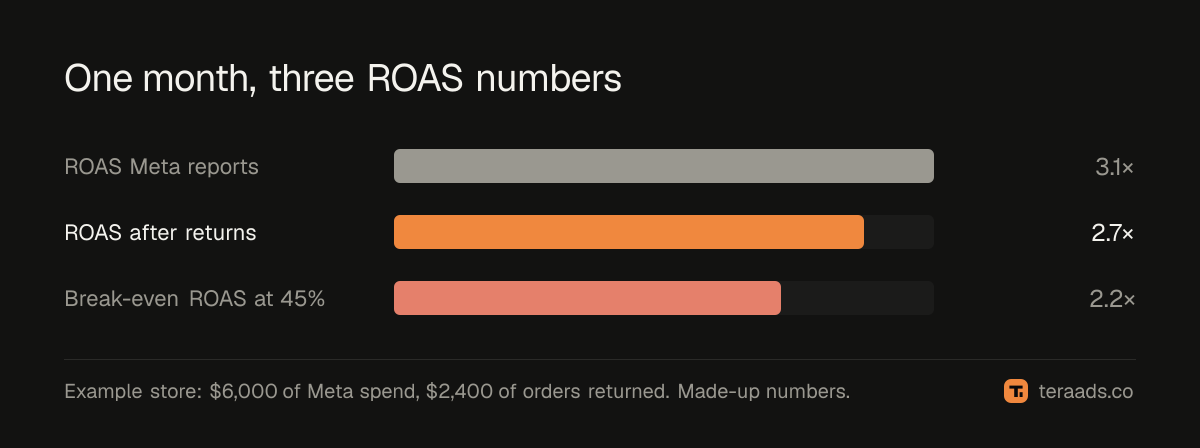
"How are my ads doing?" The assistant picks a window and reports Meta's ROAS of 3.1×. It sounds fine and tells you nothing about returns.
"What was my ROAS last month?" Better: a fixed window. But it's still Meta's 3.1×, built on $18,600 of purchase value Meta attributes to the ads.
"What was my return on ad spend after returns last month, compared with what Meta reports?" Now the answer starts from the store: say $2,400 of orders came back and were refunded, so sales kept after returns are $16,200 and ROAS after returns is 2.7×. With your margin, you can see whether that still clears break-even. These numbers are made up for the example; your own store's will differ.
The third question costs one or two more lookups, and it's the only one that answers what you wanted to know.
Common mistakes
No window. "Lately" means something different every time. Name the days.
Comparing today with yesterday. Today isn't finished. Compare completed days.
Treating Meta's purchases as orders. They're Meta's attributed count. Store orders come from Shopify, and the two often disagree.
Mixing analysis and changes. Ask, read the answer, then decide. A change request hidden in an analysis question is easy to approve by accident.
Not checking. Compare two or three answers with Ads Manager and Shopify in your first week.
Tera Ads Connect works in Claude, ChatGPT, Cursor, VS Code and Claude Code, and answers from your Shopify store as well as Meta. It's free for 30 calls a week; see what it covers or start free.
Frequently asked questions
What should I ask ChatGPT about my Facebook ads?
Ask about a fixed window and a comparison: profit after returns over the last 30 days against the 30 before, then spend and Meta's results by campaign over 14 days. Add your margin so the assistant can compare cost per purchase with what an order can afford.
Can Claude or ChatGPT see my Shopify profit?
Only through a connector that reads your store. A Meta-only connector sees Meta's reports. Tera Ads Connect reads Shopify orders, returns and costs, so it can answer with estimated profit after returns for the store.
Why do the answers differ from Ads Manager?
Ads Manager counts purchases Meta attributes to your ads. Store-based answers count orders in Shopify and take returns off, so they're usually lower than Meta's numbers.
How many questions can I ask for free?
Tera Ads Connect is free for 30 calls a week. A call is one lookup, and one question can take a few, so a long analysis chat can use a good share of a week.
Can the assistant change my ads?
Only if you allow it for that connection. You can keep it read-only, have it ask you first, or let it make changes. New campaigns, ad sets and ads always start paused.
Do these questions work in Cursor or VS Code?
Yes. The same questions work in any assistant that supports remote MCP connectors, including Cursor, VS Code and Claude Code.